


AI Trading No Longer Moves in Unison: Optical Networking and Data Centers Lead, While Memory and Power Themes Lag
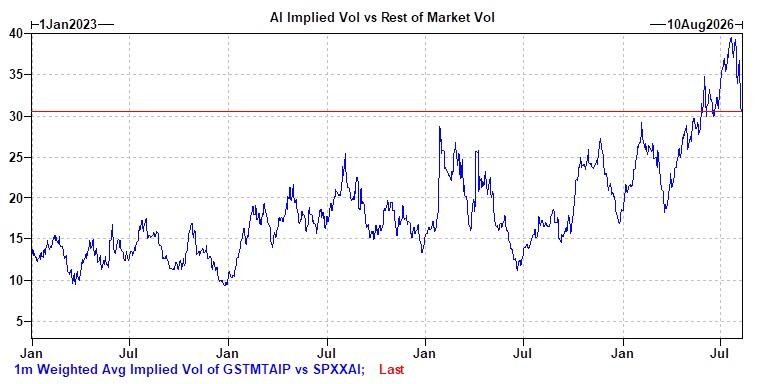
The implied volatility of the AI sector remains at a three-year high relative to other sectors, hindering clients from repositioning within the AI space. Goldman Sachs derivatives trader Tuteja warns that market sentiment toward the Federal Reserve has shifted from "fear of rate hikes" in July to an almost "turning bad into good" optimistic expectation, weakening previously existing asymmetric opportunities. He maintains his year-end target for the S&P 500 at 8,000 points but expects the index to oscillate within a relatively narrow range over the next month and a half, with overall risk-reward appeal diminishing
Goldman Sachs derivatives traders warn that the era of uniform rises and falls in the AI sector may have ended, as the market enters a phase of more selective thematic divergence. Meanwhile, expectations for the Federal Reserve have shifted from "fear" to "complacency," causing the risk-reward profile of broad market indices to become muted.
Shawn Tuteja, Head of ETF and Custom Basket Volatility Trading at Goldman Sachs, pointed out in his latest market assessment report that the high correlation in AI trading is disintegrating. During the rally from April to June and the sell-off in July, various AI sub-themes moved almost in sync. However, significant divergence has emerged over the past two weeks—optical networking, data centers, and emerging cloud service providers (neoclouds) led the rebound, while memory and AI power themes clearly lagged behind.
Tuteja also warned that market sentiment toward the Federal Reserve has shifted from "fear of rate hikes" in July to an almost "turning bad into good" optimistic expectation. This shift has weakened the asymmetric opportunities that previously existed. He maintains his year-end target for the S&P 500 at 8,000 points but expects the index to oscillate within a relatively narrow range over the next month and a half, with the overall attractiveness of risk-reward ratios declining. In this context, he advises investors to adopt a more selective strategy for the AI sector rather than pursuing comprehensive high-beta FOMO buying.
Strong Earnings Season Fails to Boost Stock Prices as Market Enters Range-Bound Oscillation
From a data perspective, this earnings season can be described as strong. Tuteja noted that 90% of S&P 500 constituents have reported their Q2 results, with 64% of companies exceeding consensus earnings per share estimates by at least one standard deviation—one of the highest levels in history. This has driven a 2% upward revision in earnings forecasts for 2027.
However, the market's reaction to these better-than-expected results has been unusually lukewarm. For stocks beating estimates by more than one standard deviation, the median excess return relative to the S&P 500 on the following day was only 33 basis points, far below the historical median of 95 basis points since 2010. Performance in the technology sector was even weaker—tech stocks that beat expectations actually underperformed the S&P 500 by an average of 99 basis points the next day.
Tuteja attributes this phenomenon to a structural shift in market sentiment. In July, clients generally reduced their risk exposure, and global fundamental long-short hedge funds experienced their second-worst monthly drawdown in the past four years. Currently, clients' net positions are at the 67th percentile of five-year history, with total positions reaching as high as the 89th percentile, indicating that the market is no longer in a low-position state.
Last Tuesday, single-day trading volume for S&P 500 call options reached 4 million contracts, setting a historical record. The decline in the short-term put/call option skew over two days was also close to the maximum seen in the past decade—signals all pointing to a rapid warming of sentiment.
Market Shifts from "Fear" to "Complacency" Regarding Fed Rate Hikes, Increasing Hedging Value
Tuteja believes that current market pricing for the September Federal Reserve meeting reflects an optimistic "win-win" logic: either the Fed stabilizes the long-end interest rate curve through a "dovish hike," or it holds steady, allowing the "rotation diffusion" trade to continue against a backdrop of strong earnings. Both scenarios implicitly assume a significant drop in oil prices.
Prior to the release of CPI data, buy-side institutions' consensus expectation for core inflation was around 21 to 22 basis points, with the probability of a September rate hike at roughly 50/50. Capital flow data shows that market positioning for a dovish outcome significantly outweighs defensive preparations for a hawkish surprise.
Tuteja points out that this emotional switch from "fear" to "complacency" is the core reason why the risk-reward profile of broad market indices has become muted.
He suggests that if the market rebounds after the CPI release, investors could consider buying put spread options on the S&P 500 excluding AI constituents (SPXXAI) as a tool to hedge macro uncertainty before the September meeting. The reference structure he provides is: SPXXAI September expiry 90/97% put spread, with an indicative cost of approximately 0.93% and a duration of 19 days.
Internal Divergence in AI Trading: Fundamental Discrepancies Begin to Drive Pricing
Tuteja attributes the divergence within the AI sector to dual drivers of fundamentals and technicals.
From a fundamental perspective, Goldman Sachs technology analyst Peter Callahan notes that while the July sell-off was largely a technical rebalancing, the rise of open-source models and ongoing discussions about the "bottlenecks" in AI capital expenditure have quietly triggered a narrative shift at the fundamental level. As the capital expenditure path for 2027 becomes clearer following Q2 earnings reports, investors are beginning to scrutinize the earnings sustainability of each sub-theme more carefully.
Callahan specifically highlights two emerging focal points of discussion:
First, the concept of the "inference economy" is gaining traction in the software sector. AI application beneficiaries insensitive to large model and computing power bottlenecks, such as SNOW, DDOG, PLTR, CRWD, PANW, OKTA, and TWLO, are receiving more attention.
Second, the investment logic for the memory (DRAM, NAND, HDD) sector is shifting from "earnings upgrades driven by average selling prices and gross margins" to "valuation expansion driven by stability, long-term agreements, and capital returns," leading to increased controversy.
Additionally, the power theme faces extra pressure from policy uncertainty ahead of the midterm elections and regulatory issues in ERCOT.
Leveraged ETF Redemptions and High Implied Volatility Constrain AI Sector Rebound Momentum
From a technical perspective, Tuteja cites data showing that the assets under management (AUM) of US semiconductor leveraged ETFs are currently around $99 billion, a significant shrinkage from the peak of $157 billion.
Notably, during the July sell-off, the market saw approximately $15 billion in "excess" buying—meaning investors subscribed to leveraged ETFs beyond what would be expected relative to the decline in spot prices. However, entering August, the rise in net asset value driven by the spot rebound is the sole source of AUM growth; in reality, investors are redeeming shares and reducing exposure amidst the rebound.
The implied volatility market reflects customer hesitation in re-betting on these stocks. This is likely because position structures have become healthier, and excessive bullish positions in leveraged ETFs have decreased.
Since July 29, the weighted average implied volatility of Goldman Sachs' AI Leader Basket (GSTMTAIP) has dropped by more than 10 volatility points, a decrease of 14.3%. In contrast, the implied volatility of SPXXAI has only decreased by 3 volatility points, a drop of 11.8%.
Nevertheless, the premium of the AI sector's implied volatility relative to the broader market remains at its highest level since early 2023 (excluding the past two months). This keeps the cost of expressing bullish views via options or buying upside protection high, constituting an obstacle for clients re-entering the market.
Tuteja suggests that at current implied volatility levels, buying underlying stocks combined with a call ratio overlay, or financing call spreads by selling put options, offers better cost-effectiveness than comprehensive high-beta FOMO buying.
The reference structure he provides is: Selling GSTMTMEM December 31 expiry 85% put options, and buying 115/150% call spreads, with an indicative net cost of approximately 1.45% and a duration of 50 days.
Bull Market Logic Remains Unchanged, but Phase of Rapid FOMO Buying May Be Over
Overall, Tuteja's core judgment is not bearish, but rather a call to lower expectations regarding the pace of gains.
He maintains his year-end target of 8,000 points for the S&P 500 but believes that the high-speed, high-beta phase of AI trading has basically ended. Optical networking, data centers, and emerging cloud service providers remain attractive, but memory and power themes face more fundamental questions, requiring more prudent screening.
On a broader macro level, as the market shifts from "fearing the Fed" to "complacency about the Fed," previously existing asymmetric opportunities have narrowed significantly. Investors need to reassess their AI exposure allocation under a framework of more refined thematic selection and more reasonable risk management.
