


Morgan Stanley admits to "picking the wrong side" and quickly upgrades the rating of U.S. IT hardware: "Chip inflation" is transforming from a demand killer into a catalyst for a procurement frenzy, with storage stocks being the most favored
Morgan Stanley admitted its previous misjudgment of the U.S. IT hardware sector, raising its rating from "cautious" to "in line with the market." The firm believes that "chip inflation" has not stifled demand but rather triggered companies to accelerate stockpiling due to "fear of missing out on purchases." At the same time, it adjusted individual stock ratings: raised HPE and Everpure to overweight, NetApp to neutral, and lowered Teradata
According to Zhitong Finance APP, Morgan Stanley has changed its previous cautious stance and upgraded the rating of the U.S. IT hardware industry. The reason is that the continuous surge in memory chip prices, referred to as "chipflation," has not suppressed demand but instead forced companies to accelerate procurement, leading to a wave of stockpiling driven by "fear of missing procurement." However, the bank also warned that the current market trend is mainly driven by cyclical factors, and once the profit upgrade cycle peaks, it will again turn cautious.
Morgan Stanley analyst Erik Woodring, in the latest report, upgraded the outlook for the U.S. IT hardware industry from "cautious" to "in line with the market," and candidly admitted that it had previously "taken the wrong side on enterprise hardware trades." The bank once believed that record component price inflation would quickly stifle the recovery of hardware spending, but the reality is quite the opposite.
With the industry rating upgrade, Morgan Stanley made a series of individual stock rating adjustments: it upgraded Hewlett Packard Enterprise (HPE.US) and Everpure, Inc. (P.US) to "overweight," upgraded NetApp (NTAP.US) to "equal weight," and downgraded Teradata (TDC.US).
"Fear of Missing Procurement" and AI Expansion Drive Reversal
Two main factors drove this reversal of stance. First, Woodring pointed out that companies are viewing memory "chipflation" as "a multi-year structural headwind." Unlike the traditional thinking of waiting for prices to fall before procurement, Chief Information Officers are rapidly prioritizing the purchase of personal computers, servers, and storage arrays to lock in currently favorable prices and avoid future supply shortages. Woodring referred to this dynamic as "Fear of Missing Procurement" (FOMP).
The second factor is Morgan Stanley's own AlphaWise survey. The results show that front-loaded demand and capacity expansion related to artificial intelligence (AI) are driving the growth rate of servers and storage to "reach the highest level in the survey's history by 2027." This long-term visibility has led the bank to believe that despite hardware stocks having experienced a surge, there is still room for the current cycle to continue.
In terms of preferences in sub-sectors, Morgan Stanley has reordered its preferences as follows: storage, servers, personal computers. The bank has comprehensively raised its earnings forecasts for the original equipment manufacturers (OEMs) it covers, with current earnings per share estimates for 2026 and 2027 being 9% to 12% higher than the general expectations on Wall Street.
Why "Chipflation" Persists
This shift in procurement behavior is rooted in a historic surge in memory prices. Driven by AI demand, memory chip prices are skyrocketing. The electronic components and accessories segment of the U.S. Producer Price Index surged 27.6% year-on-year in June, marking the largest increase since records began in 1966, easily surpassing the price surges during the rise of personal computers in the 1980s and the chip shortages during the pandemic.
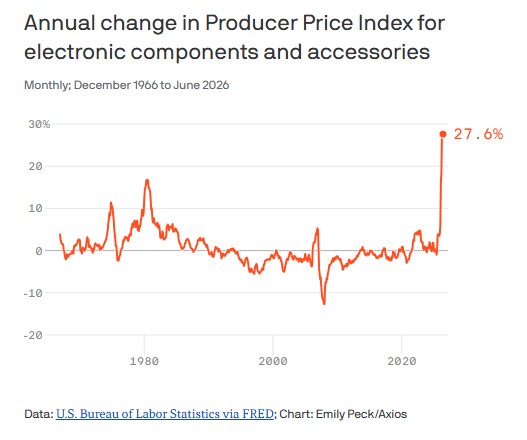 Morgan Stanley coined the term "chip inflation" in a report in June, pointing out that memory prices have risen more than sixfold over the past year. This is contrary to the trend of declining computer memory prices over the past few decades—between 1957 and 2020, the price of dynamic random-access memory per GB decreased by about one-tenth every five years. However, the bank emphasized that "this trend is no longer applicable in the AI economy."
Behind the soaring prices is a battle for supply. AI giants like Meta (META.US), Microsoft (MSFT.US), and Alphabet (GOOGL.US) are locking in memory supplies through long-term agreements years in advance, leaving traditional personal computer and smartphone manufacturers to compete for an increasingly shrinking supply pool.
Reports indicate that Apple (AAPL.US) is currently testing products from Chinese memory chip manufacturer Changxin Storage to cope with rising costs, although such collaborations typically require approval from the White House.
JP Morgan strategist Jay Kwon also commented on the memory chip sector this week. He believes that the chip shortage will take at least another two years to ease.
In a report on Monday, Kwon wrote: "Driven by both price and shipment volume, the overall potential market for memory continues to expand, and the supply-demand gap will persist for the next two years. The trend of memory demand expanding from GPUs to CPUs seems to be underestimated by investors—though conceptually well-known, the actual supply-demand impact has not been fully recognized—this remains a key variable for upward revisions in demand expectations."
The remarks of SanDisk (SNDK.US) CEO David Goeckeler during last week's earnings call may best summarize the current market landscape. Goeckeler stated, "Over the past two to three quarters, we have spent a lot of time deeply communicating demand commitments with our core major customers. Now we have over four years of business visibility and are confident about the business outlook."
Ahead of the Consumer Price Index (CPI) report set to be released on Wednesday, Morgan Stanley estimates that this "chip inflation" will boost the overall consumer price index by about 0.10 percentage points, but the impact on the personal computer and smartphone sub-index could be as high as 15 percentage points.
Despite the bullish outlook, Morgan Stanley remains cautious, characterizing the current wave of optimism as tactical rather than structural. The bank emphasized that the current favorable factors are "mainly cyclical." The hardware sector has risen more than 100% since early 2025, reaching historically expensive levels.
Woodring warned that this cycle may reverse starting in 2027, and a peak in the momentum of upward earnings forecast revisions will be a "clear signal for the bank to turn cautious again."
