


Strong Growth, Moderate Rate Hikes, Controllable Oil Prices—Deutsche Bank Says Market Is Pricing a Non-Existent Perfection
Global markets are simultaneously betting on strong growth, moderate rate hikes, falling oil prices, and controllable geopolitical risks. Deutsche Bank warns that this "Goldilocks" combination leaves almost no room for error. The S&P 500 has hit record highs and credit spreads are low, yet PCE inflation remains at 3.7%, with interest rate futures pricing in only 47 basis points of rate hikes. Historical experience shows that the Federal Reserve's tightening in the first year often exceeds 100 basis points at similar inflation levels. The Strait of Hormuz has not yet resumed normal traffic, and Brent crude has risen more than 40% year-to-date. The failure of any single assumption could trigger a chain reaction of market revaluation
Global markets are simultaneously betting on strong growth, limited rate hikes, controllable energy supply shocks, and falling oil prices. This "Goldilocks" combination appears favorable for risk assets but leaves almost no room for error regarding policy, inflation, and geopolitical developments.
In a recent report, Henry Allen, macro strategist at Deutsche Bank AG, pointed out that U.S. stocks are at record highs and credit spreads remain low, reflecting investors' belief that economic growth remains resilient. However, the interest rate market has priced in relatively limited subsequent rate hikes by the Federal Reserve. This means that if inflation does not cool as expected, or if growth continues to exceed expectations, the market may need to rapidly reassess the monetary policy path.
The energy market also shows divergence. Although Brent crude oil prices have fallen significantly from recent highs, the Strait of Hormuz has not yet resumed normal traffic, and no agreement to restart passage has been reached. There remains a gap between the supply recovery expectations reflected in oil prices and the forward curve, and the actual logistical and infrastructure risks.
For investors, the key issue is not current growth or oil prices per se, but whether multiple optimistic assumptions can hold simultaneously. Deutsche Bank warns that if strong growth pushes up inflationary pressures, or if energy supply disruptions persist, the existing pricing relationships among risk assets, interest rates, and inflation expectations could break down.
Contradiction Between Strong Growth and Moderate Rate Hike Pricing
Signals from U.S. risk assets remain optimistic. The S&P 500 hit another record high last Friday, corporate earnings growth remains strong, and credit spreads are at low levels. The Atlanta Fed's GDPNow model estimates that the annualized growth rate of the U.S. economy in the third quarter could reach 5.8%.
Financial conditions also remain relatively loose. The Bloomberg U.S. Financial Conditions Index rose to its most accommodative level since 1997 last Friday, and the July unemployment rate fell to 4.1%, a 13-month low. These indicators collectively point to continued resilience in economic activity.
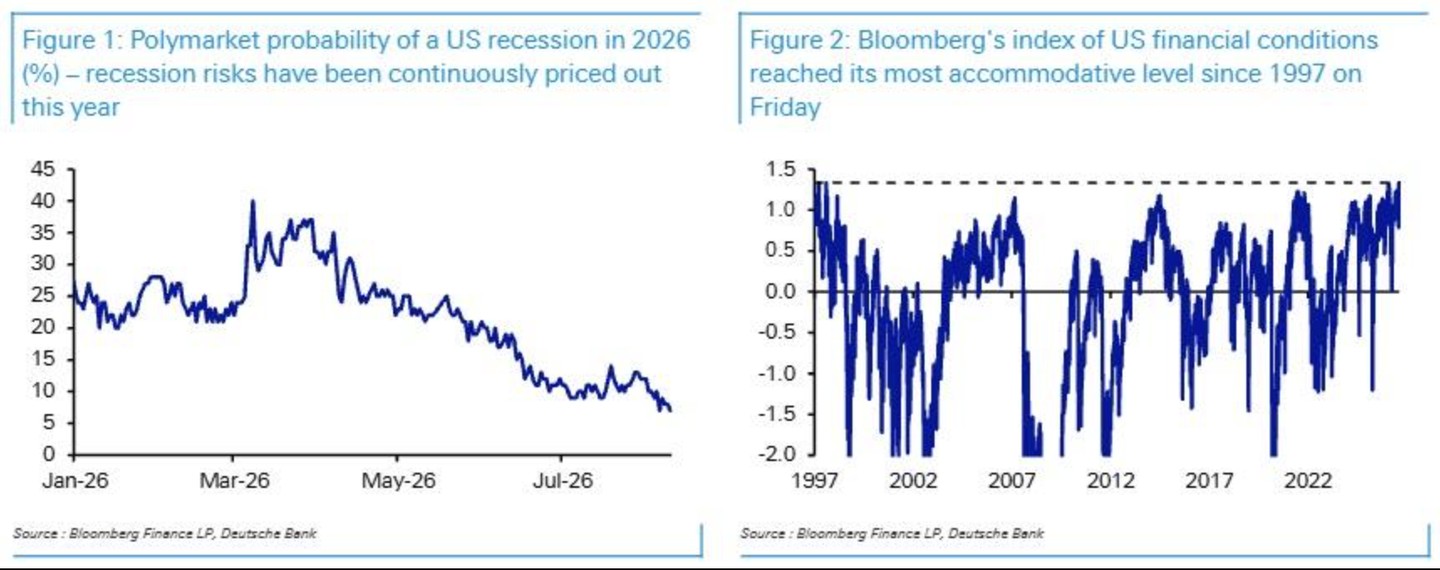
However, pricing in the interest rate market does not fully match this growth picture. The U.S. PCE inflation rate in June was 3.7%, still above the policy target, while federal funds rate futures have priced in only about 31 basis points of rate hikes by the Federal Reserve before the December meeting, with the cumulative peak hike by next June estimated at only about 47 basis points.
Deutsche Bank believes that the market is currently pricing in a combination of strong economic growth, loose financial conditions, inflation above target, and only moderate Federal Reserve rate hikes, a combination that is difficult to sustain in the long term. Adjustments could come from a rapid decline in inflation, a weakening of risk assets, or the Federal Reserve adopting a more hawkish policy path than the market expects.
Historical Trends Suggest the Federal Reserve May Tighten More Than Expected
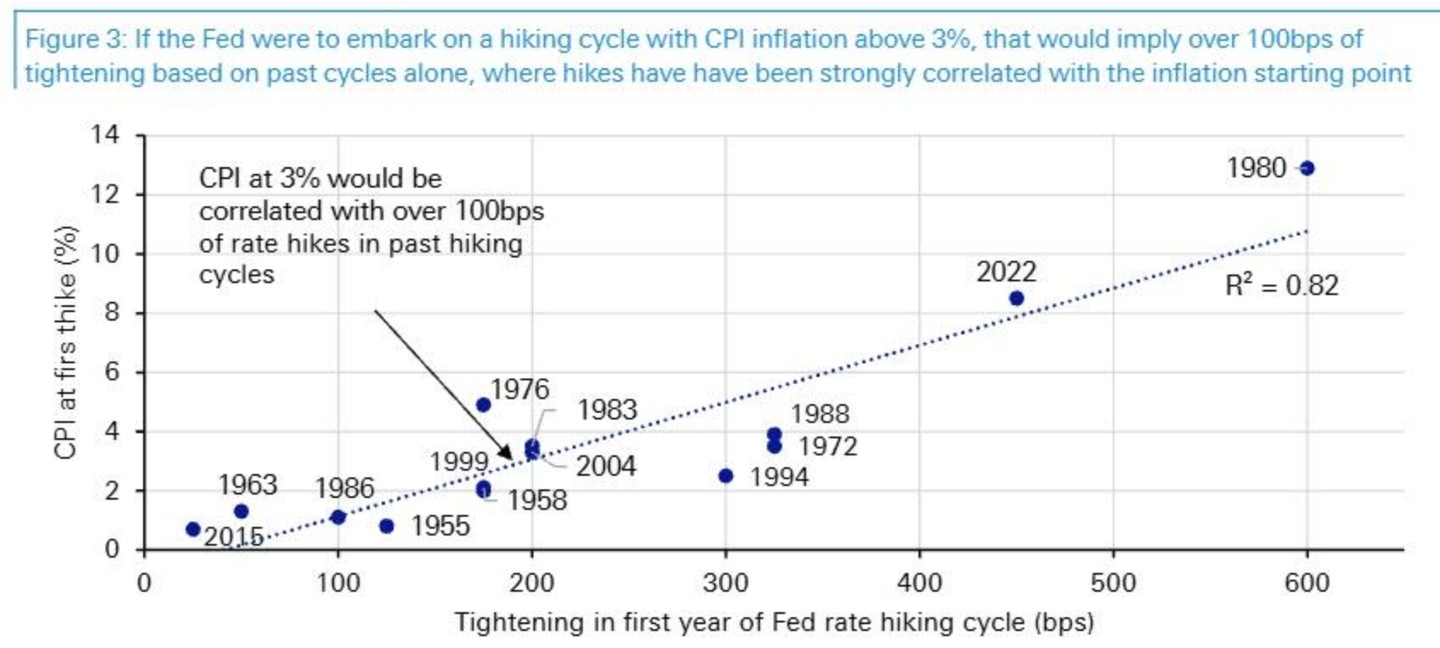
Henry Allen pointed out that over the past 70 years, there has been a strong correlation between the inflation level when the Federal Reserve started raising rates and the magnitude of rate hikes in the subsequent first year. Based on the current CPI inflation rate of 3.5%, historical trends suggest a first-year tightening magnitude of over 100 basis points, even if inflation declines somewhat by year-end.
In contrast, the cumulative rate hikes currently priced in by futures markets are less than 50 basis points, significantly lower than the level suggested by historical experience. Deutsche Bank believes that if both economic growth and inflation remain resilient, the market may be underestimating the likelihood of the Federal Reserve shifting to a tougher stance.
The experience of 2022 provides a reference. At that time, the market initially expected a relatively mild hiking cycle, and the Federal Reserve started with a 25-basis-point hike, but subsequently increased the single hike magnitude to 75 basis points, cumulatively hiking 450 basis points in the first 12 months, and 525 basis points over the entire cycle.
The report also noted that the so-called scenario of "one rate hike followed by a long period of inaction" is rare in history. Since the 21st century, 2015 was one of the few cases, where the second rate hike was a full year later, mainly due to weakening economic data and concerns about a broader slowdown.
Divergence Between Crude Oil Pricing and Geopolitical Reality
The decline in oil prices is one of the important bases for the market's optimistic pricing, but Deutsche Bank believes that this price performance is not entirely consistent with supply realities.
Brent crude is currently around $88 per barrel, lower than the level of over $100 per barrel three weeks ago, and significantly below the high of over $120 per barrel seen intraday in April. However, the Strait of Hormuz remains blocked, no agreement to resume navigation has been reached, and traffic through the strait is far from pre-conflict levels.
Meanwhile, risks to energy infrastructure have not subsided. The Houthi forces claimed over the weekend to have attacked the Jazan refinery in Saudi Arabia, further highlighting the uncertainties facing the crude oil supply chain.
Nevertheless, the market is still pricing in a supply recovery. The 12-month Brent crude futures price is more than $10 per barrel lower than the near-month contract, reflecting investors' widespread expectation that oil prices will fall in the future. Deutsche Bank believes that this expectation heavily relies on the eventual resumption of traffic through the Strait of Hormuz, but relevant progress has yet to materialize.
Supply Chain Shocks and Inflation Risks Underestimated
This year, the energy market has experienced one of its most volatile periods since 2022. In July alone, Brent crude rose by nearly $30 per barrel within three weeks, briefly returning above $100 per barrel, before falling back significantly. So far this year, Brent crude is still up more than 40%.
European natural gas prices are also at relatively high levels for the year. Deutsche Bank believes that the volatility in energy prices indicates that supply shocks have not disappeared, and the market's overall pricing of inflation risks remains relatively moderate.
Potential pressures include the continued blockage of the Strait of Hormuz, tariffs remaining part of the global economic environment, and the potential for a strong El Niño phenomenon later this year. If food and energy prices remain under pressure, inflation expectations could rise, increasing the risk of a wage-price spiral.
This means that even if oil prices are temporarily below recent peaks, the path of declining inflation may be more tortuous than the market expects. For central banks, energy and supply-side risks may limit their space to quickly pivot to easing.
Stock Market, Inflation, and Interest Rate Markets Send Mixed Signals
Since the Iran conflict began in late February, stocks, credit markets, and inflation swaps have shown high sensitivity to changes in oil prices. In mid-to-late July, as Brent crude rose back above $100 per barrel, the stock market corrected; entering August, as oil prices fell, risk assets rebounded, pushing stock indices to new highs.
Short-term inflation expectations have roughly followed a similar trajectory, declining significantly as oil prices fell. However, the reaction in the interest rate market has not been entirely consistent. Even as the stock market rebounded and oil prices dropped, bond yields continued to rise and hit new highs.
Deutsche Bank believes that some of these movements may be related to recent Federal Reserve meetings, strong global economic data, and a rebound in risk appetite, but the macroeconomic judgments reflected by different asset classes remain conflicting. The stock and credit markets are closer to a scenario of "resilient growth and controllable oil prices," while the interest rate market seems to still be pricing in the long-term impact of geopolitical conflicts and energy shocks.
Perfect Scenario Depends on Multiple Conditions Being Met Simultaneously
Deutsche Bank believes that for the current pricing to be validated, supply-driven economic growth, declining inflation, easing geopolitical risks, and the resumption of traffic through the Strait of Hormuz must occur simultaneously. Such a combination would be beneficial for corporate earnings and stock performance, and could reduce the necessity for central banks to adopt aggressive tightening policies.
Productivity growth driven by artificial intelligence could become a supporting factor for supply improvement. However, the report points out that recent price performance in areas such as memory chips also shows that AI demand itself may bring new inflationary pressures.
Therefore, the core risk facing the market is not the loss of control of a single variable, but the failure of multiple optimistic assumptions to hold simultaneously. If the economy remains strong, financial conditions continue to be loose, and inflation remains above target, pressure on central banks to raise rates will increase; if energy supply shocks continue, the foundation for declining inflation and falling oil prices will also be weakened.
In Deutsche Bank's view, the current market is not devoid of positive factors, but the margin for error reserved for positive outcomes is too small. Any deviation from expectations in any condition could force investors to reassess the pricing of growth, interest rates, and risk assets.
