


Will AI Bring About an "Employment Doomsday" in the US? Bank of America: No Evidence Yet, but Pressure is Emerging Among Young People, the Information Sector, and the Financial Industry
AI has not yet shattered the US job market, but cracks are appearing. The latest research from Bank of America reveals that the impact of AI is characterized by structural divergence rather than a total collapse—hiring has stagnated in highly exposed industries, the unemployment rate for young graduates aged 22 to 27 has rebounded, and entry-level positions are bearing the brunt of the pressure. Meanwhile, the wave of data center construction driven by AI is reversely creating 127,000 jobs in the construction and manufacturing sectors, accounting for one-quarter of the new Private Sector Employment added this year. The risk has quietly shifted from "total collapse" to "structural squeeze."
The US labor market has not been shattered by AI, but cracks are emerging among specific groups and industries. The latest research from Bank of America shows that the impact of AI on employment is more reflected in structural divergence rather than a total collapse—hiring is weak in industries with high AI exposure, and pressure on entry-level positions is rising, but there is currently no data support for systematic job destruction at the industry-wide level.
According to Zhuifeng Trading Desk, Stephen Juneau, an economist at Bank of America Securities, pointed out in a report released on August 11: "Technological shocks primarily replace tasks, not entire occupations or labor demand." Since the launch of ChatGPT 3.5 in November 2022, employment levels in industries with the highest AI exposure have largely remained flat, while industries with the lowest AI exposure have recorded approximately 2% employment growth. However, after breaking down all 206 industries individually, there is almost no statistical correlation between the degree of AI exposure and employment growth.
Meanwhile, the risks have quietly shifted. The Unemployment Rate for young college graduates aged 22 to 27 is already higher than the 2019 level, and while the information sector and the financial and insurance industries have high AI adoption rates, their labor demand has declined. On the other hand, AI-driven capital expenditure is reversely creating jobs in construction and manufacturing, adding approximately 127,000 jobs year-to-date, which accounts for about one-quarter of the total new Private Sector Employment added this year.
Highly AI-Exposed Industries Haven't Collapsed, They Just Aren't Hiring Much
The potential impact of AI on employment has triggered particularly strong anxiety because it targets white-collar and service sector jobs. The service sector accounts for nearly 84% of US Private Sector Employment. Unlike previous technological shocks where machines replaced assembly line workers in factories, AI replaces clerical work, analysis, customer service, coding, and back-office processes, directly targeting core middle-class jobs.
However, employment data has not yet provided evidence of a "systematic collapse."
According to the AI Exposure Index constructed by Felten, Raj, and Seamans in 2021, employment in industries with the highest AI exposure basically stopped growing after the release of ChatGPT 3.5, showing a significant gap compared to the approximately 2% increase in low-exposure industries. But this grouping result amplifies the narrative: when all 206 industries are broken down, the correlation between the two almost disappears. This means that weak hiring in highly exposed industries may partly stem from overexpansion in these industries after 2019, followed by a natural digestion period, rather than being entirely dominated by AI.
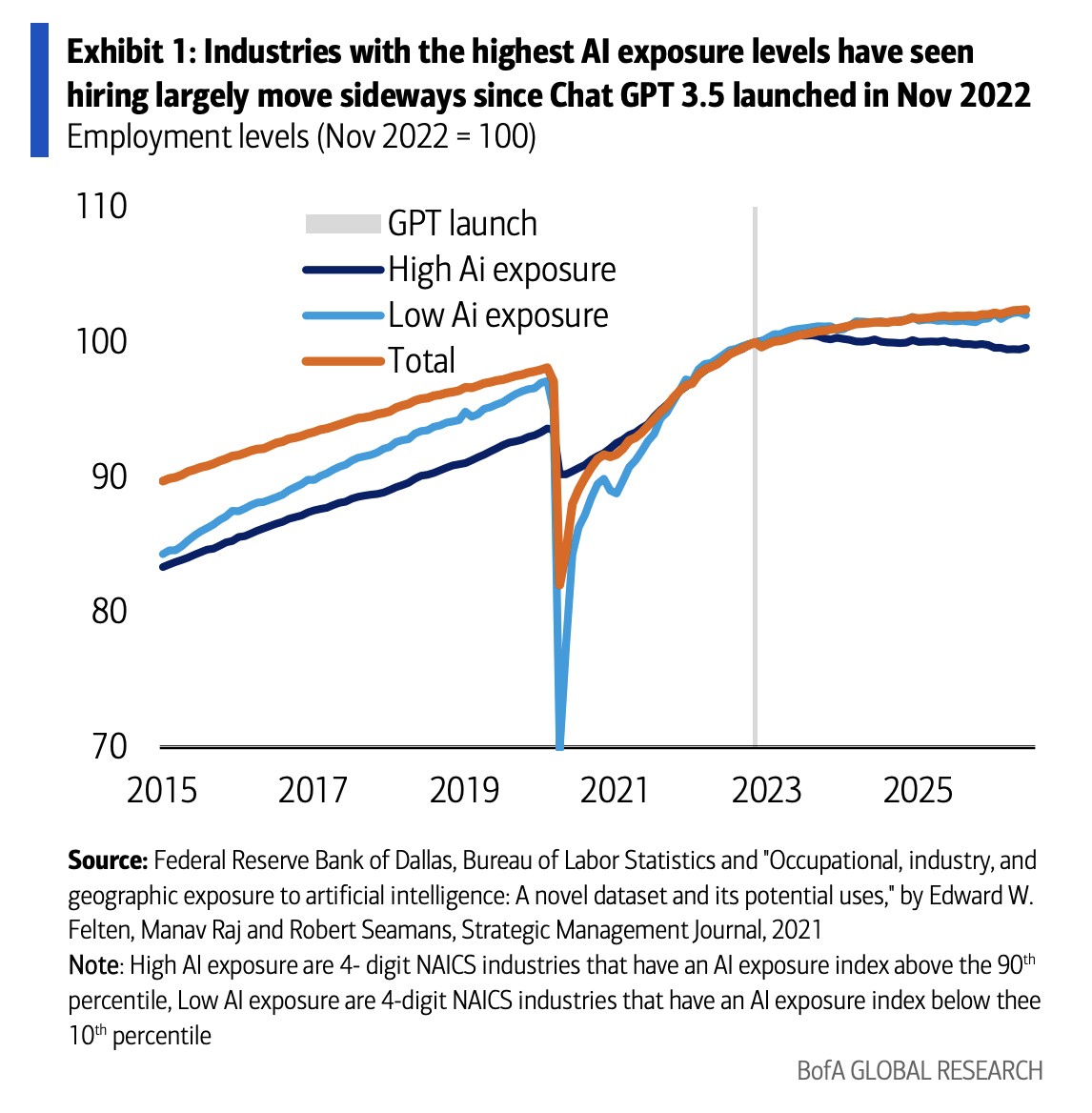
Hours worked data also shows no significant deterioration. If AI were replacing labor on a large scale, companies might compress the working hours of existing employees in addition to reducing hiring. However, there is also no clear link between changes in total hours worked and the degree of AI exposure. At least so far, companies have not simultaneously contracted on both the "headcount" and "hours" dimensions.
High AI Usage Does Not Necessarily Mean Weak Labor Demand
A more direct question is: even if AI has not eliminated jobs, has it already suppressed corporate labor demand?
Using "employment plus job vacancies" as an approximate measure of labor demand, and comparing it with corporate AI usage data collected by the US Census Bureau's BTOS survey, the conclusions for January to June 2026 remain not extreme—there is no clear linear relationship between AI usage rates and changes in labor demand.
Industry-specific data shows significant divergence: the information sector has the highest AI usage rate at 42.1%, with labor demand falling by 1.9% during the same period; the financial and insurance industries have an AI usage rate of 34.8%, with labor demand falling by 1.1%; while the professional, scientific, and technical services sector also has a high AI usage rate of 37.7%, yet labor demand grew by 1.2%. The educational services sector has a usage rate of 34.6%, with demand basically flat; manufacturing is at 17.9%, flat; and construction is at 12.3%, with demand growing by 0.9%.
The combination of the information sector and the financial and insurance industries—high AI usage coupled with declining labor demand—indeed presents characteristics of using AI to lower labor costs. But the counterexample of the professional and technical services sector indicates that the impact of AI on employment is closer to divergence at the industry and job level, rather than a simple negative straight line.
Young Graduates Are the Most Vulnerable Link
Total employment has not been shattered by AI, but entry-level positions are under pressure.
Data from the Federal Reserve Bank of New York and the US Bureau of Labor Statistics shows that the Unemployment Rate for young college graduates aged 22 to 27 is already higher than the 2019 level, and improvement has been limited since rebounding from the 2023 low. The overall unemployment rate for college graduates has fallen somewhat as uncertainty subsides, but the improvement for recent graduates in this age group is significantly smaller.
This leaves room for the impact of AI. The core value of entry-level positions often concentrates on tasks that can be standardized and broken down: organizing materials, preliminary analysis, writing basic documents, and handling standard processes. AI may not replace an entire occupation, but it may first replace the part of the work content most commonly undertaken by newcomers entering the workforce.
This is also the most unsettling part of the entire relatively optimistic judgment: if companies continue to prefer using AI to complete entry-level tasks, the threshold for young people to obtain their first white-collar job will rise, and the long-term impact will extend beyond short-term unemployment rates to the starting point of skill accumulation and career paths.
AI Capital Expenditure Is Reversely Creating Manufacturing Jobs
AI is not only replacing labor; it is simultaneously driving a round of physical investment expansion centered on data center construction.
Year-to-date, the US non-residential construction sector has added 95,000 jobs, with data center construction being a significant driver; AI-related manufacturing added 32,000 jobs during the same period. Together, they account for approximately 25% of the total new Private Sector Employment added this year.
There is also divergence within the manufacturing sector. Manufacturing serving AI and data center construction shows significantly stronger employment performance than non-AI manufacturing. AI capital expenditure is transforming from financial items on tech companies' books into actual jobs on construction sites, in equipment manufacturing, and across related supply chains.
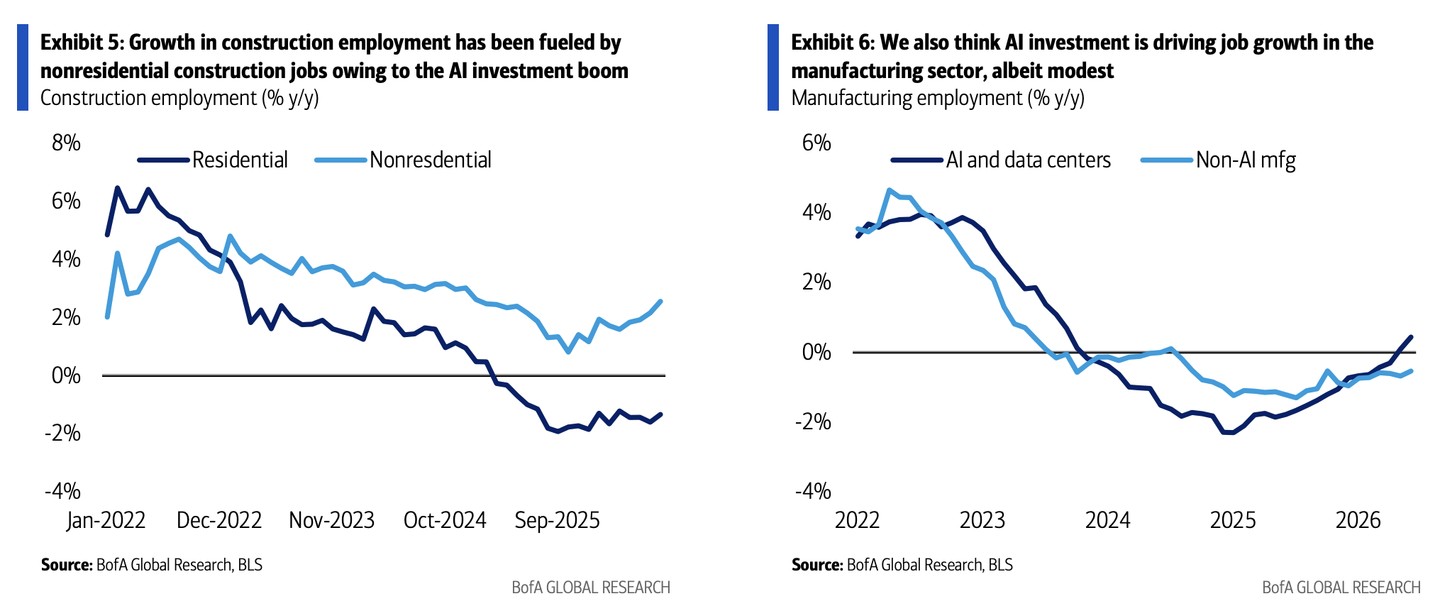
In the short term, this hedge line still provides support. Capital expenditure plans are still being revised upward, and demand for data centers and related manufacturing will not suddenly dissipate. At least at this stage, this incremental growth is sufficient to partially offset the job replacement pressure brought by AI, and to a considerable extent explains why the macro employment total has not significantly deteriorated.
Risks Have Shifted from Total Volume to Structure
The most important implication of this set of data is the repositioning of employment risk from "total collapse" to "structural squeeze."
At the total volume level, AI has not caused net job destruction: employment in highly exposed industries has remained flat rather than seeing massive layoffs, high AI usage rates do not necessarily correspond to declining demand, and new jobs in construction and manufacturing continue to provide a realistic hedge.
At the structural level, the pressure is already clear: it is harder for young graduates to find jobs, and the information sector and the financial and insurance industries deserve continuous tracking. The speed at which AI replaces tasks may be faster than the speed at which the labor force readapts to new tasks. This gap will not be directly reflected in the macro employment total, but it will be reflected in substantive changes in first jobs, promotion paths, and job content.
For investors, current evidence points to differentiated trading at the industry and demographic levels, rather than betting on directional judgments for the overall job market.
