


Bearish sentiment in US stocks continues to spread; historical data suggests it may fuel the next rally in the S&P 500
The S&P 500 has repeatedly hit new highs, yet investor sentiment remains persistently bearish. In 20 of the past 25 weeks, bears have outnumbered bulls, and institutional positioning clearly lags behind fundamental improvements. Quantitative firm 22V Research points out a severe divergence between current sentiment and economic data. Historical patterns indicate that such "excessive pessimism" often foreshadows a rebound, with expected returns reaching 7.8% over the next six months
US stocks continue to set new historical highs, but investors' anxiety has yet to dissipate. Precisely this widespread caution and skepticism may be accumulating momentum for the market's further continuation.
The S&P 500 broke through the 7,700-point mark for the first time last week, extending a series of historical records. Corporate earnings in the second quarter surged 32% year-over-year, a growth rate second only to recovery phases following major downturns in history.
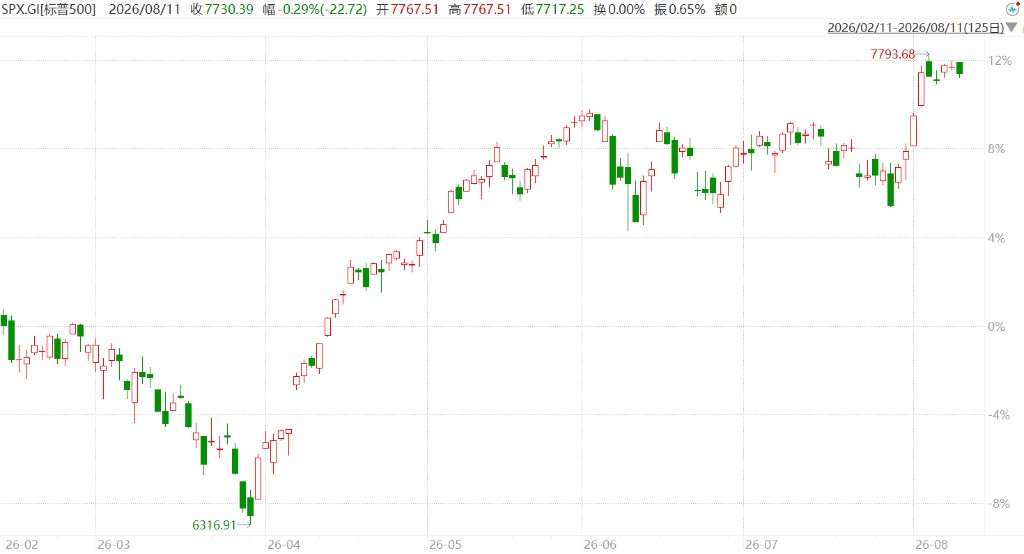
However, the pace of capital inflows into passive investment vehicles is slowing. In 20 of the past 25 weeks, the number of bears exceeded that of bulls, and the positioning levels of large fund managers have far from fully reflected the current strong fundamentals.
These signals collectively sketch a market landscape dominated by the "cautious camp." Against a backdrop where economic and corporate fundamentals remain robust, this restrained sentiment implies that potential buyers are still waiting on the sidelines to enter the market.
Quantitative firm 22V Research points out a severe disconnect between current market sentiment and economic fundamentals. Historical data shows that such "excessive pessimism" often foreshadows a rebound. The expected returns for the S&P 500 over the next 1 month, 3 months, and 6 months are 1.6%, 5.1%, and 7.8%, respectively.
Earnings growth far exceeds expectations, yet institutional positioning significantly lags
Earnings for S&P 500 components grew 32% year-over-year in the second quarter of this year. Such high growth has historically only appeared during rebounds following major economic downturns.
Mark Hackett, Chief Market Strategist at Nationwide, stated:
This can be described as the best earnings environment in history; you would have to struggle hard to construct a bearish argument.
However, large asset management institutions have clearly lagged in adjusting their positions relative to fundamental improvements.
According to data compiled by Deutsche Bank, holdings in large-cap stocks are currently at the 87th percentile of observations over the past decade.
Parag Thatte, a strategist at the bank, pointed out in a client report that this positioning level typically corresponds to mid-single-digit earnings growth, far below the current actual growth level, implying that institutional investors have not fully priced in this earnings explosion.
Bears outnumber bulls for consecutive weeks; sentiment indicators rarely remain persistently bearish
Survey data from the American Association of Individual Investors (AAII) shows that in 20 of the past 25 weeks, the number of bears exceeded the number of bulls. This duration is comparable to the market reaction after the Trump administration announced global tariff policies, a rarity in recent times.
Meanwhile, inflows into US equity ETFs last week were approximately $31 billion, lower than the inflow speed when the S&P 500 hit its previous high in early June this year.
Bank of America's sentiment survey shows that strategists currently advise clients to allocate about 56% of their assets to equities, below the historical average of about 70% between 1999 and 2007. Jill Carey Hall, Equity and Quantitative Strategist at Bank of America, stated:
Current equity positioning is not as extreme as in certain previous cycles.
Divergence between sentiment and fundamentals; historical patterns suggest upside potential
The significant divergence between investor sentiment and market fundamentals has historically often foreshadowed potential buying opportunities.
Strategists at 22V Research pointed out that the gap between the current bearish sentiment index and the firm's proprietary index tracking comprehensive economic data is at a high level. Dennis DeBusschere, President and Chief Market Strategist at the firm, wrote in a report:
Current investor sentiment relative to economic data readings implies that future returns will be higher than normal.
The persistence of skeptical sentiment is not without factual basis.
Rising interest rate risks pose a potential threat to corporate earnings, while tensions in the Middle East and the US midterm elections in November are sources of market uncertainty. However, Alastair Pinder, Global Equity Strategist at HSBC, believes:
In recent weeks, there have been many reasons for the market to question this bull run, but we believe these concerns are increasingly reflected in market pricing, while fundamental improvements remain underestimated.
