


Record Equity Issuance, Yet Goldman Sachs Bullish on S&P 500 Hitting 8,000: Demand to Continue Outstripping Supply
Goldman Sachs predicts the S&P 500 will break through the 8,000 mark. Although U.S. equity issuance is projected to hit a record $700 billion in 2026, this represents only about 1% of market capitalization, consistent with historical averages. Goldman Sachs believes demand will continue to outstrip supply, supported by robust corporate buybacks, suggesting the market performance reflects a return to normalcy rather than excessive boom
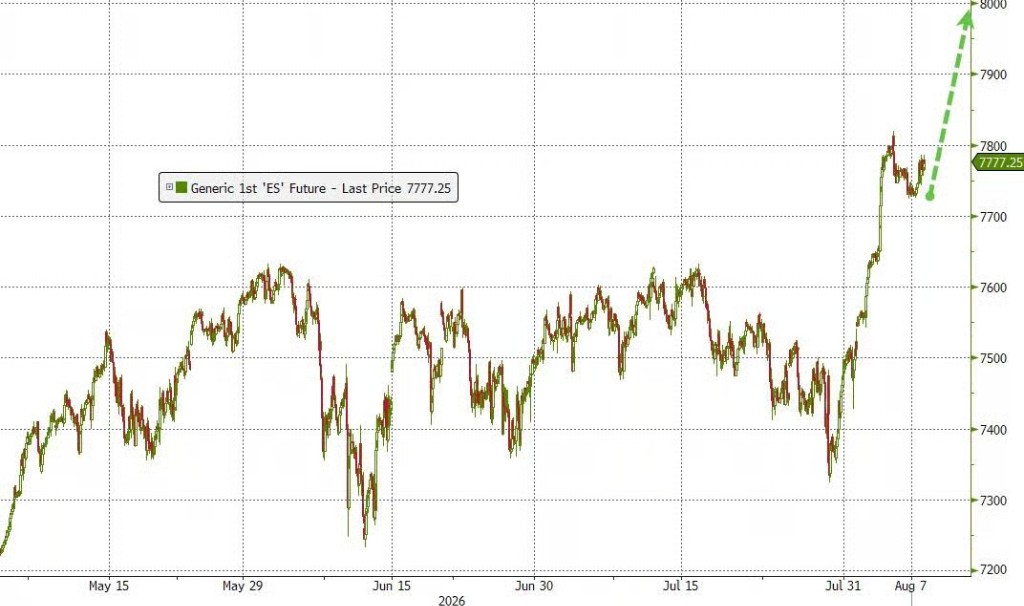
Last Friday, the S&P 500 closed at a record high of 7,757, marking its 26th record high this year and the 122nd since the beginning of 2024. The market has continued to climb amidst a host of concerns, including geopolitical tensions, high interest rates, and debates over an AI bubble.
Addressing widespread market skepticism about whether record equity issuance can be absorbed, John Flood, Partner and Head of Americas Equity Execution Services at Goldman Sachs, stated:
“Yes. The S&P 500 can surge to 8,000.”
The firm expects total U.S. equity issuance in 2026 to reach approximately $700 billion, a historical record. However, relative to market capitalization, this amounts to only about 1%, comparable to the average from 2015-2019.
Record Issuance Volume, But Low Relative Market Cap Share
Goldman Sachs anticipates that 2026 will be a record year for U.S. equity issuance in terms of value. Breaking it down: IPO issuance is expected to slightly exceed $225 billion, while other issuances (follow-on offerings, convertible bonds, SPACs, etc.) will amount to approximately $450 billion, totaling around $700 billion.
The key lies in the proportion: this total represents about 1% of the Russell 3000 Index's market capitalization, basically flat with the annual average issuance levels from 2015-2019.
On a quarterly basis, U.S. companies raised a combined $252 billion through IPOs, follow-on offerings, convertible bonds, and SPACs in the second quarter of 2026, breaking the previous single-quarter record of $234 billion set in the first quarter of 2021.
In terms of follow-on offerings, the second quarter contributed $70 billion, bringing the year-to-date total (as of July) to $105 billion, the highest for the same period since 2021. However, John Flood pointed out that when considering issuance volume relative to market capitalization size and the number of deals, "this looks more like a return to normalcy rather than a boom," with both metrics slightly below historical averages.
Buybacks Are the True "Ballast"
Although issuance volume is large, the resilience of buybacks has been underestimated by many investors.
S&P 500 component buybacks increased by +11% year-over-year in the second quarter of 2026. While hyperscalers are shifting cash flow from buybacks to capital expenditures, other sectors such as banking and semiconductors are expanding their buyback scales.
To date, U.S. corporate buyback authorizations have reached $989 billion year-to-date, setting a new historical record.
Goldman Sachs estimates that total U.S. public market stock buybacks in 2026 will reach $1.4 trillion. This figure not only covers the approximately $700 billion in primary market issuance but is also sufficient to offset the potential additional supply from post-IPO lock-up expirations—even assuming all unlocked shares are sold immediately, demand would still outstrip supply.
AI Is the Core Driver of the Issuance Wave
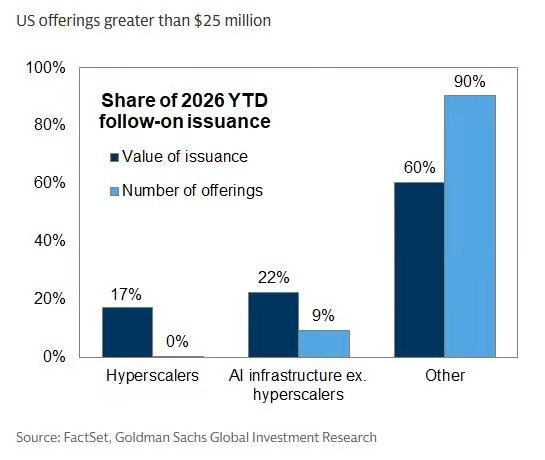
Equity issuance in 2026 is highly concentrated. Combined, the top three issuance deals (IPOs and follow-ons) account for nearly half of the total year-to-date issuance volume.
In terms of industry distribution, AI-related issuances account for approximately 40% of U.S. follow-on offerings. The Technology, Media, and Telecom (TMT) sector accounts for nearly 30% of year-to-date follow-on volume, more than double the sector's issuance share over the past five years. Healthcare has historically been the largest contributing sector and remains so this year.
The fundamental logic behind this trend is the demand for AI investment. Citing market consensus expectations, Goldman Sachs notes that hyperscaler capital expenditures will exceed $1 trillion annually in the coming years, with capex surpassing 100% of operating cash flow before 2027.
Recent communications between Goldman Sachs and investors show that "most equity investors expect hyperscaler capital expenditures to exceed consensus expectations, and other companies will also raise funds for AI investment plans."
Debt as Primary, Equity as Secondary
Faced with massive capital expenditure demands, external financing will be primarily debt-driven.
Goldman Sachs credit strategists expect hyperscalers to cover 35% of their 2027 capital expenditures through debt, corresponding to approximately $400 billion in global bond issuance. Other AI infrastructure companies will also seek additional financing.
Equity financing plays a supporting role—for some companies, moderate equity financing helps support multi-year investment plans while maintaining balance sheet quality and avoiding debt market capacity constraints.
Goldman Sachs Conclusion: Issuance Is a Headwind, Not a Storm
Goldman Sachs' Chief U.S. Equity Strategist summarized that equity issuance is a "manageable headwind, not a market hurricane."
The rise in follow-on offerings is mainly driven by AI financing demand, which is expected to persist; however, issuance is highly concentrated, and the ratio of issuance to market capitalization remains below long-term averages. Neither issuance discounts nor post-announcement stock performance shows signs of market indigestion.
Debt will bear the brunt of external financing for hyperscalers and AI infrastructure investments, while the projected $1.4 trillion in stock buybacks will far exceed the approximately $700 billion in primary issuance plus potential unlocked supply.
John Flood's judgment is concise and clear: "Corporate stock demand will continue to outstrip supply in 2026."
Risk Disclosure and Disclaimer
The market involves risks, and investment requires caution. This article does not constitute personal investment advice, nor does it take into account the specific investment objectives, financial status, or needs of individual users. Users should consider whether any opinions, views, or conclusions in this article align with their specific circumstances. Investment based on this content is at your own risk.
