


From "Instant Gratification" to "Goal-Driven": "Weight-Loss Miracle Drugs" Reshape Asia's Consumption Logic
GLP-1 weight-loss drugs are quietly rewriting the underlying rules of Asia's consumer industry. JPMorgan's latest survey reveals that 75% of users have cut back on snacks, 84% have suppressed impulse spending, and 74% have reduced food delivery orders. It is not just a specific category being eroded, but the entire consumption chain reliant on monetizing "instant desires." While wallets remain open, spending direction has shifted: goal-oriented consumption such as fitness, protein supplements, and medical aesthetics is quietly rising. As oral medications become more widespread and domestic production accelerates, valuation divergence may precede the impact on profits
The proliferation of GLP-1 weight-loss drugs is reshaping the underlying logic of Asia's consumer industry. A recent research report by JPMorgan points out that the core of this consumption transformation is a deeper shift in behavioral mechanisms—business models relying on impulse, habit, and convenience-driven consumption are facing systemic pressure.
According to Zhuifeng Trading Desk, JPMorgan's research report on the Asian consumer industry, released on August 9, stated that when GLP-1 users' appetites change, the impact extends beyond high-calorie foods to a consumption chain composed of craving, convenience, habit, situational permission, and repeat purchases. A significant portion of growth in Asia's consumer industry has been built on monetizing this chain.
In a sample of 533 current users in China, India, and South Korea, approximately 75% reduced their snack intake, 62% reduced alcohol consumption, 69% of tobacco users lowered their consumption, 74% reduced food delivery orders, and 84% reported a significant decline in the desire for impulse spending or "treating themselves." Spending in social and festive occasions also contracted significantly.
Meanwhile, consumers' wallets have not closed. Sample data shows that while users reduced spending on snacks, fast food, food delivery, alcohol, and impulse buys, they increased expenditure on home cooking, fruits and vegetables, protein supplements, fitness, health check-ups, sportswear, and certain beauty and medical aesthetic services. Consumption is shifting from being "triggered" to being "goal-oriented": controlling what is eaten, maintaining weight loss results, or making changes visible to oneself and others.
In terms of current income statements, the EPS of Asian consumer stocks has not yet been impacted. GLP-1 penetration in Asia remains low, and this survey is not a penetration forecast. However, valuations may not wait for income statement confirmation before moving. For consumer companies reliant on frequency, habits, repeat purchases, and operating leverage, multiples may react prematurely if investors begin to doubt whether future transactions will occur as easily.
What Is Weakened Is Not a Specific Category, But "Instant, Stimulus-Driven Consumption"
The survey reveals that the impact of GLP-1 goes far beyond reducing food intake. In the three markets, 85% of respondents reported decreased appetite, but more significant for investment purposes is the comprehensive contraction in consumption behavior.
The survey sample covered 175 people in China, 183 in India, and 175 in South Korea, all current GLP-1 users. 56% had been using the drugs for more than six months, 91% reported losing at least 3 kilograms after starting, and 85% reported decreased appetite.
The survey shows that the most significant reductions are concentrated in categories driven by craving, indulgence, and instant rewards: 79% reduced snacks, 77% reduced fried foods, and 70% reduced sugary drinks. This pattern spans vastly different dietary habits—Chinese users reduced milk tea consumption, Indian users reduced instant noodles, pizza, and traditional desserts, while Korean users reduced fried chicken, buns, and baked goods. While local products vary, the direction of behavior is highly consistent.
More notably, this restraint extends to categories with no direct link to calories. 62% of respondents reduced alcohol consumption, and nearly 70% of tobacco users lowered their consumption. 84% of respondents reported a decreased desire to "treat themselves" or engage in impulse shopping—this is a broader desire effect, not merely a dietary adjustment.
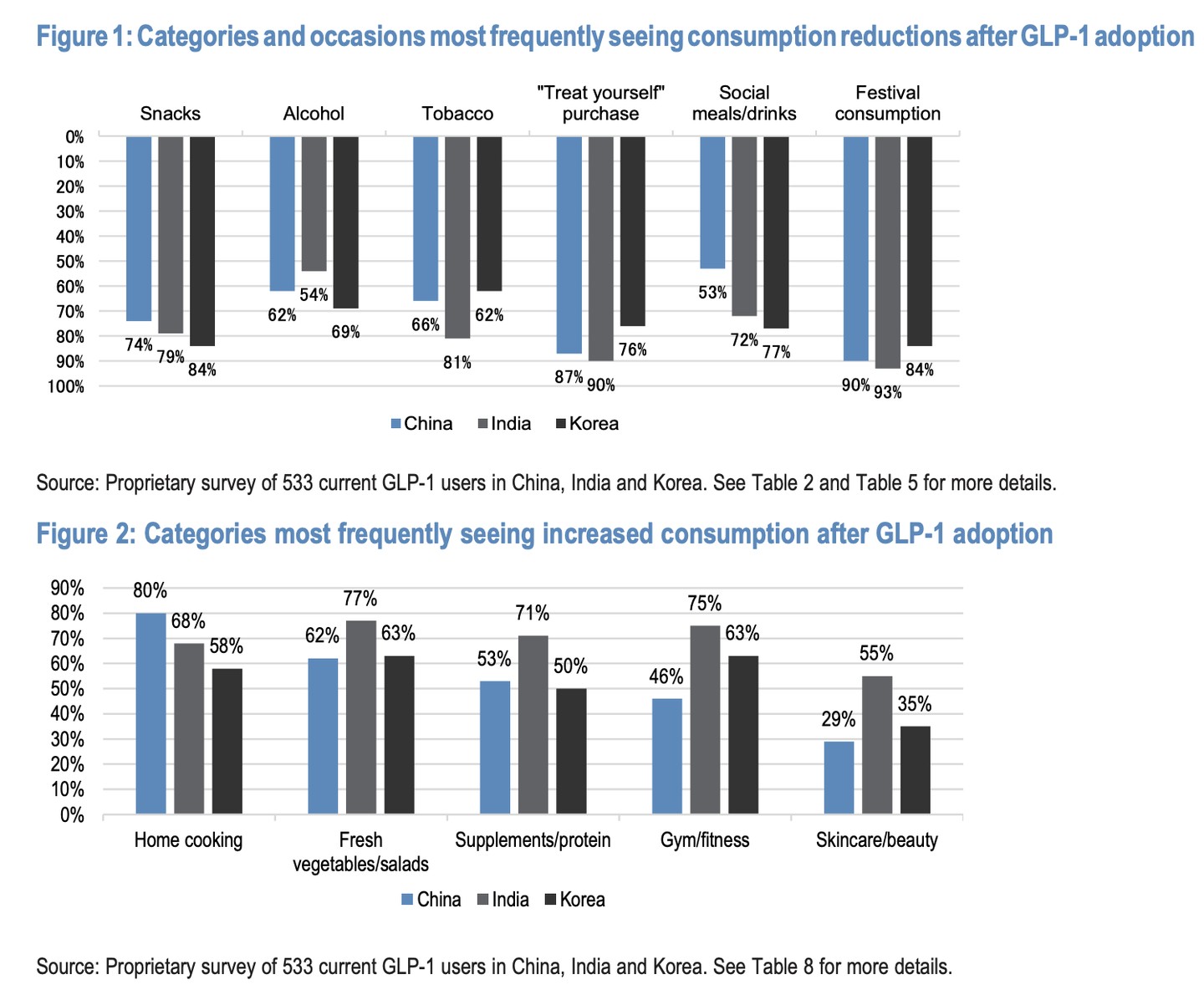
JPMorgan attributes these phenomena to the same underlying logic: these categories rely on consumers saying "yes" without thinking. Desire initiates consumption, convenience completes the conversion, occasions provide permission, and repetition accumulates value. This mechanism is where Asia's consumer industry has achieved the most thorough monetization. GLP-1 disrupts every link in this chain—decreased appetite weakens the trigger, reduced desire to "treat oneself" softens impulses, restraint in social and festive occasions invalidates "situational permission," and convenience alone can no longer reliably convert weaker desires into transactions.
The Risk for Food Delivery and Fast Food Is Not Just Lower Average Order Value
If it were merely about eating less, consumer companies could partially hedge through smaller portions, price increases, product combinations, and low-sugar, high-protein formulas. The more tricky scenario is the disappearance of the transaction itself.
In the sample, 79% reported a decrease in fast food spending or frequency, 74% reduced food delivery spending or frequency, and 68% increased home cooking. The data from China is particularly illustrative: even in a market with a highly developed food delivery system, 74% reduced food delivery orders, and 80% increased home cooking.
This means convenience no longer automatically equals transaction conversion. The growth logic of many past consumption models was reducing friction—stores closer, delivery faster, payments smoother, menus easier to order. The premise of this logic is that consumers already have desire. GLP-1 weakens the front-end trigger; no matter how smooth the back-end is, it may not pull orders back.
Social and festive scenarios also lack natural moats. In the sample, 92% of users said social dining was affected, and 89% said festive spending decreased or became more restrained. Many still attend gatherings or holiday events, but eat and drink less, ordering more cautiously. For dining, alcohol, gifting, and shared consumption, the risk is not just smaller individual appetites, but potential transmission to total table spending, frequency of additional orders, and the efficiency of scenario-driven demand.
JPMorgan categorizes the risks in the report into three layers: average order value risk (still buying, but buying less), frequency risk (buying less often), and scenario risk (the consumption occasion itself disappears). Frequency risk is harder to hedge than average order value risk, and scenario risk is harder to defend against than frequency risk.
Money Changes Direction: From Instant Gratification to Control and Visible Progress
GLP-1 users have not stopped spending; their wallets are simply following goals.
The most significant growth is in consumption related to controlling the process, maintaining results, and making changes visible: 62% increased spending on gyms or fitness classes, 58% increased supplements/protein products, 51% increased medical care or health check-up spending, 44% increased sportswear/sneakers spending, 40% increased skincare/beauty spending, and 31% increased medical aesthetics spending. Additionally, 84% reported increased exercise frequency, and 68% increased home cooking.
These categories do not all fall under "healthy food." Sneakers are not medicine, skincare does not equal weight loss, and medical aesthetics are not nutritional supplements. But they serve the same consumption task: enabling users to control the process, maintain results, or make changes more visible. JPMorgan summarizes this as "Control is the New Convenience"—old convenience made it easier for desire to turn into consumption; new convenience makes it easier to persist in progress.
In the sample, 26% increased travel spending, 18% increased gold/jewelry spending, and personal electronics, luxury accessories/watches, and perfumes all saw increases of approximately 17%. Money saved from food and beverages is being reallocated with purpose, shifting from triggered consumption to goal-oriented consumption.
Applied to stocks, the core question is not "does the company belong to food and beverages," but rather: how much of its growth comes from consumers' automatic nodding? JPMorgan identifies three types of companies affected. The first group relies on "without thinking"—demand comes more from frequency, habit, craving, or scenario; these companies will be negatively impacted. The second group is transitioning, such as expanding into nutrition, protein, and functional foods. The third group centers on goal-oriented demand. These latter two groups will benefit.
Valuation Debate May Precede Profit Impact
The current biggest boundary condition is clear: GLP-1 is not yet an issue for the current income statements of Asia's consumer industry. The sample is a behavioral survey of current users, not a penetration forecast; the data is self-reported changes, not equivalent to causal proof.
However, consumer stock multiples often capitalize future frequency, repurchase rates, store efficiency, and customer lifetime value. Once investors begin to doubt these assumptions, income statements may lag, but valuations may not.
There are three signals in the sample that should alert investors in advance: 89% plan to continue using GLP-1 for at least another six to twelve months; 71% have recommended GLP-1 to others; and 79% expect to retain at least some new habits after stopping use. Gallup data shows that GLP-1 usage among US adults rose from about 3% in 2024 to 11% in 2026, with a cumulative usage rate of 15%. Once oral formulations, domestic production, pricing, and channels open up, adoption rates in Asia may accelerate.
JPMorgan highlighted three noteworthy time nodes in the report: First, the entry of oral GLP-1 into Asia—Novo's oral Wegovy was approved in the US in December 2025, and Lilly's orforglipron was approved in the US in April 2026. According to JPMorgan's pharmaceutical team, orforglipron could be approved in China as early as late 2026 or early 2027. Second, the first batch of domestic semaglutide in China is expected to be approved from 2027 onwards; the entry of over ten local enterprises may drive price competition and channel penetration into lower-tier markets. Third, consumer companies begin launching exclusive products for GLP-1 users, such as muscle-preserving protein and portion-controlled packaging—once operators start redesigning products for these users, the market will find it difficult to view this as purely a pharmaceutical issue.
The ultimate question is not whether GLP-1 will cause all consumer stocks to fall. The real question is more specific: Which companies previously profited from consumers' impulses, and which profited from consumers' goals? The former need to prove they do not rely solely on frequency and scenarios; the latter need to prove that goal-oriented spending can recur. Valuation divergence may start here.
