


SpaceX Surges 23% in Two Days Following Stock Lifting; Record Option Turnover as Short Squeezes May Further Drive Up Share Price
SpaceX's market capitalization surged by $327 billion over two days, with its share price approaching the $135 IPO issue price again. As of 1:50 p.m. New York time on Friday, SpaceX option turnover reached 2.24 million contracts, with call option volume hitting 1.3 million, setting a historical record. Currently, more than 250 million SpaceX shares remain shorted, and rapid price increases could force shorts to cover, potentially pushing the share price even higher
SpaceX shares rose sharply for the second consecutive trading day, just one step away from reclaiming the $135 IPO issue price. On Friday, the company's share price rose approximately 16%, bringing the cumulative two-day gain to about 23%, during which its market capitalization increased by over $327 billion.
This strong rebound occurred after the first large-scale lifting of restricted shares. On Thursday, approximately 911.5 million SpaceX shares had their selling restrictions lifted, increasing the number of tradable shares from about 639 million to 1.55 billion. The market had previously worried that concentrated selling by early investors would exert immense pressure on the share price, but the actual outcome was quite the opposite.
The rapid rebound in SpaceX's share price has also placed enormous pressure on investors who had previously bet on a decline. Currently, more than 250 million SpaceX shares remain shorted, equivalent to about 16% of currently tradable shares. If the share price rises rapidly, forced covering by shorts could further drive up the price.
Meanwhile, trading in the SpaceX options market has become unusually active. As of 1:50 p.m. New York time on Friday, SpaceX option turnover reached 2.24 million contracts, with call option volume hitting 1.3 million, a historical high, indicating that capital is flowing back in.
However, the rapid rebound does not mean that concerns about SpaceX's high valuation have disappeared. As the supply shock from the stock lifting is gradually digested, investors still face a core question: Is the market willing to continue paying an extremely high valuation for SpaceX before its AI, satellite internet, and aerospace businesses fully realize their potential?
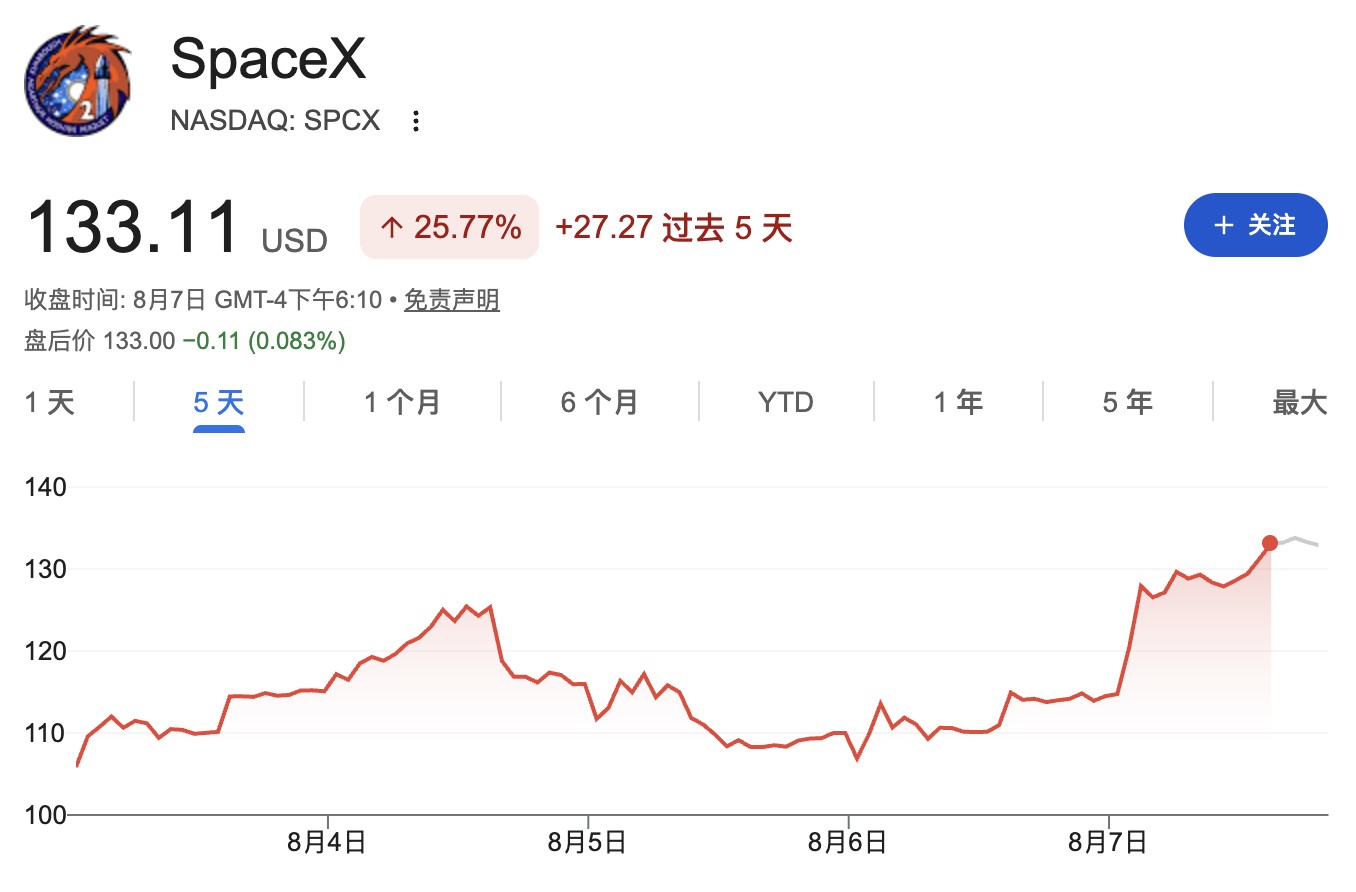
No Drop After Stock Lifting; SpaceX Market Cap Increases by $327 Billion in Two Days
SpaceX previously experienced a sharp correction.
Shortly after its IPO, the share price quickly climbed to historical highs, subsequently erasing over $1 trillion in market capitalization. On Wednesday, after SpaceX released its first public earnings report since listing, the share price fell 14% in a single day, partly because the company's spending on artificial intelligence business exceeded market expectations.
But just two trading days later, market sentiment reversed significantly.
On Friday, SpaceX's share price rose approximately 16%, bringing the two-day cumulative gain to about 23%, moving the price close to the $135 IPO price again. Based on Friday's closing price, SpaceX shares closed at $128.18.
What makes this rebound particularly noteworthy is that it occurred after the market's most feared event: the lifting of restricted shares.
On Thursday, approximately 911.5 million previously restricted shares entered the market, significantly increasing the number of tradable SpaceX shares from 639 million to 1.55 billion, more than doubling the float size.
According to previous market concerns, the large influx of new shares could have created massive potential selling pressure. However, judging by the actual trend, the stock lifting instead became the starting point for the share price rebound.
Shorts Suffer Reversal; Over 250 Million Shares Still Shorted
The rapid rebound in SpaceX's share price has also placed enormous pressure on investors who had previously bet on a decline.
According to data from S3 Partners, prior to this rebound, shorts had accumulated paper profits exceeding $9 billion at one point.
As of the latest data, more than 250 million SpaceX shares remain shorted, equivalent to about 16% of currently tradable shares. This ratio was previously even higher.
Before the lifting of 911.5 million shares, SpaceX's short interest ratio had reached over 36% of tradable shares. As a large number of new shares entered circulation, the short interest ratio dropped rapidly.
Matt Maley, Chief Market Strategist at Miller Tabak, stated that there were definitely some short positions that needed to be closed around the time of the stock lifting.
This means that, in addition to being driven by new buying power, this round of gains may also involve significant short covering.
For popular stocks with high short interest ratios, if the share price does not fall as expected by shorts but instead rises rapidly, forced covering by shorts can further push up the price, creating a positive feedback loop of "rise – cover – further rise."
Record Option Turnover as Bullish Capital Chases the Rally
Beyond the spot stock market, the SpaceX options market has also seen a clear speculative frenzy.
Exchange data compiled by Bloomberg shows that as of 1:50 p.m. New York time on Friday, SpaceX option turnover had reached 2.24 million contracts.
Of these, call option volume reached 1.3 million, a historical high; put option volume was approximately 943,000 contracts.
Trading in individual contracts was particularly active. The call options expiring on August 14, 2026, with a strike price of $320, saw a volume of 64,857 contracts, whereas as of Thursday, the open interest for this contract was only 17,702.
Additionally, put options expiring on August 7, 2026, with a strike price of $125, saw a volume of 27,866 contracts, corresponding to an open interest of 6,314; call options expiring on August 7, 2026, with a strike price of $120, saw a volume of 20,747 contracts, corresponding to an open interest of 26,724.
The sharp amplification in option trading, especially the record-breaking call option volume, reflects that some capital is betting on continued rises in SpaceX's share price.
Meanwhile, SpaceX's three-month implied volatility decreased by 1.55 percentage points to 77.37%, and the three-month 90/110 skew decreased by 1.29 percentage points to -0.15%.
This indicates that while the share price rebounded quickly, the options market's pricing of tail downside risk has also eased.
Wall Street Remains Bullish, But High Valuation Controversy Persists
Although the stock lifting was viewed as a significant risk event for SpaceX's share price, the lifting of restrictions does not mean early investors must sell their shares immediately.
This is also an important reason why the current market trend deviated significantly from previous pessimistic expectations.
At the same time, Wall Street remains highly optimistic about SpaceX overall.
Argus Research upgraded its rating on SpaceX from "Hold" to "Buy" on Friday, citing that the company's investment in AI infrastructure might yield "quick returns."
According to data compiled by Bloomberg, nearly 80% of analysts covering SpaceX currently give a "Buy" rating, with an average target price of approximately $221.
But behind the optimistic expectations, SpaceX's valuation remains an issue the market cannot avoid.
Matt Maley, Chief Market Strategist at Miller Tabak, pointed out that once the trading impact of the restricted share lifting gradually fades, investors will ultimately need to decide whether they are willing to buy into a company that may take years to fully realize its potential at such a high price.
In other words, the current rebound mostly proves that the market has regained its risk appetite, not that SpaceX's long-term valuation issues have been resolved.
AI and Space Business Determine Whether This Rally Can Continue
SpaceX's current valuation logic is no longer limited to traditional aerospace business.
The company is simultaneously betting on multiple growth directions, including rocket launches, satellite internet, and AI infrastructure. Among these, AI investment has received particular attention from capital markets, but it is also one of the main sources of the spending that exceeded expectations in recent earnings reports.
Therefore, whether SpaceX's future share price can continue to break upward depends not only on the growth of existing businesses like Starlink, but also on whether the market can see actual returns from AI infrastructure investments.
Currently, the stock lifting, an event that might have triggered selling, has been quickly digested by the market, while short covering and call option trading have further amplified the upward momentum.
But as short-term trading factors gradually recede, the market will ultimately return to a fundamental question: Can SpaceX use business growth over the next few years to fulfill the current extremely high market expectations?
If the answer is yes, $135 may just be the starting point for the next round of gains; if the realization speed of AI and aerospace business falls short of expectations, then the recent surge driven by short covering and option capital could become a new source of volatility.
