


"Black July" Ends with "Two-Day Rally": Has the "AI Trade" Bottomed Out?
U.S. stocks ended July with two consecutive days of gains, but the NASDAQ Composite Index still fell 3% for the month. The selling spree triggered by forced liquidations of leveraged AI bets was halted after Citadel stepped in to buy up positions. The market is debating whether this rebound is a technical fix from oversold conditions or a sign that the AI investment thesis has bottomed out. Goldman Sachs' High Beta Momentum Basket recorded its worst monthly performance since 2000
As the month came to a close, Wall Street witnessed a collective rebound. However, there is far from consensus in the market on whether this rebound is merely a technical repair after being oversold or a genuine signal that the AI investment logic has truly bottomed out.
In the last two trading days of July, high-momentum stocks, which had previously suffered heavy losses, completed a strong two-day rally. The KOSPI index, heavily weighted towards Korean chip stocks, surged more than 18% in a single day at one point, while the U.S. semiconductor sector recorded its largest two-day gain since June.
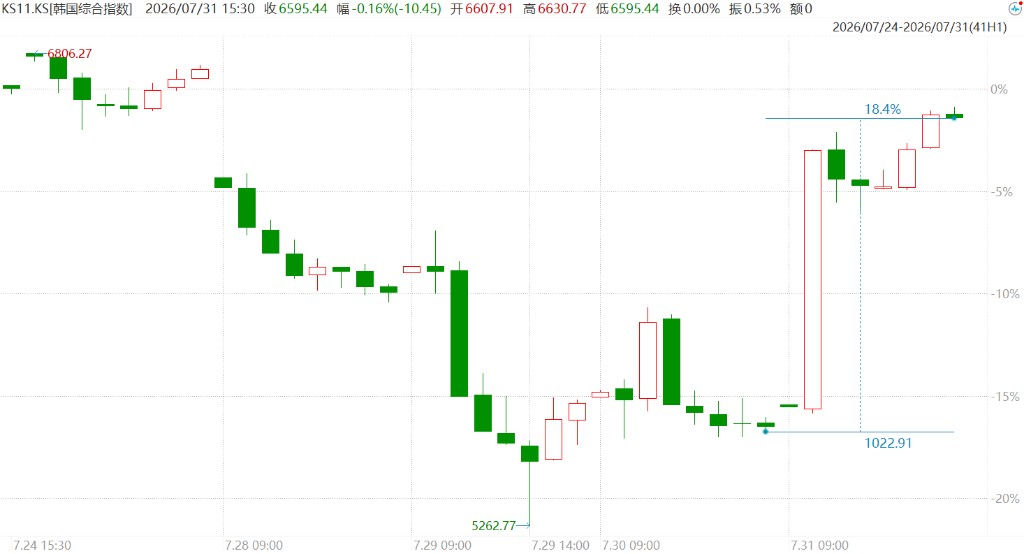
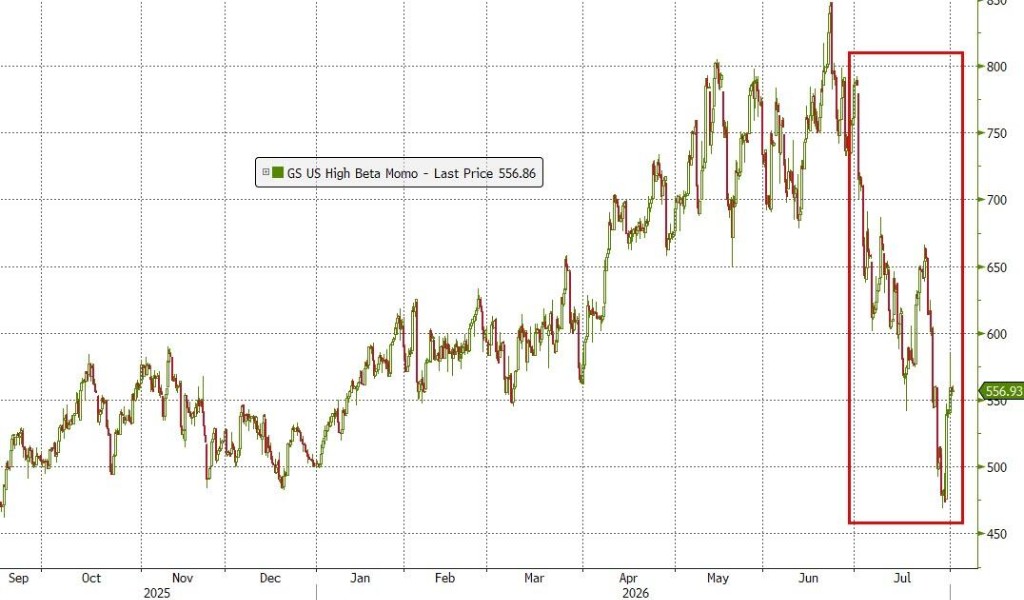
However, in July, the NASDAQ Composite Index fell approximately 3%, marking its worst monthly performance since March and posting declines for two consecutive months. The decline in Goldman Sachs' High Beta Momentum Basket in July was even more severe, setting a record for the worst monthly performance since November 2000.

The direct trigger for this turmoil was the collapse of leveraged AI bets.
As mentioned by Wallstreetcn, the hedge fund Situational Awareness (SA), managed by Leopold Aschenbrenner, faced margin calls due to the liquidation of its leveraged AI positions, forcing it to sell public equity assets in a falling market.
The spiral decline was only paused when Citadel, one of the world's largest hedge funds, stepped in to take over most of its stock portfolio. However, in the view of many market participants, this event exposed far more than just the position risks of a single fund.
SA Liquidation Storm and Forced Deleveraging
At the core of this storm was the hedge fund Situational Awareness, led by Leopold Aschenbrenner.
Wallstreetcn noted that the fund suffered significant losses on its AI-related leveraged positions, triggering margin calls and forcing the sale of public market stocks during the downturn, which further accelerated the decline.
The scale and speed of deleveraging were evident across multiple dimensions:
- Global tech stocks experienced their largest-scale sell-off in over five years;
- As of July 30, the assets under management (AUM) of U.S.-listed leveraged/inverse ETFs hovered at slightly below $150 billion, shrinking by nearly $60 billion from the June peak.
- The AUM of Korean stock leveraged ETFs plummeted from a peak of $53 billion in June to approximately $15 billion;
- Multiple quantitative factors saw their largest single-day fluctuations in four years.

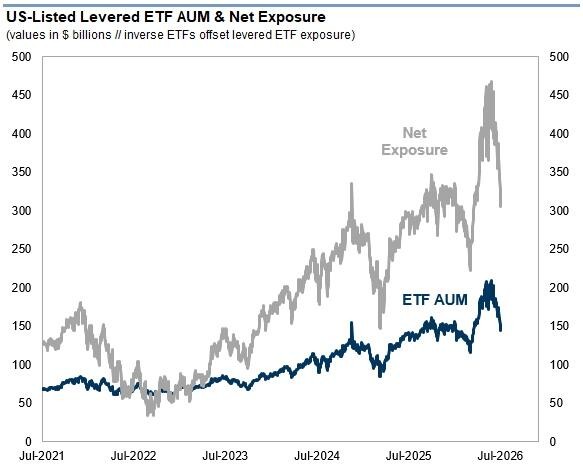
The spiral decline was interrupted only after Citadel stepped in to take over the vast majority of its public market stock portfolio. However, the SA hedge fund was not an isolated black swan event.
Previously, the AI sector had begun to weaken as investors questioned the returns on AI investments. An otherwise uneventful Federal Reserve interest rate meeting also sparked market doubts about new Chair Walsh's determination to curb inflation, pushing long-term U.S. Treasury yields higher.
The weekly expansion of the slope of the 5-to-30-year yield curve was the largest since August 2025.
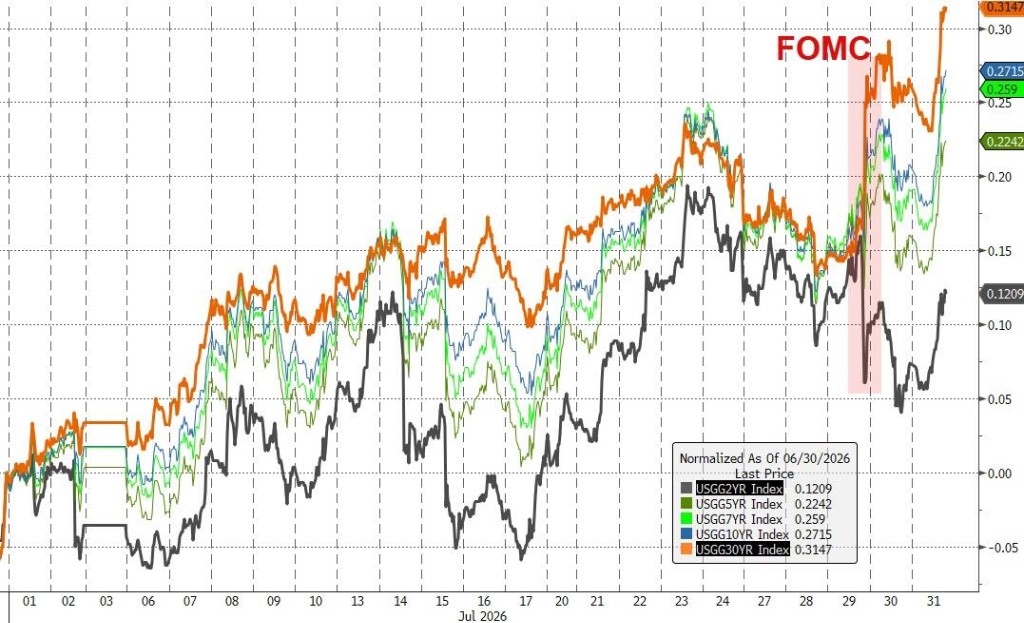
According to Yin Luo, a quantitative analyst at Wolfe Research, the rise in long-term yields does not merely reflect a strong economy but points more to rising inflation expectations and higher term premiums, that is, the extra return investors demand for holding long-term Treasuries rather than rolling over short-term debt.
July Momentum Factor Collapse: A Historic Style Shift
From the perspective of quantitative factors, the intensity of this market movement was particularly notable.
Momentum strategies, which bet on recently strong-performing stocks, first experienced their largest four-day drop since 2020, followed by the largest single-day rebound in the same period.
While the S&P 500 Index's average daily fluctuation this week was less than 1%, Goldman Sachs' flagship momentum index saw an average daily fluctuation of nearly 10%. Some analysts believe that one should not expect a significant rebound in the stock market until this signal weakens.
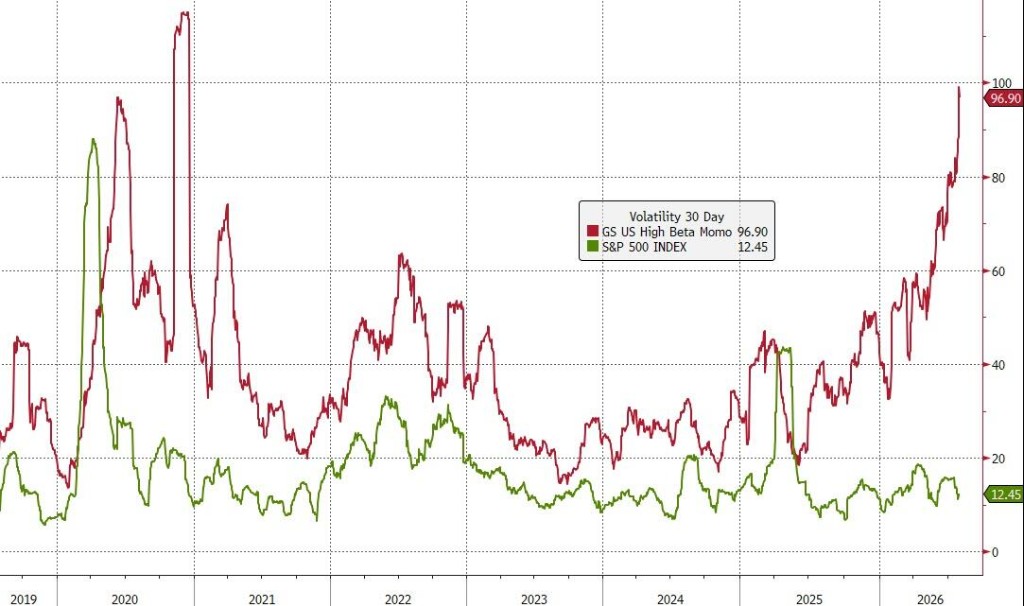
Looking back at the entire month of July, Goldman Sachs' High Beta Momentum Basket posted its worst monthly performance since November 2000. Long positions in the basket were generally under pressure, while several software stocks that had previously been shorted rose against the trend.
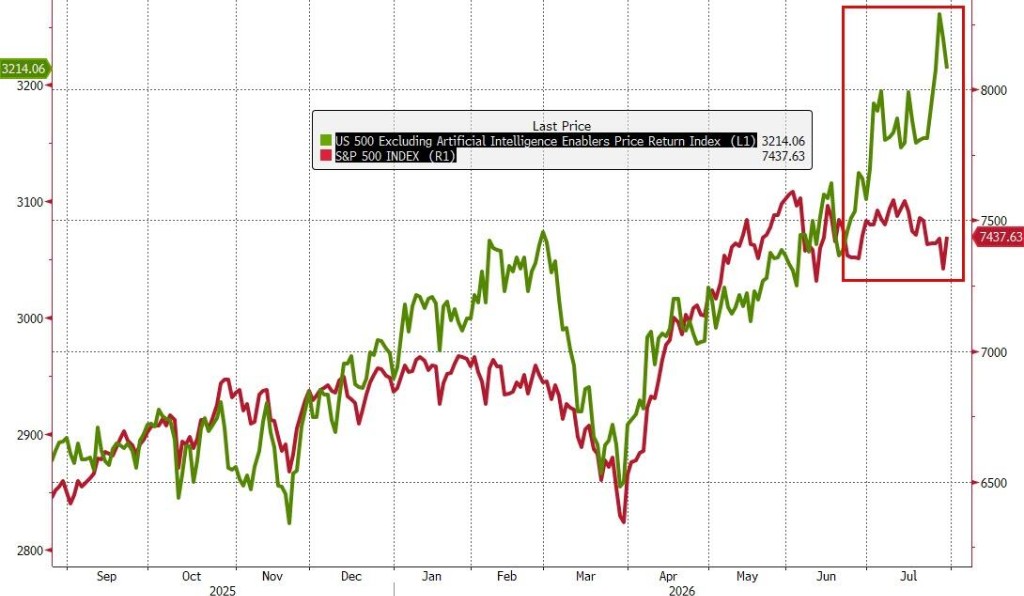
At the same time, factors such as value, quality, and low volatility, which have long been at a disadvantage, showed a clear rebound, preliminarily reversing the style ranking established since the AI-dominated rally began.
The S&P 500 Equal Weight Index, the Low Volatility Index, and the S&P 500 Index excluding AI-related components all hit record highs this week.
Wai Lee, Head of Systematic Equity Research at Allspring Global Investments, stated:
The recent weakening of momentum looks more like a rotation than a crash or correction. The market is rewarding stocks that demonstrate better return on investment and free cash flow.
Has the Market Reached a Turning Point?
The rebound this weekend provided the market with some breathing room.
Semiconductor stocks recorded their largest two-day gain since June, the KOSPI index, with a high weighting in Korean chips, surged 18.5% at one point, the S&P 500 Index recovered its 50-day moving average, and the VIX fear index fell from above 20 earlier in the week to 15.99.
However, Michael Dickson, Head of Research at Horizon Investments, raised a more cautious question:
The real question is: Have we reached the bottom of the momentum rotation?
Lewis Grant, Senior Portfolio Manager at Federated Hermes, believes that after the significant correction in momentum stocks and some valuation repair in AI leaders, "the most intense phase of the rotation should be over."
Mike Shell, Chief Investment Officer at Shell Capital, stated that data from his broker shows that the momentum unwinding is closer to its end, and the risk-reward ratio is becoming more attractive. However, he also emphasized that this does not mean a precise bottom has been confirmed.
JPMorgan's quantitative team took a more cautious stance. In a report on Friday, the strategy team led by Khuram Chaudhry wrote that deteriorating sentiment and peaking money supply growth suggest the rotation is likely to continue. "This month feels different from the past," and they recommended increasing exposure to quality factors.
Paisley Nardini, Head of Simplify Asset Management, offered a broader warning: July showed that "simply buying the index" is no longer sufficient in the current market environment, and the value of active management is re-emerging.
Seasonal factors are also a variable. Historically, August and September are the two weakest months of the year. One question the market is asking is: Has the usual late-summer volatility been released in advance?
Goldman Sachs' Pasquariello provided a relatively optimistic comprehensive assessment in his weekly report: the economy is operating steadily, earnings growth is strong, capital flows are trending toward improvement, and over $1 trillion in AI capital expenditure is flowing into the system.
The report pointed out:
The fundamental foundation of the market remains solid, and the overall outlook for U.S. stocks remains favorable.
However, he also clearly highlighted tail risks, especially noting that movements in long-term interest rates in the global bond market deserve close attention, "particularly for long-duration stocks."
He believes that the S&P 500 Index will continue to move forward under pressure, but there will be more frequent attempts to rally in the near term, while the summer liquidity environment will make risk transfer more difficult.
He advises investors to maintain a preference for "increasing liquidity and reducing complexity" in their holdings over the next few weeks.
Risk Warning and Disclaimer
The market carries risks, and investment requires caution. This article does not constitute personal investment advice, nor does it consider the specific investment objectives, financial status, or needs of individual users. Users should consider whether any opinions, views, or conclusions in this article align with their specific circumstances. Investors bear full responsibility for their own investment decisions.
