


South Korea's Deleveraging Plays the Existing Stock Card: Leveraged ETFs Can Be Forced to Reduce Leverage to 1x, Assets Shrink by 78%, Foreign Capital Returns Early
Although South Korea's deleveraging process has largely subsided, tail risks remain unresolved. The balance of first-tier financial leverage financing has declined, and the scale of forced liquidations has dropped significantly. In the second tier of trading leverage, the market value of leveraged ETFs has shrunk by 78.2% from its peak, reducing absolute risk exposure. However, share adjustments are lagging, necessitating continued attention to the volatility caused by negative gamma cycles and subsequent digestion
Core Views
Has South Korea's deleveraging ended? Overall, it has largely subsided, but tail risks have not yet cleared.
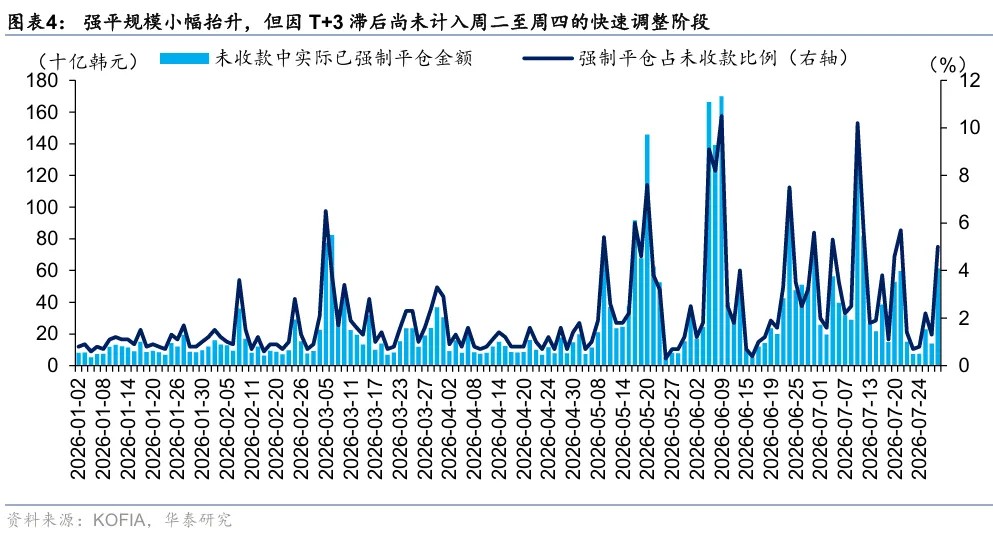
In our previous report ("How to View the Future Trend of Korean Stocks?", 2026/07/13), we pointed out that leverage in the South Korean stock market is divided into two layers. The first layer is financial leverage created by banks and non-bank institutions for investing in financial markets. The second layer corresponds to trading leverage formed by financial products such as leveraged ETFs. These two layers amplify market risk multiplicatively rather than additively, with pressure concentrated more on the second layer. 1) The risk of the first layer lies in forced liquidations triggered by T+2 margin calls. If stock prices adjust rapidly, investors may be forced to close positions due to margin calls, thereby amplifying market declines and creating one-sided downward pressure. 2) The risk of the second layer is mainly reflected in leveraged ETFs amplifying volatility through negative gamma cycles, causing significant two-way fluctuations in the market.
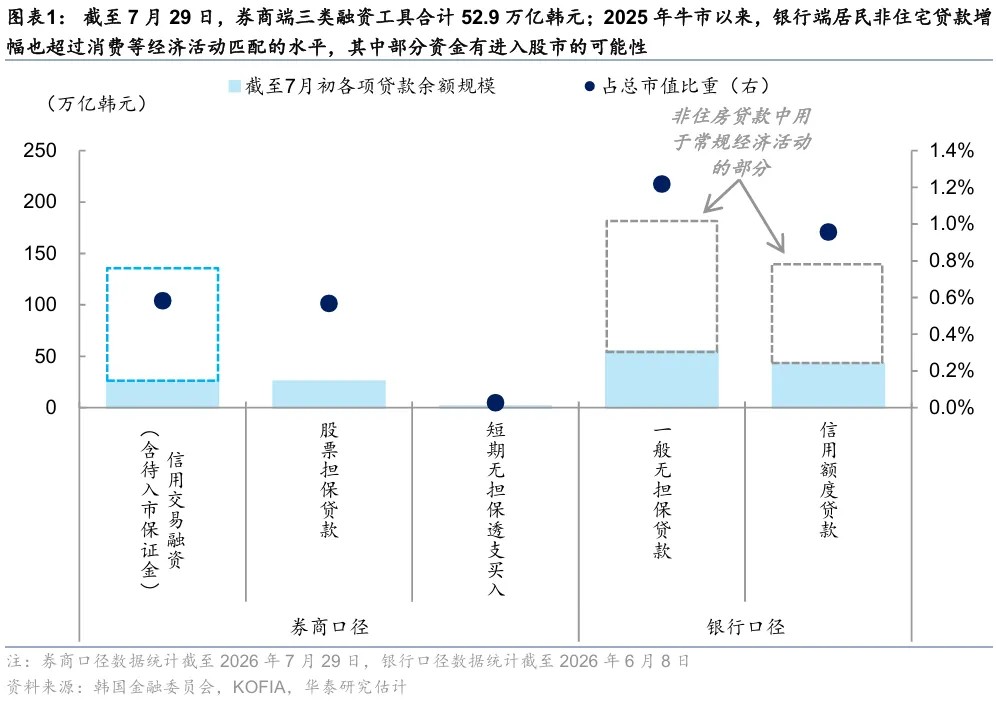
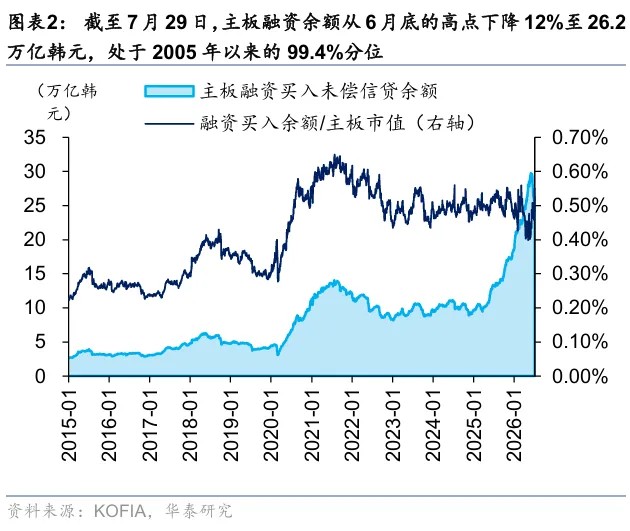
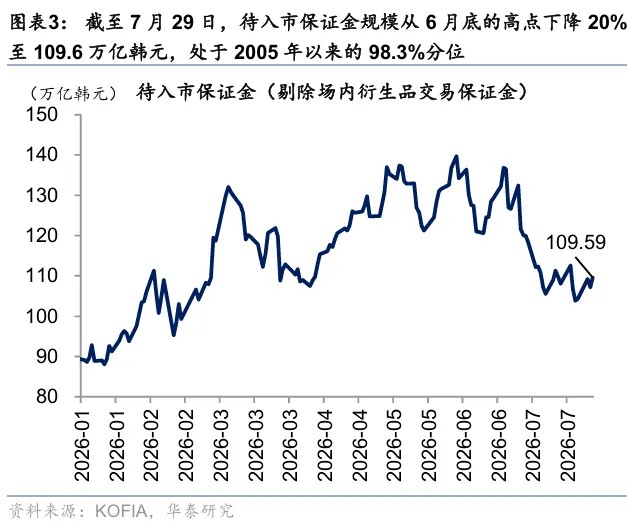
Regarding the first layer of financial leverage, the financing balance is gradually declining, and its level is not high, so it is not the core source of pressure in this round of volatility. As of July 29, 2026, the total balance of three types of financing tools at brokerages (excluding margin deposits pending entry into the market) had fallen to 52.9 trillion won, accounting for 1.2% of the total market capitalization of Korean stocks. The latest data shows that from last Tuesday to this Monday, the scale of forced liquidations dropped significantly, with an average forced liquidation scale of only 22.536 billion won, falling to the 31.7th percentile since June 2026. It should be noted that forced liquidation execution follows the T+2 rule, and data is published with a one-day delay (T+1), meaning the actual forced liquidation data visible to the market lags until T+3. Therefore, the currently low scale of forced liquidations reflects the situation during the previous week when Korean stocks were stabilizing sideways. The forced liquidation scale corresponding to the rapid adjustment of Korean stocks from this Tuesday to Thursday has not yet been reflected in the data and needs to be tracked and confirmed.
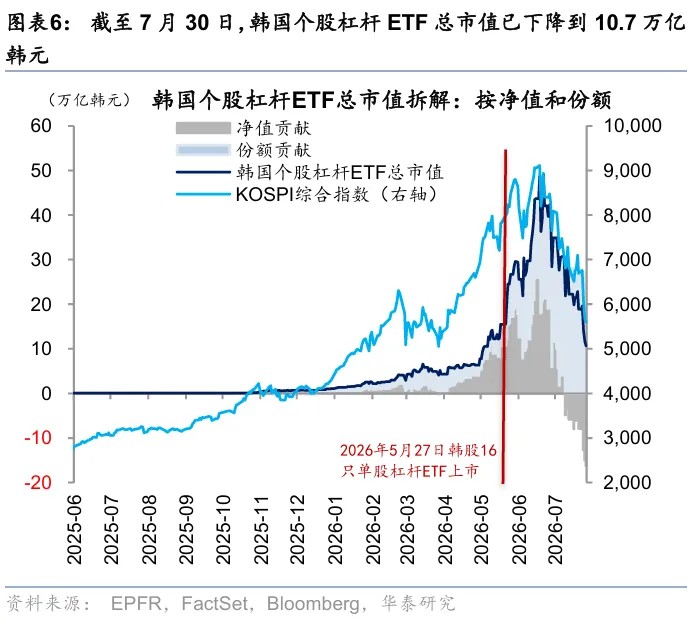
Regarding the second layer of trading leverage, the absolute scale of leveraged ETFs has decreased significantly, and risk exposure has clearly declined, but share adjustments are relatively lagging, requiring completion of the final stage of digestion. The total market value of individual stock leveraged ETFs has fallen sharply from a high of about 49 trillion won on June 25 to 10.7 trillion won on July 30, a decrease of 78.2%. While the progress of deleveraging in absolute terms is significant, a breakdown reveals three tail risks that require attention:
-
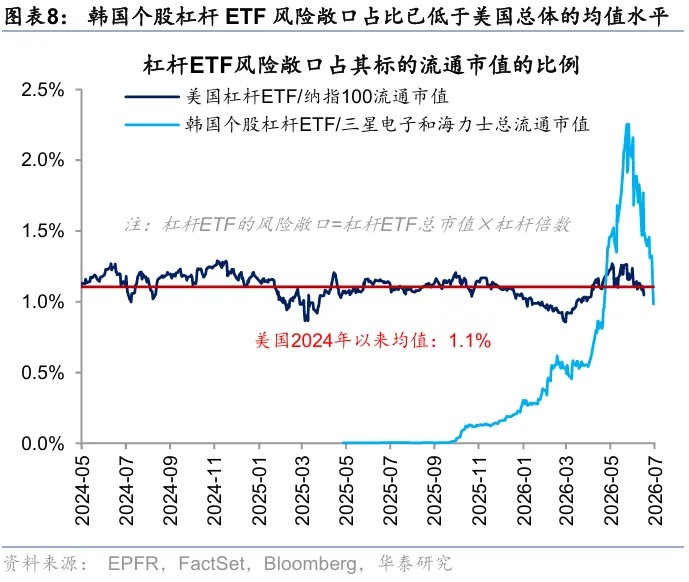
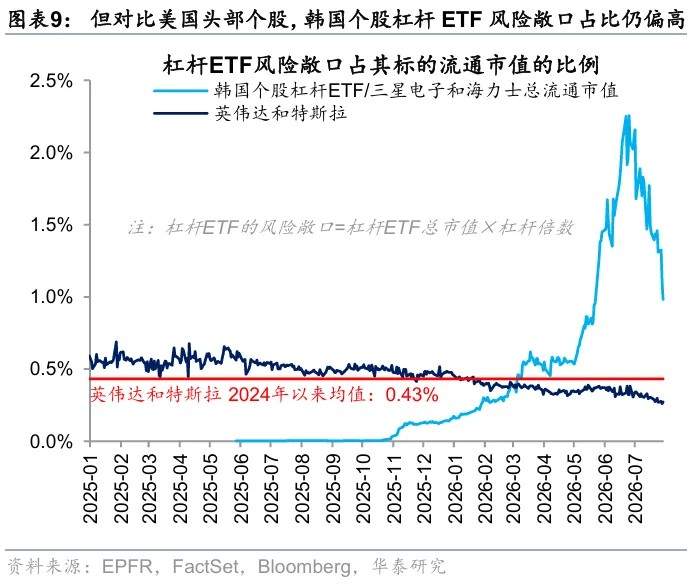
Risk exposure ratio of leveraged ETFs: As of July 30, although the proportion of risk exposure of Korean leveraged ETFs to the circulating market value of underlying assets has fallen to 0.93%, which is lower than the normalized average for the US stock market (about 1.1%); comparatively, for Nvidia and Tesla, which have the highest proportion of leveraged ETF scale in the US market, the ratio of leveraged ETF risk exposure to individual stock circulating market value is only around 0.4%. This ratio remains significantly higher in South Korea.
-
Shares only declined moderately: The contraction of risk exposure in this round was mainly passively contributed by the decline in the net asset value of the underlying assets, while shares only declined moderately. This is essentially because changes in shares are passively determined by the arbitrage subscription and redemption mechanism driven by secondary market premiums and discounts. Since core measures to truly suppress secondary market enthusiasm, such as tightening deviation rate standards, implementing fast suspension procedures, and strictly requiring reduced leverage multiples, have not yet been fully implemented, buying enthusiasm in the secondary market has not cooled significantly. Moreover, some investors may have rushed to buy before the new deposit money regulations took effect on July 31, offsetting redemption pressure during the decline.
-
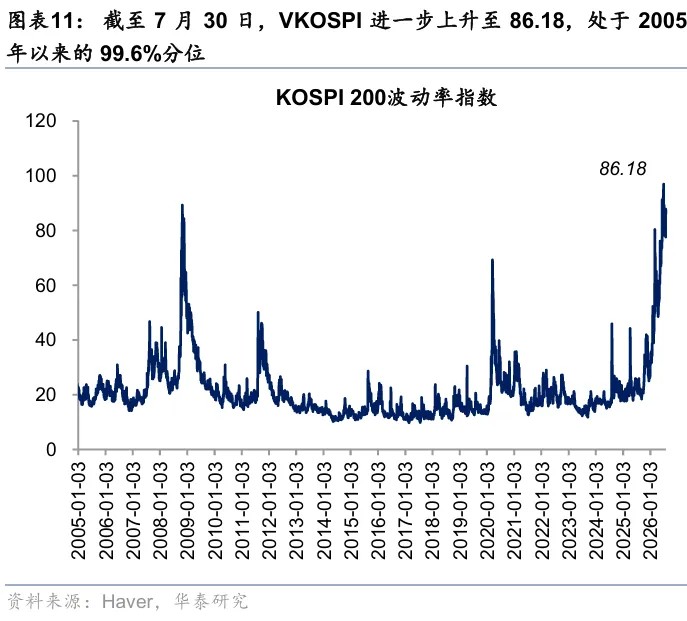
Korean stock volatility remains high: As of July 30, the VKOSPI (KOSPI 200 Volatility Index) remained at a relatively high level of 86.18, at the 99.6th percentile since 2005, indicating that market volatility is still at historically extreme levels.
What is the current policy orientation? Regulatory policies accelerated and intensified this week, leading to accelerated deleveraging.
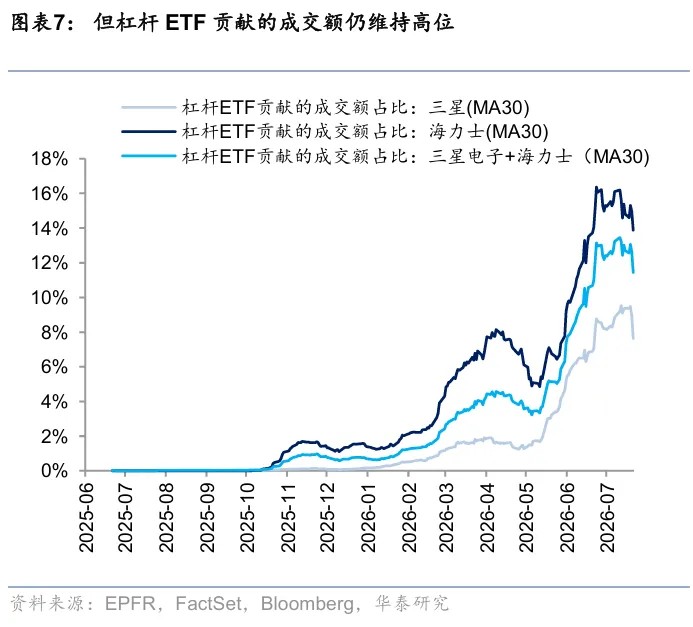
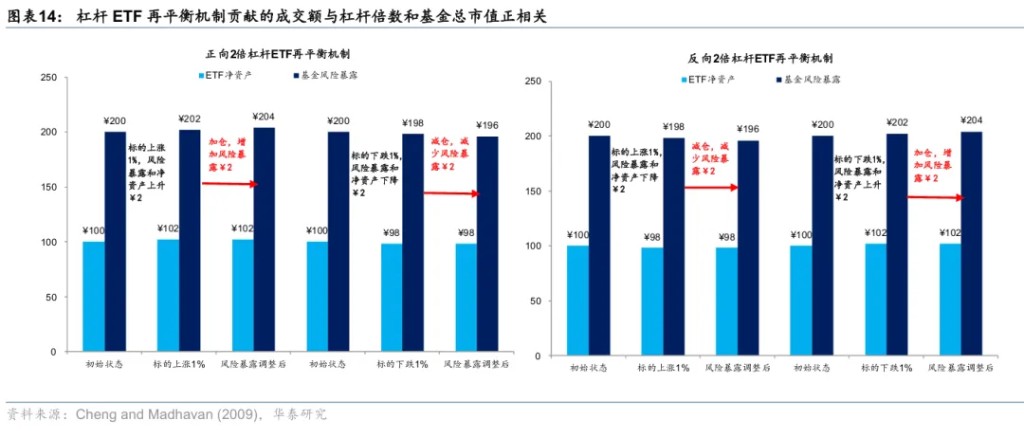
The ultimate goal of risk reduction is to lower stock market volatility, which remains at historically high percentiles. One of the main causes of this round of volatility is the intraday rebalancing mechanism of leveraged ETFs, which chases rises and kills falls. We conservatively estimate that the transaction volume contributed by leveraged ETFs still accounts for 11.4% of the 30-day average transaction volume of Samsung Electronics and SK Hynix, making it one of the core factors keeping Korean stock volatility high. Furthermore, since the current decline in leveraged ETF scale is due to net asset value rather than shares, there is a possibility that leverage risks could reignite after a stock market rebound. Therefore, even though the scale has decreased significantly, regulatory policies continued to tighten this week.
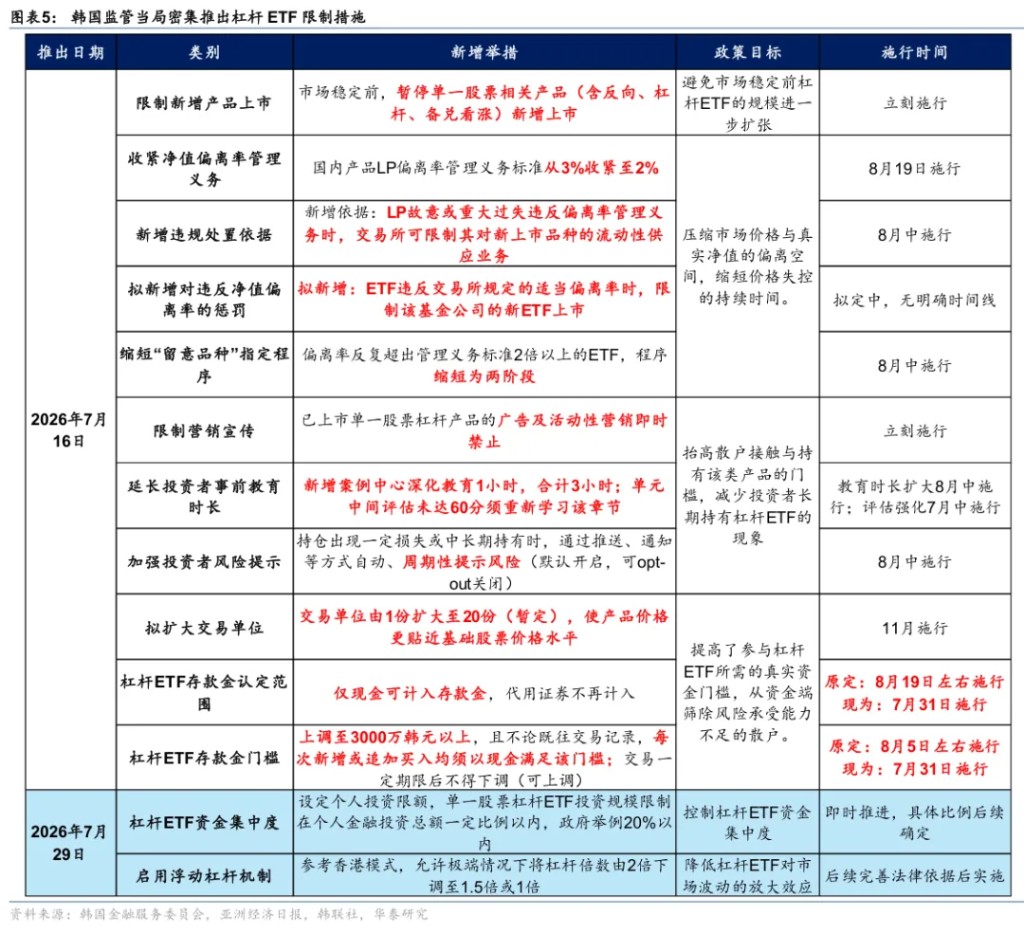
Current policies mostly target the shares of leveraged ETFs, with policy ideas including "controlling incremental growth" and "digesting existing stock." The peak of policy pressure may have passed:
-
Controlling incremental growth: Raising the capital threshold for purchasing leveraged ETFs to limit the speed of share expansion from the source. On July 24, the Financial Services Commission of South Korea announced that the revision of deposit money recognition standards, originally scheduled to take effect on August 19, and the increase in the deposit money threshold, originally scheduled for August 5, would both be advanced to July 31. The new regulation raises the deposit money threshold from 10 million won to 30 million won. Thirty million won is approximately 40% of the average annual household income in South Korea and 22% of the average household financial asset holdings. Only cash is recognized; substitute securities are no longer counted as deposit money, and proceeds from selling securities can only be counted after T+2 settlement is completed. The new regulation on July 24 only restricts new buying behavior, does not retroactively affect existing positions, and does not involve supplementary deposit money or forced liquidations. This move will raise the capital threshold for new purchases, compressing the space for share growth.
-
Digesting existing stock: Policies prior to this week did not target existing stock, but new policies this week began to promote existing stock management. The current policy idea is to relax the multiple constraints on existing leveraged products. On one hand, this reduces the impact of daily rebalancing of leveraged ETFs on stock volatility; on the other hand, it may promote the gradual return of existing shares to normal levels. On July 29, regulators added new measures to provide a basis for the flexible operation of leverage ratios. In emergencies, the current fixed 2x leverage can be lowered to 1.5x or 1x as an emergency tool for market stability. The purpose of this measure is not to directly require leveraged ETFs to sell off exposure, but to compress the nominal amount of buying and selling required for daily rebalancing by reducing the leverage multiple during extreme market rises and falls. The nominal amount of underlying assets required for daily rebalancing of leveraged ETFs is roughly "Fund Size × (L² - L)" (where L is the leverage multiple). After the multiple is lowered, the chasing and killing forces brought by rebalancing narrow accordingly. At the same time, once the leverage multiple is lowered, some investors may reassess their holdings, promoting moderate digestion of shares.
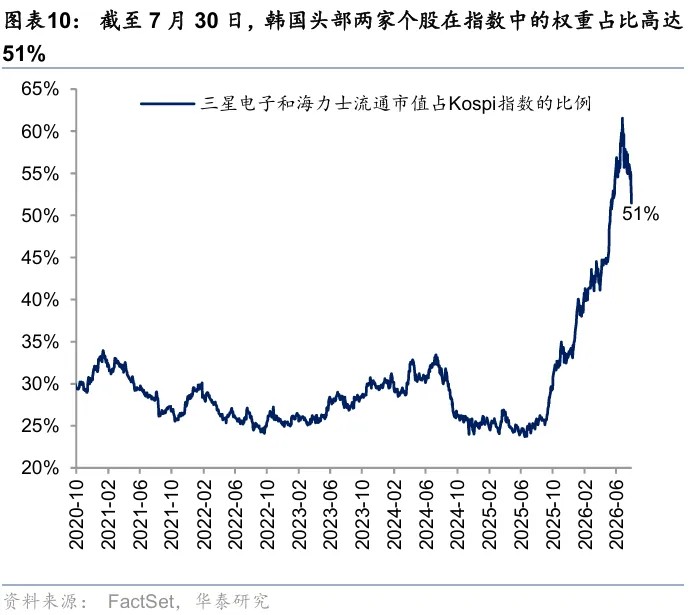
One aspect causing high volatility in Korean indices is the high volatility of individual stocks, and the other is the high positive correlation between individual stocks. The latter needs to be addressed by adding index weight caps to reduce market concentration, which is not yet under discussion. As of July 30, 2026, Samsung Electronics and SK Hynix accounted for 51% of the market capitalization in the KOSPI. Since both belong to the memory sector, their high correlation is endogenous. The high weight concentration in the index makes market volatility easier to amplify.
How will it evolve in the future? Policies intensify again, deleveraging enters the final stage, and mid-August is a key node.
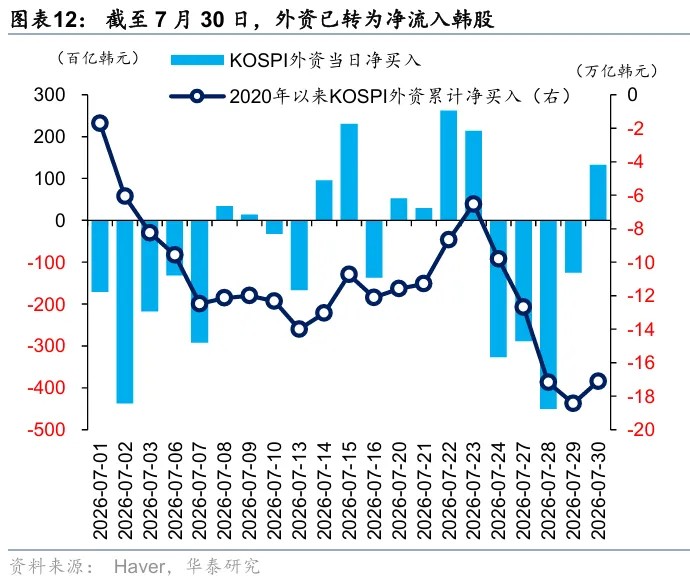
In the short term, due to the recent acceleration of regulatory policies, attention still needs to be paid to redemption risks of leveraged ETFs. We expect Korean stocks to maintain high volatility and oscillation before policies are fully implemented in mid-August, as the market enters the final stage of risk clearing. From late July to mid-August is the window for concentrated policy implementation. Position adjustments during the policy transition period may still bring phased disturbances, but directional pressure is significantly weaker than in the earlier period. However, after the rapid adjustment this week, the current risk exposure of leveraged ETFs as a proportion of the circulating market value of underlying assets has fallen to a relatively low level of about 1.1%. Even if shares accelerate digestion, the impact on the market is expected to be more controllable. Coupled with the marginal slowdown in net foreign sales (which turned into net inflows on July 30), the risk of severe adjustment due to rapid leverage clearing has eased. The market is more likely to complete the final stage of risk digestion through high volatility oscillation. It is expected that after mid-August, as the policy shock fades, the trend of Korean stocks will depend more on the fundamentals of the semiconductor industry.
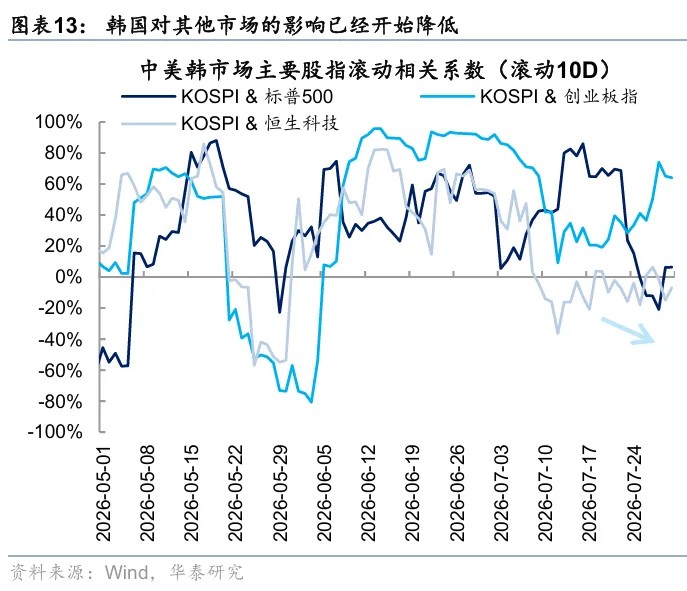
From the perspective of other markets, as Korean stock volatility subsides, the spillover impact on overseas markets may converge. As of July 30, the correlation of the KOSPI with the ChiNext Index, S&P 500, and Hang Seng Index has fallen by 24.7, 48.2, and 62.8 percentage points respectively from the highs in early July, dropping to 64.0%, 6.3%, and -7.0%. The sensitivity of major global markets to Korean stock volatility has decreased.
Huatai Securities Strategy Research
Risk Warning and Disclaimer
The market carries risks; investment requires caution. This article does not constitute personal investment advice, nor does it consider the specific investment objectives, financial status, or needs of individual users. Users should consider whether any opinions, views, or conclusions in this article align with their specific circumstances. Responsibility for investments made based on this content lies solely with the investor.
