


CGS Interprets July PMI: Economic Recovery Awaits Policy Support
CGS interprets the July PMI data, noting that both manufacturing and non-manufacturing indices fell below the 50% threshold, reflecting a phased decline in economic sentiment. The core contradiction is insufficient effective demand; although external demand shows resilience, production and demand are declining in tandem. Looking ahead to August, reduced weather disruptions may help repair the PMI, but the magnitude of the rebound depends on whether demand stabilizes. On the policy front, the Politburo meeting emphasized strengthening counter-cyclical adjustments, with expectations for accelerated fiscal spending and monetary easing (interest rate and reserve requirement ratio cuts) to help achieve the annual GDP target
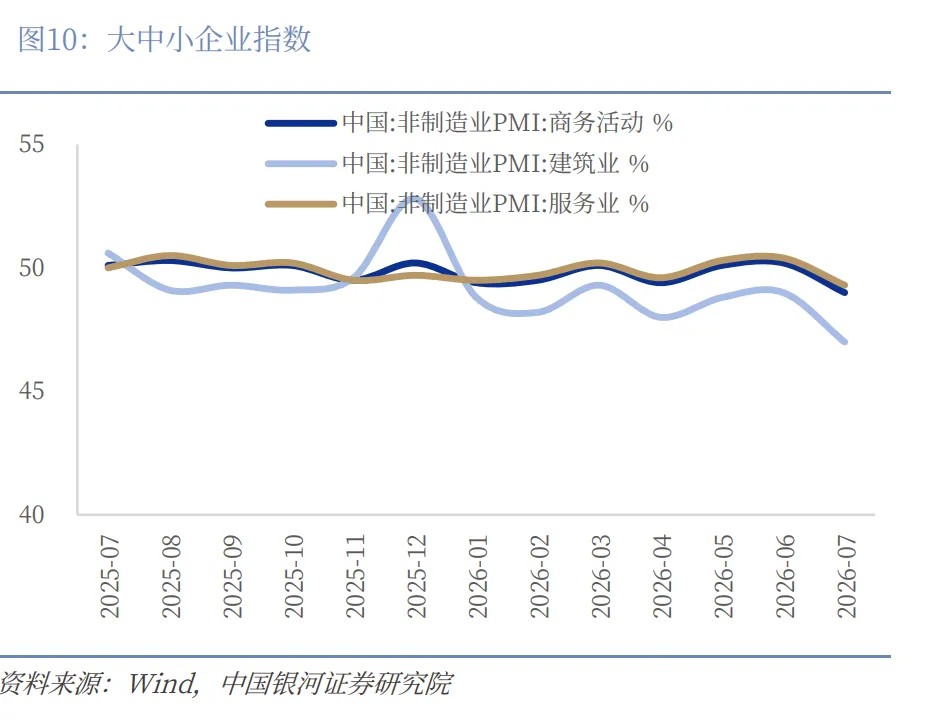
National Bureau of Statistics released data on July 31: In July 2026, the Manufacturing PMI was 49.2%, down 1.1 percentage points from the previous month, falling back into contraction territory. The Non-Manufacturing Business Activity Index was 49.0%, down 1.2 percentage points, with the Construction Index at 47.0% and the Services Index at 49.3%.
Core Viewpoint: The July PMI reflects a relatively significant phased decline in economic sentiment, with manufacturing, non-manufacturing, and composite PMIs all dropping below the 50% threshold, indicating substantial weakening. Within the manufacturing sector, the combination of factors includes declining production, a larger drop in demand, resilient external demand, rising costs alongside falling selling prices, and weakened willingness among enterprises to restock. While July is traditionally a low season for production, and weather factors such as high temperatures and heavy rainfall may have amplified short-term fluctuations, the significant declines in new orders, imports, purchase volumes, and non-manufacturing new orders suggest that insufficient effective demand remains the primary driver of this month's downturn.
Outlook: Weather disturbances are expected to marginally ease in August, offering potential for a repair in the Manufacturing PMI, but the extent of the rebound depends on whether demand can stabilize. On the policy front, the July Politburo meeting explicitly called for strengthening counter-cyclical adjustments, timely planning of practical and effective incremental policies, accelerating fiscal expenditure and the use of bond funds, advancing the construction of "Two Major" projects, "Two New" initiatives, and "Six Networks," and continuing to expand domestic demand. The relatively slow pace of fiscal expenditure in the first half of the year corresponded with the decline in Q2 economic growth from 5.0% to 4.3%, which was also one of the reasons for the sharp drop in this month's PMI. There is still room for acceleration in the progress of general budget expenditures and special bond issuances in the second half of the year. If the established policy measures, including ultra-long special sovereign bonds and the 800 billion yuan new policy-based financial instruments, can be fully implemented faster in the second half, converting policy tools into physical workloads, then this year's GDP target can still be successfully achieved. Regarding monetary policy, the meeting placed greater emphasis on counter-cyclical adjustments and explicitly discussed the use and adjustment of monetary policy tools, raising expectations for comprehensive interest rate and reserve requirement ratio (RRR) cuts.
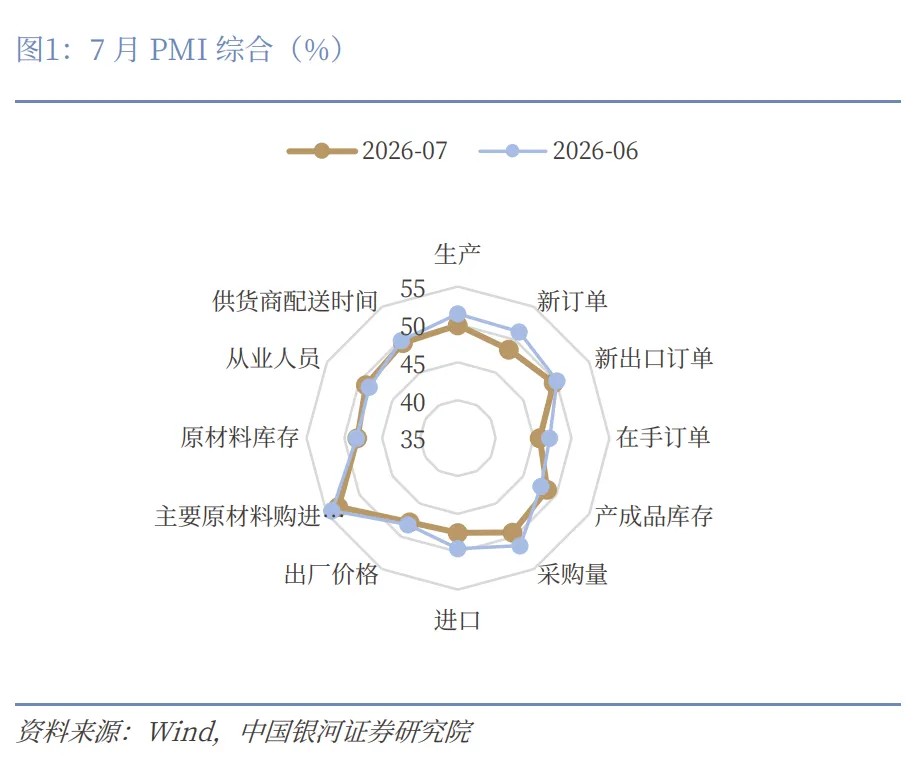
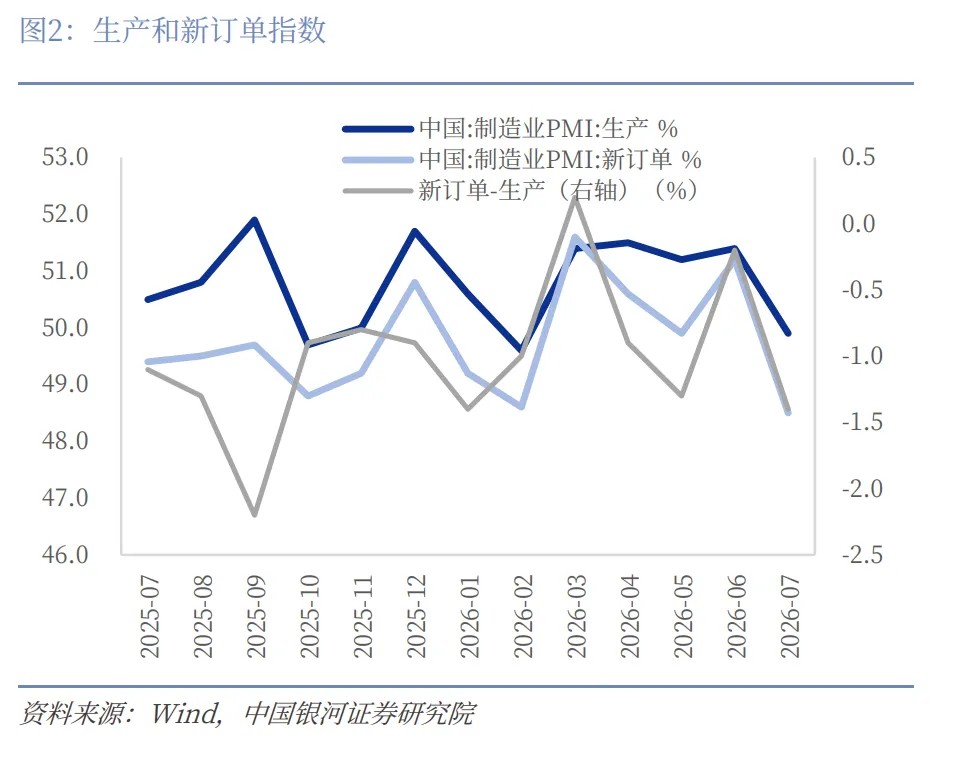
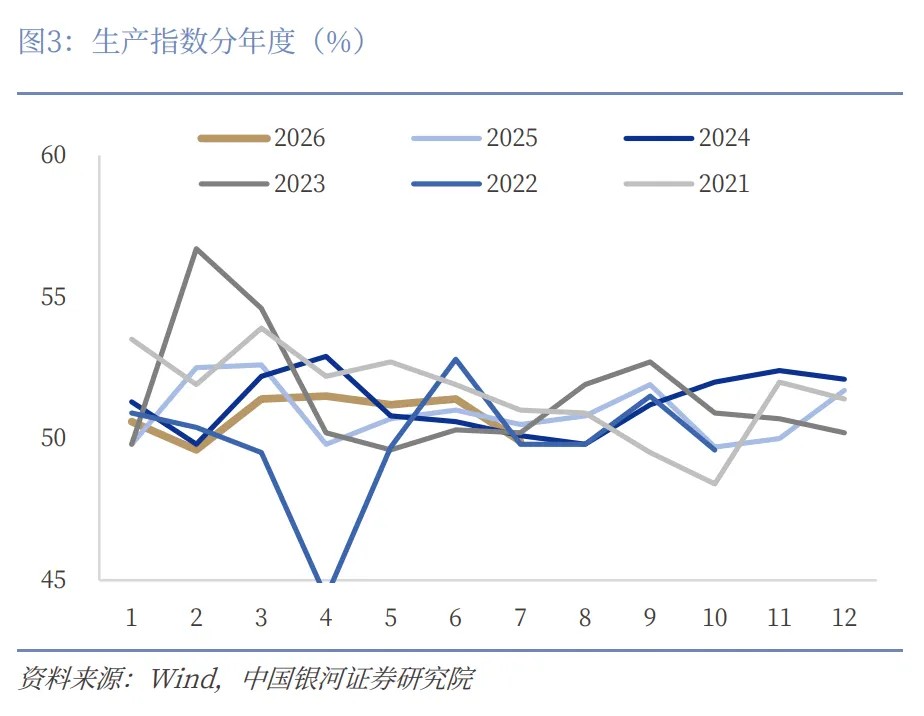
I. Supply and demand declined in tandem, with demand weaker than production. The Production Index in July was 49.9%, down 1.5 pct from the previous month, falling into contraction territory for the first time since February this year; the New Orders Index was 48.5%, down 2.7 pct from the previous month, with a significantly larger decline than production. The supply-demand gap widened to 1.4 pct this month, a notable increase from 0.2 percentage points in June. While there is still some inertia in corporate production, the demand side is declining faster, putting pressure on the production side to converge further with orders in the future. Notably, the Backlog of Orders Index dropped to 45.8%, down 1.3 pct, indicating that the reserve of undelivered orders held by enterprises is also decreasing. Although adverse weather conditions such as high temperatures, rainfall, and typhoons affected the country in July, the simultaneous weakening of production, new orders, and backlog of orders suggests that the decline in July production was not entirely due to weather and seasonal shutdowns; insufficient demand has begun to affect corporate production scheduling.
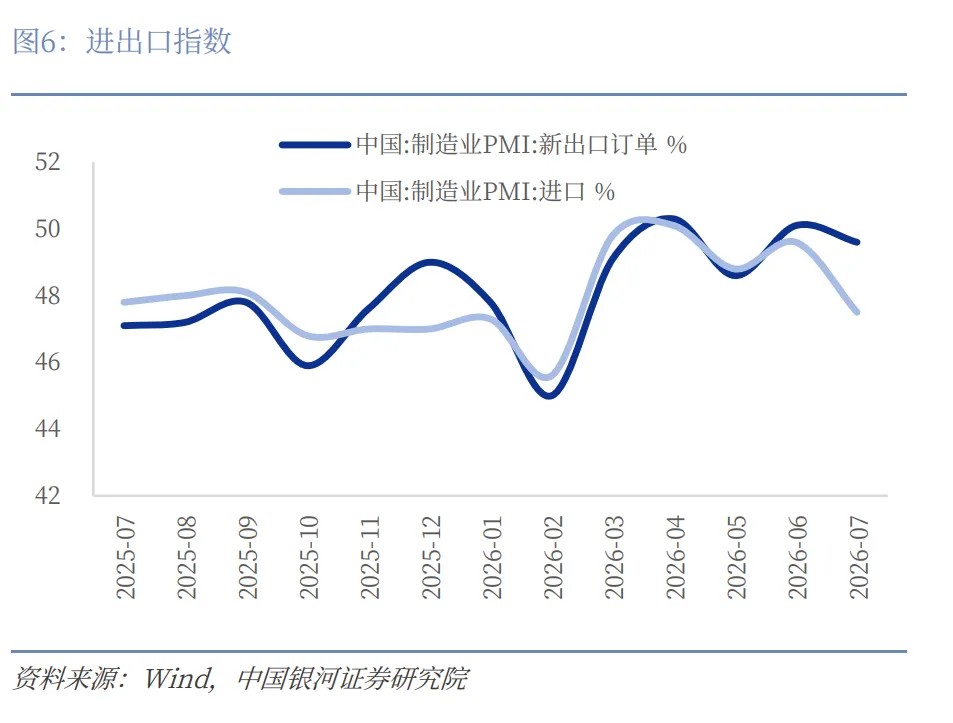
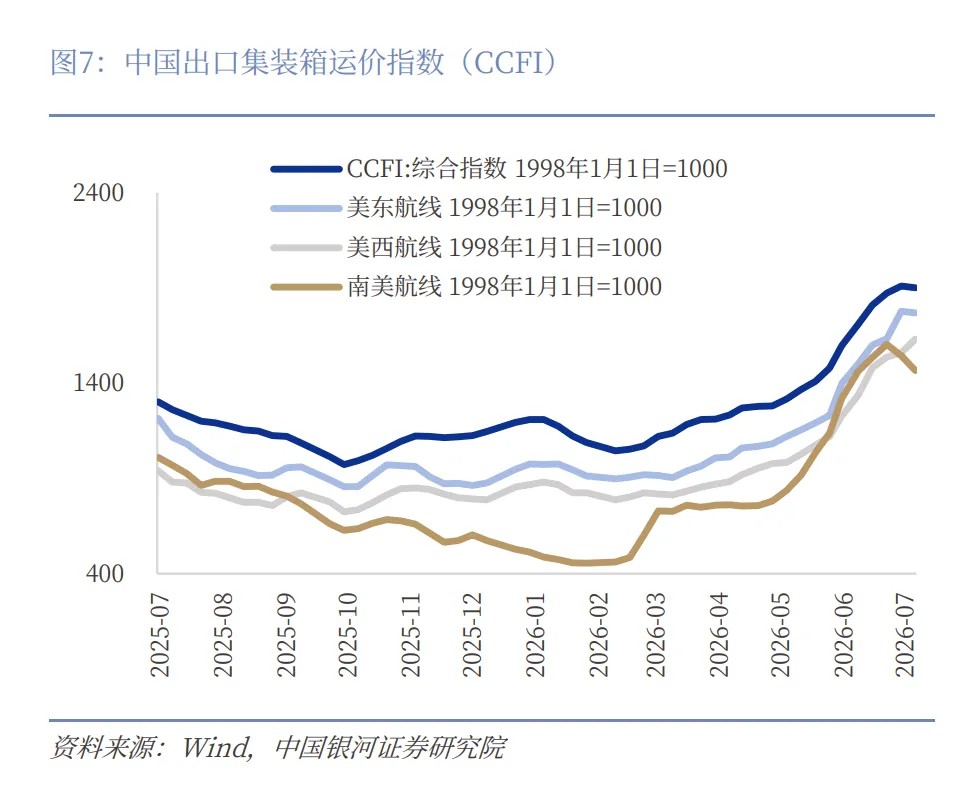
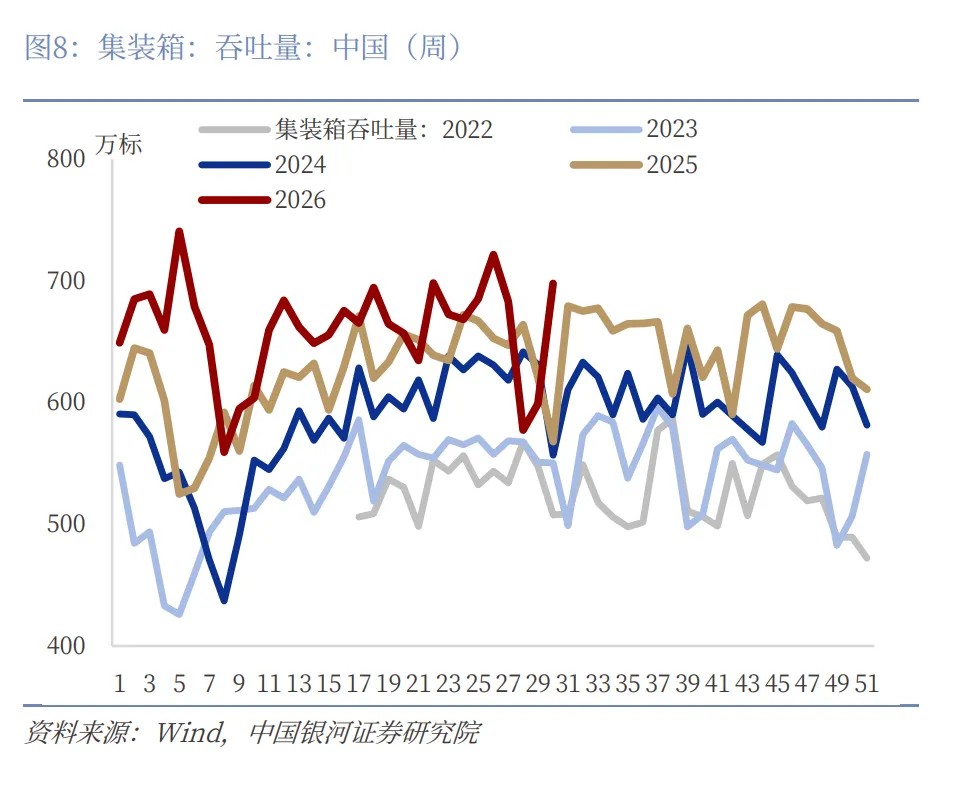
External demand is more resilient than domestic demand, but has exited expansion territory. The New Export Orders Index in July was 49.6%, down 0.5 percentage points from the previous month. Although it returned to contraction territory, the decline was significantly smaller than that of overall new orders. In contrast, the Imports Index dropped to 47.5%, down 2.1 percentage points, reflecting a significant weakening in import demand related to domestic consumption. High-frequency data shows that port container throughput in July decreased by 6.9% month-on-month and by 1.1% year-on-year.
By industry, among the 15 key industries, 6 industries' PMIs remained in expansion territory. Industries maintaining expansion included Textiles and Apparel, Petroleum Processing, Electronic Information, Non-ferrous Metals, Special Equipment, and Electrical Machinery, corresponding to three main support lines: First, the advanced manufacturing chain including Electronic Information, Electrical Machinery, and Special Equipment. Electronic Information and Electrical Machinery are still supported by AI investment, grid investment, and equipment renewal demand, but their PMIs both declined significantly from June. Specifically, production and total orders in Electronic Information remain in expansion, but export orders fell into contraction, indicating marginal weakening in overseas demand; Second, the consumer goods chain such as Textiles and Apparel. Textiles and Apparel remain the industry with the highest sentiment, with production, orders, exports, and purchases all maintaining expansion; Third, the resources and energy chain. Petroleum Processing was one of the few industries where sentiment continued to rise month-on-month in July, with production, new orders, and price indices all at relatively high levels, supported by energy prices and domestic restocking demand; however, export orders have declined, and production is significantly faster than orders, with finished goods inventory still at high levels, potentially facing inventory accumulation pressure in the future. Non-ferrous Metals are supported by export orders and price transmission, with ex-factory prices higher than purchase prices, making it one of the few industries with a relatively favorable profit environment; however, production is significantly faster than total orders, and sentiment has also declined from June, requiring observation of whether external demand can continue to absorb output.
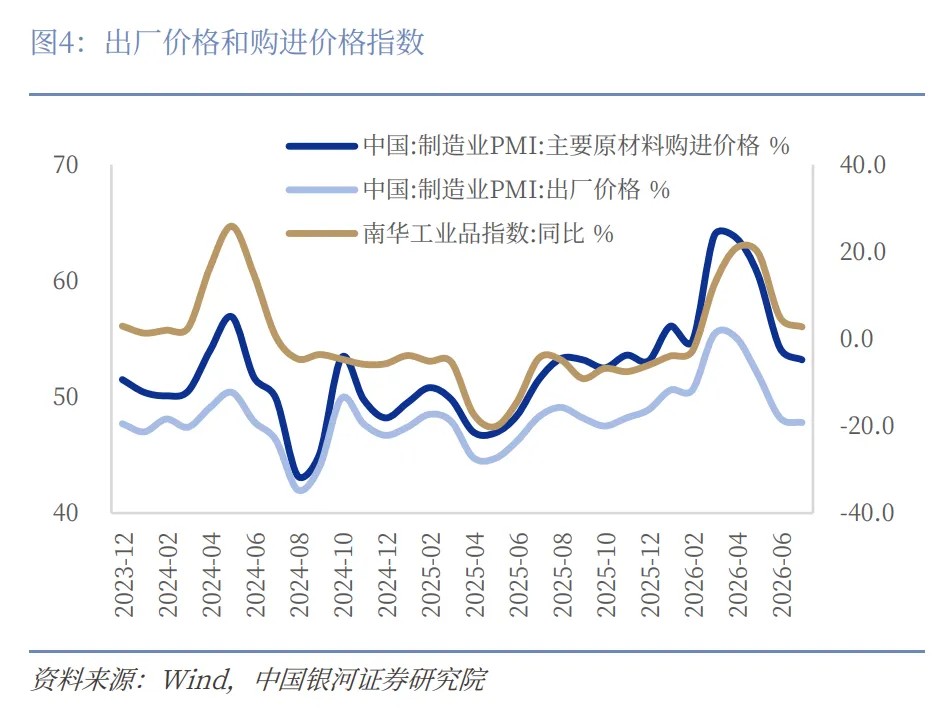
II. Costs continue to rise, while ex-factory prices continue to fall. The Main Raw Materials Purchase Price Index in July was 53.2%, down 1.0 percentage point from the previous month, remaining in expansion territory; the Ex-factory Price Index was 47.8%, down 0.4 percentage points, continuing to reside in contraction territory. The gap between purchase prices and ex-factory prices was 5.4 percentage points, indicating that insufficient demand is constraining the transmission of mid-stream costs to downstream sectors. This also means that "anti-involution" efforts and the repair of industrial product prices have not yet widely diffused into ex-factory prices. Rising prices for some resource products may improve upstream revenues, but for most mid- and downstream manufacturing enterprises, weak orders, price competition, and cost pressures will continue to squeeze profits. The July Politburo meeting continued to emphasize the comprehensive rectification of "involutionary" competition and the construction of a unified national market, which helps improve price order and corporate profitability in the medium term, but the policy effects still await the gradual realization of demand recovery and industry supply governance.
By industry, price transmission remains uneven, with profit improvements concentrated in only a few sectors. Among the 15 industries, 11 had purchase price indices above 50%, but only 4 showed significant expansion in ex-factory prices. Both purchase and ex-factory prices for Petroleum Processing rose sharply, with relatively smooth price transmission; Non-ferrous Metals saw a combination of falling purchase prices and rising ex-factory prices, creating the most favorable profit environment. Ex-factory prices for Non-metallic Minerals and General Equipment were slightly stronger than purchase prices, but both price indices were weak, largely reflecting that costs fell faster than selling prices, rather than indicating a significant strengthening of demand. Purchase prices for Electrical Machinery, Electronic Information, Chemical Fibers, Metal Products, Automobiles, and Agricultural and Sideline Foods were significantly higher than ex-factory prices, with Metal Products, Electrical Machinery, and Chemical Fibers showing large price gaps, meaning profits remain significantly squeezed.
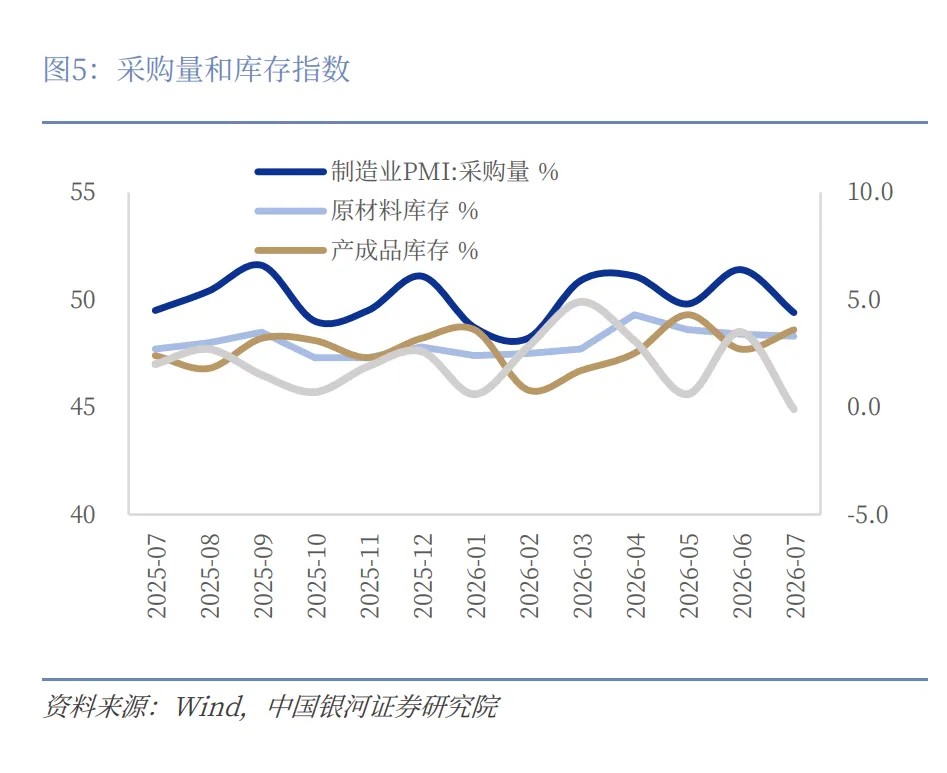
III. Purchasing weakened, and the pace of finished goods destocking slowed. The Purchase Volume Index in July dropped to 49.4%, down 2.0 percentage points from the previous month; the Raw Materials Inventory Index was 48.3%, down 0.1 percentage points, indicating that enterprises reduced purchases and continued to lower raw material inventories following the decline in orders. The Finished Goods Inventory Index rose to 48.6%, up 0.9 percentage points from the previous month. Although still below 50, implying that the total volume of finished goods inventory is still decreasing, the destocking speed has significantly slowed, reflecting the impact of weakening demand. Combined with the supply-demand gap where "production is stronger than orders," the inventory side in July is closer to an interruption of active restocking and a marginal rise in passive inventory pressure. If new orders do not stabilize in time, enterprises may further reduce purchasing and production to avoid continued accumulation of finished goods inventory.
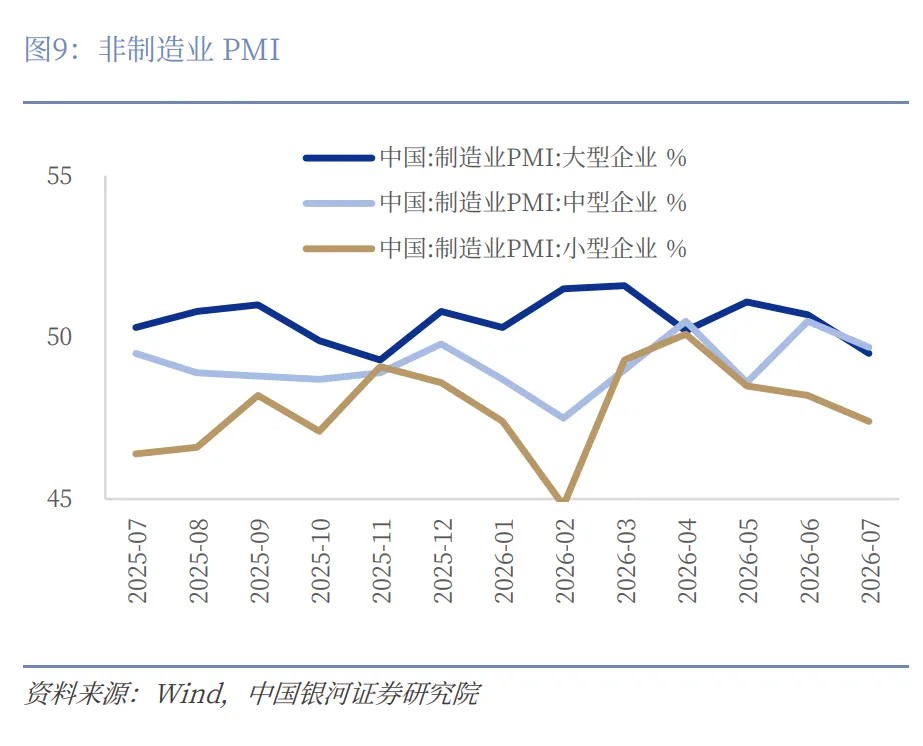
IV. Enterprises of all sizes contracted, and the non-manufacturing sector weakened in tandem. In July, the PMIs for large, medium, and small enterprises were 49.5%, 49.7%, and 47.4% respectively, down 1.2, 0.8, and 0.8 percentage points from the previous month, all residing in contraction territory. Large enterprises declined significantly, indicating that the downturn in sentiment has spread from SMEs to leading enterprises; small enterprises remain at the lowest level, with insufficient domestic demand and price competition pressures being more prominent. The Manufacturing Employment Index bucked the trend to rise to 49.0%, up 0.5 percentage points, one of the few indicators showing marginal improvement this month, but it has not yet entered expansion territory. The non-manufacturing sector was also weak. The Construction Index dropped to 47.0%, and the New Orders Index dropped to 40.1%; the Services Index dropped to 49.3%, and the New Orders Index dropped to 45.2%. The downturn in construction may have been influenced by high temperatures, rainfall, and the low season for construction, but hitting the lowest level since March 2020 still indicates that demand-side factors such as sluggish real estate investment and slow formation of physical workload in infrastructure remain the main drags.
Source of this article: CGS Macro
Risk Warning and Disclaimer
The market carries risks, and investment should be approached with caution. This article does not constitute personal investment advice, nor does it take into account the specific investment objectives, financial status, or needs of individual users. Users should consider whether any opinions, views, or conclusions in this article align with their specific circumstances. Investment decisions made based on this content are the sole responsibility of the investor.
