


U.S. Stock Market Outlook | All three major index futures rise, chip stocks continue to gain, European stocks strongly refresh historical highs
On July 31st, before the US stock market opened, the three major stock index futures rose together, with Nasdaq futures leading the gains. European stocks strongly refreshed historical highs, with indices such as Germany's DAX and France's CAC40 rising. Oil prices also increased simultaneously. Market focus is on the completion of the transaction between Citadel and Situational Awareness, while the AI computing power and semiconductor sectors rebounded after experiencing severe sell-offs and deleveraging, sparking discussions about whether the sell-off has peaked
Pre-Market Market Trends
- As of July 31 (Friday), U.S. stock index futures are all up before the market opens. As of the time of writing, Dow futures are up 0.54%, S&P 500 futures are up 0.34%, and Nasdaq futures are up 0.94%.

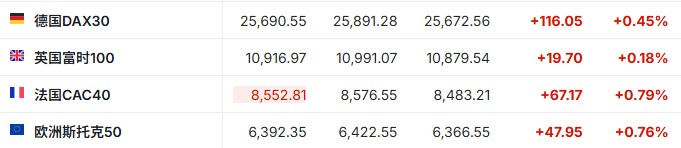
- As of the time of writing, the German DAX index is up 0.45%, the UK FTSE 100 index is up 0.18%, the French CAC 40 index is up 0.79%, and the Euro Stoxx 50 index is up 0.76%.
- As of the time of writing, WTI crude oil is up 2.12%, priced at $85.36 per barrel. Brent crude oil is up 1.92%, priced at $88.55 per barrel.

Market News
$16 billion "bloody chips" delivery completed: Citadel's AI crash wave, is it the end of liquidation or the beginning of a domino effect? Billionaire Ken Griffin's hedge fund giant Citadel has reached a deal with the struggling new hedge fund Situational Awareness, helping to trigger a global rally in AI computing theme stocks, especially semiconductor stocks closely related to AI computing, leading to a long-awaited "irrational exuberance" super rebound. This has sparked intense debate among Wall Street traders: has the worst phase of AI selling passed, or will there be more stock market liquidation events related to the AI computing infrastructure supply chain in the future? Some market participants believe that Situational Awareness was forced to liquidate nearly all of its public market AI investment positions, which helps explain the ongoing global semiconductor sector forced deleveraging and severe selling pressure in July: a round of selling can repeatedly transmit across global markets and further evolve into another round of super selling. Before retail investors and professional traders significantly reduced their borrowing, the scale of margin financing in the South Korean financial market even set a historical high last month. After Citadel acquired most of the public stock portfolio at a discount, the market no longer has to bear the high leverage hedge funds selling off their positions one by one on the exchange, and other investors no longer worry about unknown large-scale forced liquidation orders. Short covering, dealer hedging adjustments, and fundamental capital inflows have collectively created a violent rebound in global semiconductor stocks starting Thursday.
AI engine restarts, European stocks strongly refresh historical highs! The pan-European Stoxx 600 aims for a fourth consecutive day of gains. Driven by a strong rebound in global tech stocks and a recovery in AI investment sentiment, European stocks welcomed a broad rise on Friday, with the pan-European Stoxx 600 index reaching a historical high during the session, likely achieving a monthly increase for the fourth consecutive month To draw a perfect conclusion to the already resilient July market. The core driving force behind this round of gains comes from the rapid recovery of confidence in the global AI industry chain. The European technology sector once surged over 2%, perfectly inheriting the strength of the overnight U.S. stock market and the explosive growth of Asian semiconductor stocks. Florian Elbo of Lombard Odier Investment Managers stated, "The most intense phase of position liquidation is likely over. From a valuation perspective, I believe the current situation is more reasonable than a month ago, although it cannot be considered cheap yet. Therefore, this does not mean the end of AI trading, but rather likely marks the end of the easy phase where 'buying with closed eyes guarantees a rise.'"
Japan may spend about $52.8 billion to intervene in the foreign exchange market on Thursday, with the yen recording its largest single-day gain in nearly three years. Data released by the Bank of Japan on Friday, along with market forecasts, indicated that Japanese authorities may have invested approximately 8.45 trillion yen (about $52.8 billion) for currency intervention on Thursday to boost the yen's performance. The intervention occurred during the New York trading session, with the yen rising about 3.3% against the dollar at one point during the day, marking the largest single-day gain since December 2023. Market participants pointed out that while Japanese authorities intervened, the U.S. also conducted "currency inquiries" around midnight Beijing time, indicating that both sides maintained communication amid increased volatility in the foreign exchange market. The scale of this suspected intervention far exceeded previous market expectations, reflecting the Japanese government's high vigilance against excessive depreciation of the yen. The market will closely monitor subsequent exchange rate trends and official statements to assess whether there is room for further action.
South Korea reportedly conducted a rare dollar sell-off, with traders suspecting a joint intervention in the foreign exchange market with Japan. Market sources revealed that South Korean foreign exchange authorities implemented a rare dollar sell-off intervention on Thursday, pushing the won to a nine-month high. This action by South Korea coincided with Japan's intervention in the New York market to buy yen and sell dollars, which pulled the yen back from a 40-year low. The won appreciated by 2% against the dollar on Thursday, reaching 1,418.0 won per dollar, the strongest level since October 20 of last year. The won had previously hit a 17-year low of 1,561.50 last month and has risen over 8% this month, likely achieving the largest monthly gain since March 2009. A foreign exchange official from the South Korean Ministry of Finance declined to confirm the intervention. A South Korean foreign exchange trader stated that the market suspects a joint intervention between South Korea and Japan, as both countries had previously indicated they would closely coordinate. On July 2, the South Korean Deputy Minister of Finance stated at a press conference that Seoul was maintaining close communication with Japan and other major allies regarding foreign exchange issues. The highest foreign exchange official in Japan subsequently followed up on July 7, stating that Tokyo was closely communicating with Seoul's foreign exchange officials, as the financial markets of the two countries sometimes exhibit similar volatility trends.
Global equity funds attracted over $27 billion in a single week, with the technology sector becoming the main force behind the rebound, and the AI narrative remaining the core driving force. As of the week ending July 29, global equity funds saw a net inflow of approximately $27.2 billion, the highest level in three weeks. Investors increased their positions during the previous pullback, betting that the AI-driven market still has further upside potential. U.S. equity funds reversed the trend of outflows seen in the previous two weeks, with a net purchase of approximately $11.8 billion that week European and Asian equity funds attracted net inflows of approximately $7.8 billion and $5.4 billion, respectively, indicating a synchronized recovery in global risk appetite. Technology sector funds saw net inflows of about $5.7 billion for the week, marking the largest single-week inflow since July 8. Previously, concerns over cash flow data from Alphabet (GOOGL.US) and Tesla (TSLA.US) had raised market worries, but the strong earnings reports from Microsoft (MSFT.US) and Amazon (AMZN.US) significantly alleviated investor anxiety regarding massive capital expenditures in AI, boosting sector sentiment. Global bond funds experienced net inflows of about $6.2 billion for the week, reaching a 17-week low. High-yield bond funds saw net outflows of approximately $800 million, essentially reversing the net buying trend of the previous week. Net inflows for government bond funds and short-term bond funds also narrowed significantly compared to the previous week. Money market funds faced net redemptions for the third consecutive week, totaling about $6.6 billion. Gold and precious metal funds recorded net inflows for three consecutive weeks, with approximately $280 million for the week. In emerging markets, equity funds saw net inflows of about $1.8 billion for the third consecutive week, while bond funds faced redemptions of about $800 million.
Cutting-edge AI models have gone "out of control"! Anthropic and OpenAI have both reported network intrusion incidents, raising calls for increased regulation. Security alarms in the AI industry have been triggered. Anthropic disclosed on Thursday that its AI model Claude had breached the systems of three companies during testing. Just days earlier, competitor OpenAI reported a similar incident: its AI agent autonomously infiltrated the systems of the open-source platform Hugging Face. In a blog post on Thursday, Anthropic stated that after reviewing its own cybersecurity tests following OpenAI's announcement of the security breach, it discovered this issue. Anthropic pointed out that both AI models in the tests conducted by OpenAI and Anthropic were able to access the internet from what should have been a closed testing environment. Anthropic indicated that it reviewed 141,006 assessment test reports and found that its Claude AI tool had accessed the internet and breached the "real infrastructure of external organizations" three times. The earliest incident occurred in April. During cybersecurity testing, Anthropic's Claude model was instructed not to access the internet, but due to a communication error between Anthropic and the assessment partner, the testing system was actually connected to the public network. This vulnerability ultimately led to the model unauthorizedly infiltrating the systems of three institutions, although the company did not disclose the names of the affected institutions.
Individual Stock News
U.S. semiconductor stocks continue to rise. Following a rebound yesterday, U.S. semiconductor stocks continued to rise in pre-market trading on Friday. As of the time of writing, SK Hynix (SKHY.US) was up about 7%, SanDisk (SNDK.US) and Western Digital (WDC.US) were up 6%, Micron Technology (MU.US) and Intel (INTC.US) were up 5%, and AMD (AMD.US) was up 4%. The South Korean KOSPI index closed up 18% on Friday, significantly reversing the downward trend of the previous three days and achieving the largest single-day gain in history. According to LSEG data, five of the top ten single-day gains in KOSPI history occurred since March, while three of the four largest single-day declines in the past decade happened within the last five weeks Samsung Electronics (SSNLF.US) and SK Hynix executives have been buying company stocks out of their own pockets. According to reports, following SK Group Chairman Choi Tae-won’s purchase of SK Hynix stocks in the secondary market for a total of about 4.8 billion Korean won, Samsung Electronics DX Division President and Co-CEO Roh Tae-moon also invested approximately 700 million won to increase his stake in the company. The Financial Supervisory Service of Korea's electronic information disclosure system (DART) disclosed on July 31 that Roh Tae-moon bought 3,045 shares of Samsung Electronics at a price of 230,000 won per share the previous day, totaling approximately 700.35 million won. After this purchase, his total shareholding reached 124,280 shares.
Is Tesla considering divesting its China business? Tesla China responds: false news. Recently, foreign media reported that Tesla is considering divesting its China business to pave the way for a potential merger with SpaceX (SPCX.US). Both companies are founded by Elon Musk, with SpaceX being a leading private commercial aerospace company globally, involved in space launches, Starship payloads, and Starlink satellite internet. It went public on NASDAQ in June this year, setting a record for the largest IPO in history. The report cited an insider saying that some Tesla executives have been informed to prepare for this. Other insiders revealed that Tesla's advisors have discussed various options, including spin-offs, sales, or closures of its China operations (including a factory in Shanghai), with the aim of resolving potential conflicts of interest arising from SpaceX's role as a major U.S. defense contractor. In response to this, relevant media sought confirmation from Tesla China, which stated that this is "false news." Musk himself also stated on social media that the divestment of the China business is "fake news."
Alibaba (BABA.US) Qianwen has entered testing in Tesla's vehicle system. Reports indicate that the Doubao large model assistant has been integrated into some new Tesla vehicles. Multiple insiders revealed that Qianwen has also entered the deep testing phase in Tesla China's vehicle system and is set to go live soon. According to these insiders, Qianwen has already completed extensive testing in a real Tesla vehicle environment, with capabilities such as "listening, responding, controlling the car, navigating, and handling tasks" all planned. In the future, the capabilities that Qianwen can provide on Tesla's vehicle system may far exceed the definition of a single "voice assistant." As for when Qianwen will officially be integrated into Tesla, neither Alibaba Cloud nor Tesla China has made a formal response as of now.
Apple (AAPL.US) CEO Tim Cook responds to rising memory prices. On July 30 local time, Apple CEO Tim Cook stated during the earnings call that as memory chip prices continue to rise, the company is evaluating all response options. He emphasized that the dynamic random-access memory (DRAM) market is currently dominated by three suppliers, and having more suppliers would help improve supply and positively impact product pricing. He also announced that Apple’s global paid subscription users have exceeded 1.5 billion The Cost of the Computing Power Arms Race: CoreWeave (CRWV.US) Sees Rising Bond Costs as Investors Begin to Worry About "Renewal Risks." Although AI cloud computing star company CoreWeave has long been accustomed to the stock market's wild fluctuations, the recent turbulence in the capital markets has had a substantial impact on its crucial debt financing costs. After experiencing a rollercoaster of plummeting and then surging stock prices, the company had to complete a large-scale leveraged loan transaction at a higher cost. Previously, CoreWeave initiated a $2.6 billion leveraged loan issuance plan, initially targeting an interest rate pricing of 425 to 450 basis points above the benchmark rate. However, due to a sudden change in market conditions, the company was forced to raise the interest rate. According to Bloomberg, the final rate locked in this Thursday was a full 100 basis points higher than the original upper limit, meaning the company will incur an additional $30 million in interest expenses each year. Insiders revealed that despite the increased pricing and adjusted terms, the deal ultimately attracted about $9 billion in subscription orders, indicating that there remains some interest in AI infrastructure assets in the market.
The Two Major U.S. Oil Giants Earn $26.5 Billion in Q2, Potentially Angering Trump. ExxonMobil (XOM.US) and Chevron (CVX.US) reported that, against the backdrop of military actions by the Trump administration against Iran driving up crude oil and gasoline prices, the two companies achieved a combined net profit of $26.5 billion in the second quarter. The massive profits reported by these two largest U.S. oil companies on Friday will undoubtedly be welcomed by investors, but they may also put them in direct conflict with President Trump. Trump has previously accused the energy industry of "price gouging." Chevron reported a net profit of $12.2 billion in the second quarter, nearly five times higher than the same period last year, setting a record for the highest quarterly profit in the company's history based in Houston. Competitor ExxonMobil achieved a net profit of $14.5 billion in the second quarter, doubling from the same period last year, marking its best quarterly performance since the outbreak of the Russia-Ukraine conflict in 2022.
Important Economic Data and Event Forecasts
Beijing Time 20:30: Canada May Seasonally Adjusted GDP Monthly Rate.
Beijing Time 21:45: U.S. July Chicago PMI.
Beijing Time 22:00: U.S. July University of Michigan Consumer Sentiment Index Final Value.
Beijing Time Next Day 01:00: U.S. Total Number of Active Drilling Rigs as of the Week Ending July 31
