


"Intervention Rumors" Confirmed? BOJ Data Suggests Action on Thursday, Scale May Reach 8.45 Trillion Yen; Finance Minister Declines to Comment
The Japanese government may have intervened in the foreign exchange market again on July 30, with a scale of approximately 8.45 trillion yen, causing USD/JPY to plummet nearly 500 points and break below the 158 level. Although not officially confirmed, the market widely believes there are clear signs of intervention. Meanwhile, the Bank of Japan kept interest rates unchanged, with Governor Kazuo Ueda sending hawkish signals, though this did not significantly alter market expectations. Analysts point out that against the backdrop of sustained high interest rate differentials between the US and Japan, the long-term pressure on the yen is unlikely to change
The Japanese government's new round of foreign exchange market intervention actions may have been "confirmed."
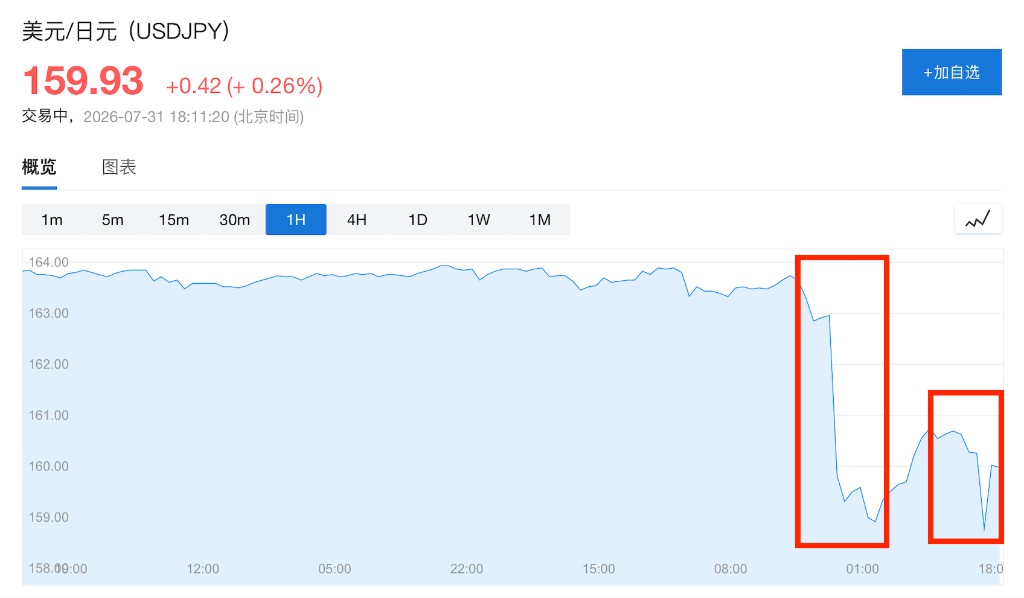
On July 31, according to Bloomberg's analysis of Bank of Japan account data, the Japanese government likely entered the market on July 30 to buy yen and sell US dollars, with an intervention scale of approximately 8.45 trillion yen (about $52.8 billion). During the early US trading session that day, USD/JPY plunged nearly 500 points in less than an hour, briefly breaking below the 158 level, with an intraday drop of 3.3%, marking the largest single-day decline since December 2023.
Although Japanese officials have not yet confirmed this action, market speculation about intervention is intensifying. Japanese Finance Minister Satsuki Katayama stated she would "not comment," while Vice Finance Minister Jun Mimura said he had "nothing to announce," but simultaneously indicated that Japan has received support from the US side that goes "beyond mere moral support," further strengthening market speculation about potential coordinated actions between the US and Japan.
On July 31, the yen surged again before falling back. At the time of writing, USD/JPY had returned to around 160. Bank of Japan Governor Kazuo Ueda sent somewhat hawkish signals that day, causing USD/JPY to briefly drop to 158.63, but it subsequently weakened and approached the 160 level again.
Plunge of 500 Points Intraday, Market Identifies "Signs of Official Intervention"
This market volatility occurred during the New York trading session on July 30.
In about 50 minutes after 9:30 AM New York time, USD/JPY rapidly fell from around 162.5 to below 158, with a maximum single-day drop of 3.3%. The sharp and concentrated price movement bears a strong resemblance to the trading patterns observed during Japan's previous foreign exchange interventions.
Data from the Bank of Japan, combined with forecasts from money brokers, suggests that the Japanese government may have deployed approximately 8.45 trillion yen to support the yen on July 30.
Citing market sources, Nikkei reported that the Bank of Japan and other government agencies executed large-scale yen-buying operations during the New York trading session that day, while the US side also conducted exchange rate inquiries. Typically, the US Treasury Department requests foreign exchange quotes from banks through the Federal Reserve Bank of New York to assess market conditions or coordinate with allies. The US Treasury Department has not yet responded to this.
US Treasury Secretary Bessent stated in an interview that day, "The yen appears to be severely undervalued, and the market will likely realize that the yen should be stronger." This statement was viewed by the market as indirect support from the US for Japan's exchange rate stance.
Geoffrey Yu, Senior Strategist at BNY Mellon, stated that such magnitude of volatility "strongly suggests that the Japanese government likely conducted foreign exchange intervention," but the ultimate effect still depends on subsequent market reactions.
Record-High Intervention in First Half Failed to Reverse Yen Weakness
This suspected action marks the potential start of another large-scale foreign exchange intervention by Japan this year, drawing significant market attention.
According to Bloomberg, citing data from the Japanese Ministry of Finance, Japan cumulatively invested approximately 11.73 trillion yen (about $73.2 billion) in foreign exchange intervention between April 28 and May 27, setting a historical record. The market generally believes that Japanese authorities primarily raised funds by selling foreign reserve assets, including US Treasury bonds.
However, the effects of previous interventions were not sustained. As the interest rate differential between the US and Japan remains high, carry trades remain active, putting renewed pressure on the yen. On July 23, USD/JPY briefly rose to 163.99, reaching a new high in nearly 39 years and 8 months. Market participants pointed out that without a significant shift in Japanese monetary policy, relying solely on foreign exchange intervention is difficult to change the long-term trend of the yen.
Ueda Sends Hawkish Signals, But Market Expectations Unchanged
The Bank of Japan maintained its policy rate at 1% at its July 31 monetary policy meeting, in line with widespread market expectations.
Governor Kazuo Ueda sent somewhat hawkish signals at the press conference, repeatedly emphasizing upside risks to inflation and stating that underlying inflation is close to the 2% target level. If financial conditions become excessively loose, the Bank of Japan may accelerate the pace of rate hikes. Ueda also pointed out that the impact of exchange rates on inflation is strengthening, and the central bank needs to pay closer attention to price pressures caused by yen fluctuations.
However, since the meeting did not send clear signals of an early rate hike, the market reaction was limited. USD/JPY rebounded after a brief decline. Currently, the market expects that the Bank of Japan may raise rates again as early as October, but this judgment still depends on future inflation, wage growth, and exchange rate trends.
Carry Trades Remain the Core Conflict, Limiting Yen Rebound Potential
Analysts believe that while Japan's intervention this time can change short-term trends, it is difficult to eliminate the core factors causing long-term pressure on the yen.
Bloomberg data shows that measured by the 2-year US-Japan overnight index swap spread, the 90-day rolling correlation coefficient between USD/JPY and the interest rate differential has risen from about 0.25 in March to 0.44, indicating that the impact of the US-Japan interest rate differential on exchange rate trends is strengthening.
As long as the US-Japan interest rate differential remains high, carry trades may continue to support USD/JPY.
Citigroup analysts stated that the rapid decline in USD/JPY this time is "consistent with trends during previous interventions," but since Kazuo Ueda's policy statements did not significantly exceed market expectations, further appreciation of the yen may face challenges.
