Korean Brokerage KIS: Samsung Electronics is 'Severely Undervalued'; Target Price Raised by 10% to 650,000 South Korean won
Samsung Electronics' operating profit in the second quarter reached 89.5 trillion South Korean won, a year-on-year surge of 1814%. Korea Investment & Securities believes that five-year long-term supply agreements are driving the memory business to transition from being 'cycle-driven' to an 'Order Driven Market,' significantly enhancing earnings stability and predictability. The firm points out that the current valuation, at approximately 1.3 times price-to-book ratio, is severely undervalued, and coupled with a clear shareholder return policy, the medium- to long-term investment value is prominent
Samsung Electronics' better-than-expected quarterly results, combined with long-term supply agreements covering the world's five largest hyperscale data center customers, have further solidified Korea Investment & Securities' (KIS) bullish stance.
In a research report released on July 31, KIS raised its target price for Samsung Electronics by 10% to 650,000 South Korean won, maintaining a "Buy" rating. The firm believes that the market continues to price Samsung based on traditional cyclical stock logic, ignoring the fact that long-term supply agreements are driving the memory business to transition from being "cycle-driven" to an "Order Driven Market." As a result, the company's earnings stability, performance predictability, and valuation 中枢 are expected to improve, with the current share price being "severely undervalued."
In the second quarter, Samsung Electronics' operating profit reached 89.5 trillion South Korean won, a year-on-year increase of 1814%, exceeding the market consensus estimate by approximately 5.5%. KIS also raised its earnings forecasts for the company for 2026 and 2027, believing that a clear shareholder return policy further enhances its medium- to long-term investment value.
Q2 Performance Broadly Beats Expectations, Semiconductor Business Contributes Almost All Profit
Samsung Electronics achieved revenue of 171.5 trillion South Korean won in the second quarter, up 28% quarter-on-quarter and 130% year-on-year; operating profit was 89.5 trillion South Korean won, up 56% quarter-on-quarter and surging 1814% year-on-year, about 5.5% higher than the market consensus of 84.8 trillion South Korean won.
Profits came almost entirely from the semiconductor business. According to Korea Investment & Securities data, the semiconductor division's operating profit in the second quarter reached 89.2 trillion South Korean won, accounting for approximately 99.7% of the company's total operating profit; within this, the memory business generated an operating profit of 91.5 trillion South Korean won.
Price improvements became a key driver of profit growth. In the second quarter, the average selling price (ASP) of DRAM rose by more than 40% quarter-on-quarter, while the ASP of NAND increased by over 60%. Meanwhile, the foundry business turned profitable after accounting for employee-related expenses.
Five-Year Long-Term Contracts Change Industry Logic: From Cycle-Driven to Order-Driven
Korea Investment & Securities believes that the significance of these multi-year supply agreements goes far beyond locking in future revenue; more importantly, they change the long-standing supply-demand dynamics of the memory industry.
In the past, memory manufacturers mainly based capital expenditures on forecasts of market demand, leaving the industry plagued by oversupply and price cycle volatility. Under the long-term supply agreement model, capacity planning is increasingly based on customer orders, significantly improving operational stability and earnings predictability for the industry.
According to Samsung Electronics' plans, future long-term contracts are expected to cover approximately 60% to 70% of DRAM and NAND capacity, with the remaining 30% to 40% retained for spot market sales to balance long-term order stability with the earnings elasticity brought by rising market prices.
Korea Investment & Securities believes this means Samsung is gradually establishing a new memory business model centered on being an Order Driven Market.
HBM Is Not the Sole Focus; Greater Emphasis on Long-Term Customer Cooperation
Korea Investment & Securities also pointed out that Samsung is not blindly pursuing HBM capacity expansion but is maintaining a relatively balanced supply strategy between HBM and traditional DRAM.
Against the backdrop of HBM profitability being temporarily lower than that of standard DRAM, the company dynamically adjusts the production mix of the two products based on customer demand, emphasizing long-term supply stability and customer relationships rather than pursuing short-term profit maximization.
The firm believes this further confirms that Samsung's memory business is shifting from a model centered on price cycles to one focused on customer orders and long-term cooperation.
Valuation Remains Low, Shareholder Returns Provide Important Support
Despite the significant improvement in fundamentals, Korea Investment & Securities believes Samsung Electronics' current valuation remains low.
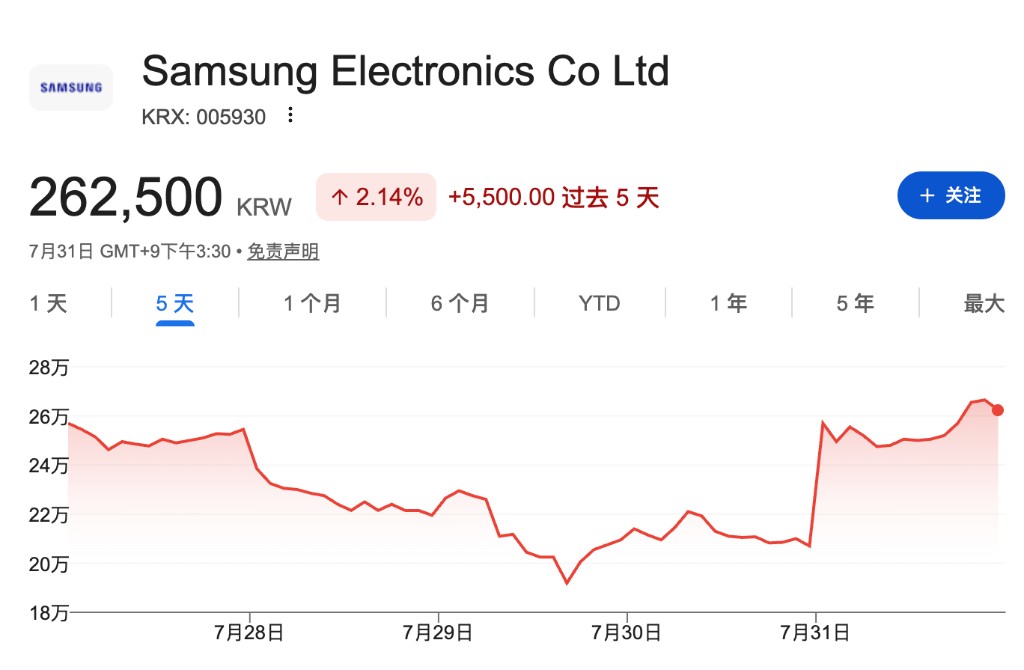
As of July 30, the company's share price was quoted at 207,000 South Korean won. Based on the book value per share (BPS) for 2027, this corresponds to a price-to-book ratio (PBR) of only about 1.3 times, placing it in a historically undervalued range.
Korea Investment & Securities set the valuation corresponding to its target price at 5 times PBR of the BPS for the next 12 months (129,892 South Korean won), resulting in a target price of 650,000 South Korean won. At the same time, the firm raised its operating profit forecasts for 2026 and 2027 by 3% and 7% respectively, to reflect the improved earnings stability brought by long-term supply agreements, as well as the potential benefits of rising HBM prices in 2027.
Shareholder returns also serve as a support factor for valuation. Samsung Electronics reaffirmed that it would base shareholder returns on 50% of its annual operating free cash flow (FCF).
Korea Investment & Securities believes there is a clear divergence between the current market valuation and the company's profitability, cash generation capability, and clear shareholder return policy. Rather than waiting for market sentiment to improve, investors should focus on the company's long-term value itself.