


Goldman Sachs: Fed's Opaque Framework May Be Counterproductive; Long-End Rates Could Force Another Rate Hike
Goldman Sachs warns that by eliminating forward guidance while obscuring its policy framework, the Fed is not rebuilding but accelerating the erosion of its credibility. If economic data does not clearly soften before September, the market may "force" the Fed to raise rates again. Meanwhile, global fiscal expansion continues to push up term premiums, with momentum strategy deleveraging occurring at a pace comparable to the shock of the pandemic
The Federal Reserve held rates steady, but market turmoil triggered by a press conference is shaking investor confidence in its policy framework.
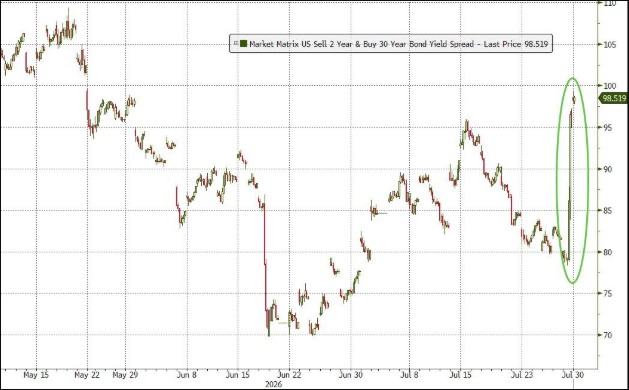
The Fed kept interest rates unchanged at its July meeting. However, what truly rattled the market was not the decision itself, but Chair Wash’s remarks during the press conference. Rich Privorotsky, head of trading at Goldman Sachs, pointed out that Wash has failed to articulate a clear reaction function regarding the trade-off between inflation and employment, sharply intensifying market doubts about the Fed’s policy logic. The yield on the 30-year U.S. Treasury note subsequently climbed to a new high, and the yield curve steepened significantly.
Goldman Sachs warns that this situation could be counterproductive: if the Fed eliminates forward guidance while simultaneously obscuring its policy framework, its credibility will not only fail to recover but may suffer further damage. More critically, the uncontrolled movement of long-end interest rates could force the Fed to act again—unless economic data clearly softens before September, the market may compel the Fed to raise rates once more to re-anchor the long end and restore credibility.
Press Conference Becomes Focus; Lack of Reaction Function Sparks Doubts
According to Goldman Sachs’ Rich Privorotsky, since taking charge of the Fed, Wash’s core objective has been to rebuild the credibility lost after years of failing to meet the 2% inflation target by eliminating forward guidance. However, removing guidance does not mean avoiding transparency in the policy framework.
During the press conference, when pressed on how to balance inflation and employment, Wash failed to provide a clear policy reaction function. When asked about the basis for inflation judgments, he stated that the committee references a broader set of indicators but did not specify which indicators carry the most weight or how they are weighted.
Rich Privorotsky pointed out that if the Fed removes forward guidance while also obscuring its policy methodology, the impact on credibility may be contrary to its intentions—leading to deterioration rather than improvement.
Long-End Rates Unanchored, Potentially Forcing Another Rate Hike
Market confusion over the Fed’s reaction function is directly reflected in the sharp volatility of long-end interest rates. The yield on the 30-year U.S. Treasury note broke through to new highs after the meeting, and the yield curve steepened markedly, indicating growing market concern about long-term inflation and fiscal prospects.
Goldman Sachs believes this trend has significant policy implications. Unless economic data shows a clear and broad-based slowdown before September, the market may actively "demand" that the Fed raise rates again to re-anchor long-term interest rates and restore policy credibility. The combination of low front-end rates and high long-end rates is particularly unfavorable for small-cap stocks and other long-duration assets.
Global Fiscal Expansion Intensifies Pressure on Long End
Concerns about long-end interest rates do not exist in isolation but are embedded in a broader global fiscal context. Goldman Sachs notes that in Japan, Takaichi is pushing for a reduction in the consumption tax; in the UK, policy discussions have shifted from "whether to increase defense spending" to "how to pay for it." Overall fiscal deficits in developed markets continue to expand, showing no signs of normalization.
Since the pandemic, the fiscal positions of major economies have moved in only one direction and have never normalized. This structural feature implies that term premiums will remain elevated, inflation will be stickier, and nominal interest rates will stay at structurally high levels for longer.
Risk Assets Under Pressure; Market Deleveraging Continues
At the market level, Goldman Sachs describes a concerning picture. Stocks were sold off, the U.S. dollar weakened, and risk assets faced overall pressure, driven primarily by doubts about the Fed’s reaction function.
Meanwhile, the market is undergoing a severe deleveraging process. Goldman Sachs points out that the current drawdown in momentum strategies has exceeded 2.5 standard deviations from the 20-day average, with the speed of deleveraging almost tracing back to the pandemic era for a comparable case. However, the nature of the two events differs: during the pandemic, selling was passive due to market dysfunction, whereas this appears to be an active clearing following excessive position concentration and high leverage accumulation.
Historical data shows that starting from similar oversold levels, forward-looking returns over the next 15 years are typically flat to positive. However, Goldman Sachs believes that the key to achieving a recovery with a better Sharpe ratio lies in the convergence of realized volatility relative to the S&P 500 Index—until then, the performance of momentum strategies will be more volatile and range-bound, rather than experiencing an explosive rebound.
On the fundamental side, Goldman Sachs believes corporate earnings still support related trades, but the market’s pricing logic is shifting—investors are increasingly unwilling to simply pay for AI capital expenditures and are more inclined to reward companies that can demonstrate AI monetization results. Goldman Sachs believes this distinction will become increasingly critical in the upcoming earnings season.
