


Bank of Japan Governor: Will Continue Rate Hikes Depending on Conditions, Pace May Accelerate; Exchange Rate Impact on Inflation Greater Than Before
Kazuo Ueda stated that upside risks to inflation are increasing, with underlying inflation approaching the 2% target, and that rate hikes could accelerate if financial conditions become excessively loose. He emphasized the significant impact of exchange rates on inflation, noting the need for close monitoring, and said the likelihood of reintroducing yield curve control in the short term is low
On July 31, Bank of Japan (BOJ) Governor Kazuo Ueda repeatedly emphasized upside risks to inflation at a press conference following the monetary policy meeting, pointing out that underlying inflation is close to the 2% target and that the central bank will avoid letting policy lag behind economic conditions. He clearly stated that if financial conditions become excessively loose, the central bank may accelerate the pace of rate hikes.
Ueda also noted that while the risk of returning to deflation has significantly decreased, it has not been completely eliminated. He specifically mentioned that amid the situation in the Middle East, US and European central banks are shifting back toward tightening, and the impact of exchange rates on inflation is becoming more pronounced, requiring closer monitoring. A small number of companies reported that rising borrowing costs have constrained investment, while exchange rates remain an important variable affecting prices.
He emphasized that greater vigilance against price increase risks is needed going forward, and plans to hold in-depth discussions on this starting from the next meeting. Meanwhile, he stated he would avoid commenting on daily market fluctuations. Ueda pointed out that appropriate monetary policy is crucial for maintaining the stability of the yield curve, noting that the likelihood of reactivating yield curve control measures in the short term is low.
Additionally, he said he would continue to monitor the impact of the Kumamoto earthquake on the economy but expects it will not cause serious funding supply issues.
These remarks followed the BOJ's latest interest rate decision. The Bank of Japan kept its benchmark interest rate unchanged at 1% on Friday, in line with the expectations of all 52 economists surveyed by Bloomberg. It also slightly raised its growth forecasts for the coming years and reiterated that it would continue to promote policy normalization based on economic and price developments.
However, divisions emerged within the Policy Board, with member Hajime Takata casting the sole dissenting vote in favor of consecutive rate hikes, reflecting the view of some members that current inflation trends justify further policy tightening.
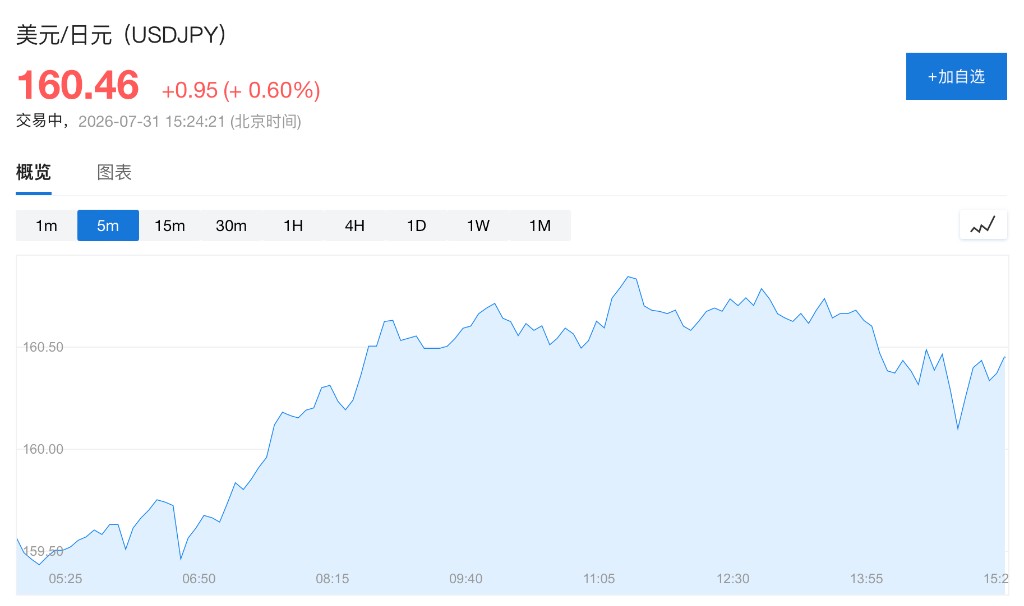
At the time of writing, the yen continued to weaken, with the USD/JPY exchange rate at 160.46. However, during early US trading on Thursday, July 30, the USD/JPY pair rapidly fell below the 160 level, plunging nearly 500 points within an hour to dip below 158.00, marking an intraday drop of up to 3.3%, the largest single-day decline since December 2023.
Hawkish Stance Further Strengthened
Ueda stated that due to the expansion of AI-related investments and the recent depreciation of the yen pushing up import costs, the inflation rate is expected to rise significantly above 2% later in the fiscal year, with underlying inflation posing a risk of exceeding the target. He emphasized that the central bank can adjust policy in advance before the inflation trend is fully confirmed, and upside risks to inflation should not be underestimated.
He pointed out that AI-related demand is very strong, and related spending is sustainable to some extent.
Ueda also noted that adjustments to monetary policy take time to transmit to the real economy. Since last month's rate hike, market interest rates have risen, and the impact of previous tightening measures still needs to be assessed. He pointed out that the impact of consumption tax reductions on prices remains to be observed; currently, only a few companies are affected by rising financing costs, and the overall financial environment remains loose.
Furthermore, Ueda stated that he did not participate in the vote because he was unable to attend the policy meeting in June. He emphasized that the Bank of Japan does not have the authority to provide advice to the government on fiscal policy.
Yen Still Dominated by Interest Rate Differentials; Rate Hike Expectations Await Fulfillment
Compared to the BOJ's statements, the US-Japan interest rate differential remains the decisive factor influencing exchange rates.
Bloomberg data shows that the 90-day rolling correlation between the USD/JPY exchange rate and the interest rate differential, measured by the 2-year US-Japan Overnight Index Swap (OIS) spread, has risen from about 0.25 in March to 0.44, indicating that the explanatory power of interest rate differentials on exchange rate movements continues to strengthen.
Although the Bank of Japan continues to signal a hawkish stance and explicitly lists exchange rates and the Middle East situation as important variables for future policy observation, since this meeting did not release clear signals of an early rate hike, the market's judgment on the policy path has not fundamentally changed.
After the announcement, the USD/JPY pair weakened only slightly. Investors generally bet that the Bank of Japan may raise rates again as early as October, but this expectation still depends on further verification from subsequent developments in inflation, exchange rates, and external risks.
Meanwhile, the market continues to closely watch whether Japanese authorities have intervened in the foreign exchange market again. According to reports citing informed market participants, Japanese authorities entered the market during New York trading hours on Thursday, pushing the yen to rise by 3.3% against the dollar in a single day. Although the Japanese government has not officially confirmed intervention, Japan's Chief Currency Officer Jun Mimura stated that the support Japan received from the United States was not limited to moral suasion, further sparking speculation about coordinated intervention.
With the Bank of Japan failing to provide policy support for the recent yen rebound through an early rate hike, the logic of carry trades has not fundamentally changed. Short-term interest rate differentials continue to attract capital flows into US dollar assets, making the yen more reliant on official intervention rather than sustained appreciation driven by narrowing interest rate differentials.
