


MiniMax Releases Open-Source Omni-Modal Model H3: Tops Global Video Editing Rankings, Pricing Slashed to One-Third of Peers
MiniMax has shaken up the AI video sector with a "price bomb"—its first open-source multi-modal model, H3, is priced at just 0.8 yuan per second, one-third the cost of industry flagships, while ranking first globally in video editing capabilities. Following the announcement, its stock price surged 14% in a single day. Beyond the parameter arms race, MiniMax is carving out a differentiated path through a dual drive of extreme cost-effectiveness and open-source strategy
At a critical juncture where the domestic AI sector is shifting from a parameter race to a contest of costs and ecosystems, MiniMax has dropped a "price bomb" on the market with a video generation model priced at just one-third that of its peers, while also issuing a direct challenge to global competitors like Sora.
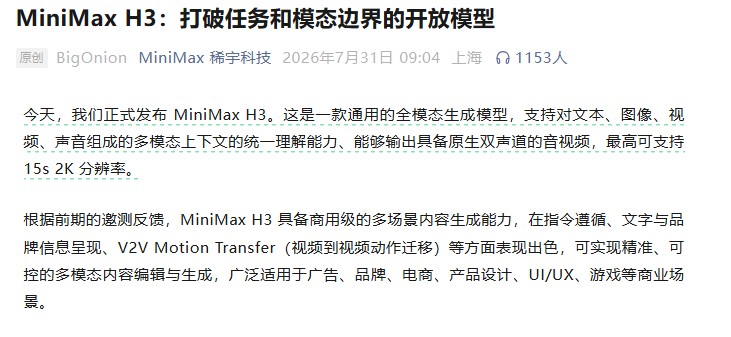
On July 31, MiniMax officially released H3, its first open-source multi-modal generation model. The model supports direct output at 2K resolution and can generate audio-visual content up to 15 seconds long, ranking first globally in the Artificial Analysis video editing capability leaderboard. Even more impactful is its pricing strategy: the video generation price has been reduced to 0.8 yuan per second, merely one-third the cost of similar flagship models in the industry. MiniMax stated:
This is a general-purpose omni-modal generation model capable of unified understanding of multi-modal contexts composed of text, images, video, and audio. It can output audio-video content with native dual-channel sound, supporting up to 15 seconds at 2K resolution.
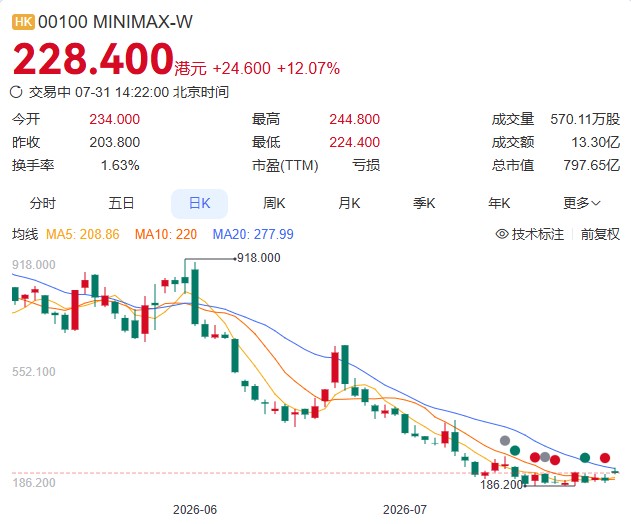
Buoyed by this news, MiniMax's stock price surged over 14% in a single day, reversing the previous downward trend caused by share lock-up expirations and product price cuts. Investors have high expectations for H3's commercial breakthrough achieved through extreme cost control.
Against the backdrop of leading industry players tightening supply, MiniMax is attempting to forge a differentiated path in the AI video generation track, distinct from the internal competition over parameters, by focusing on "extreme cost-effectiveness + open source."
Omni-Modal Unified Architecture, Ranked First Globally in Video Editing
H3 is positioned as a general-purpose omni-modal generation model. Its technical architecture achieves a unified understanding of multi-modal contexts comprising text, images, video, and audio, and can output audio-video content with native dual-channel sound, supporting video generation of up to 15 seconds at 2K resolution.
In terms of performance, MiniMax emphasizes H3's capabilities in instruction following, presentation of text and brand information, and V2V Motion Transfer (Video-to-Video Motion Transfer). V2V Motion Transfer refers to the technical ability to precisely migrate motion features from a source video to a target video, facilitating controllable multi-modal content editing. In the Artificial Analysis video model leaderboard, H3 ranks first globally in video editing capabilities.
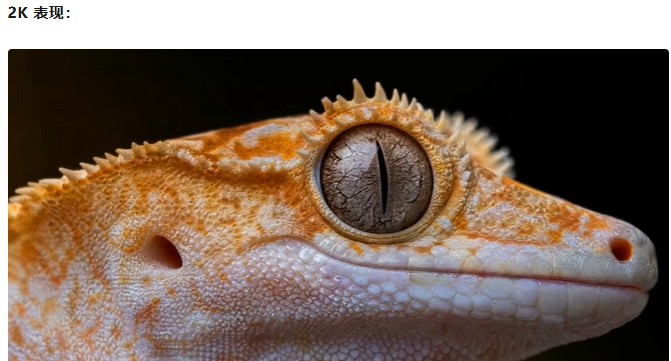

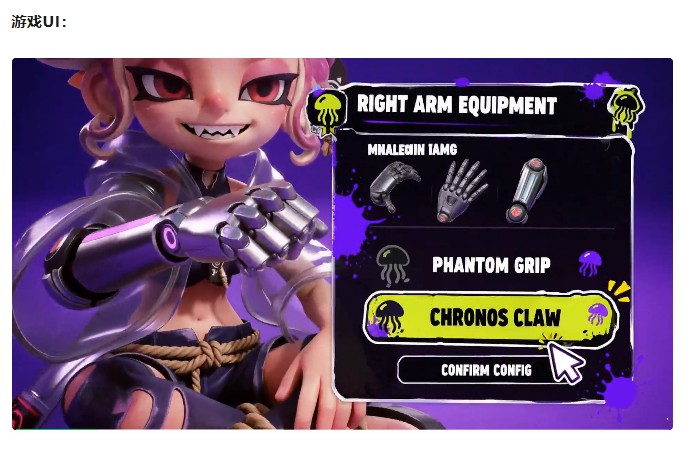

MiniMax stated that H3 possesses commercial-grade content generation capabilities across multiple scenarios, widely applicable to commercial scenes such as advertising, branding, e-commerce, product design, UI/UX, and gaming. It is positioned to lower the barrier for enterprises and developers to create high-quality video content.
Pricing Pierces Industry Floor, High-Compression Tokenizer Drives Price Down to One-Third of Industry Average
The pricing of H3 video generation at 0.8 yuan per second is another key highlight of this release. The price for generating 2K resolution video is 0.8 yuan per second, only one-third that of similar flagship models in the industry.
This cost advantage stems from system-level optimization: MiniMax reduces the number of tokens required for video generation through a high-compression Tokenizer, while simultaneously performing targeted optimizations in heterogeneous training, load balancing, and GPU utilization efficiency. This significantly lowers training and inference costs while ensuring model performance.
If this cost structure can be validated in scaled applications, it will help H3 form a differentiated competitive advantage in commercial implementation. MiniMax indicated that H3 is widely applicable to cost-sensitive commercial scenarios such as advertising, e-commerce, product design, and gaming, providing a low-cost, high-efficiency solution for enterprise-level video content creation.

H3 Video Generation Sample
Open-Source Strategy: Targeting Enterprise Local Deployment to Promote Industrial Ecosystem Openness
Open source is one of the strategic focuses of this H3 release. MiniMax stated that it plans to release the model weights in the coming days, in compliance with relevant laws and regulations. Enterprises will then be able to deploy it locally with flexibility, optimizing it with their own data and business needs to better meet security and compliance requirements.

"Chip manufacturers and developers can also participate in adaptation and optimization, reducing usage costs and expanding the scope of application," said a MiniMax representative. "We will continue to push excellent text and multi-modal models from past closed services toward a more open and collaborative industrial ecosystem."
The open-source route is becoming an increasingly important chip in the competition among domestic large language models. On July 16, Moonshot AI released Kimi K3, with 2.8 trillion parameters, becoming the largest open-source model globally by parameter count. Within 48 hours of its release, user requests approached the cluster's capacity limit, leading to the suspension of new C-end user subscriptions on July 19 to prioritize computing power for existing paying users.
Avoiding Parameter Involution: Can the Differentiated Path Be Sustained?
The violent reaction in the capital market confirms investors' recognition of H3's commercial prospects. The stock price rose over 14% in a single day, successfully reversing the previous downward trend triggered by share unlockings and product price reductions.
From a competitive landscape perspective, MiniMax has chosen a path distinctly different from the involution of parameter scale. At a time when leading industry players are forced to contract supply due to computing power bottlenecks, with user requests approaching cluster capacity limits, MiniMax is attempting to build a moat in commercial implementation through cost control and open-source strategies, rather than simply competing on model parameters.
The market will closely watch the progress of community adaptation after H3 is officially open-sourced, the pace of commercial order fulfillment, and whether this "price-for-volume" strategy can help MiniMax return to the "center stage" of the AI track.
