


AI Infrastructure Arms Race Accelerates: NVIDIA Unveils Spectrum-6, Computing Power Competition Enters the Gigawatt Era
NVIDIA has launched its new-generation Ethernet switch, Spectrum-6, with a capacity of 102.4T, designed specifically for the Vera Rubin platform and gigawatt-scale AI factories. The product has been adopted by leading enterprises such as Microsoft and Tesla, addressing communication bottlenecks in ultra-large-scale GPU clusters by enhancing network efficiency and energy efficiency
The competition in AI infrastructure is crossing a new magnitude threshold.
NVIDIA recently officially launched Spectrum-6, a new-generation Ethernet switch designed for gigawatt-scale AI factories. It doubles the network bandwidth compared to the previous generation and has already been adopted by leading AI infrastructure builders, including CoreWeave, Microsoft, Nebius, SpaceX AI, and Tesla.
Spectrum-6 is an Ethernet switch with a capacity of 102.4T, built specifically for NVIDIA's Vera Rubin platform, forming the core of the new-generation Spectrum-X Ethernet platform. As global AI factory scales expand to hundreds of thousands of concurrent GPUs, NVIDIA positions networking as a key variable affecting overall computing power output, rather than merely a connectivity layer component.
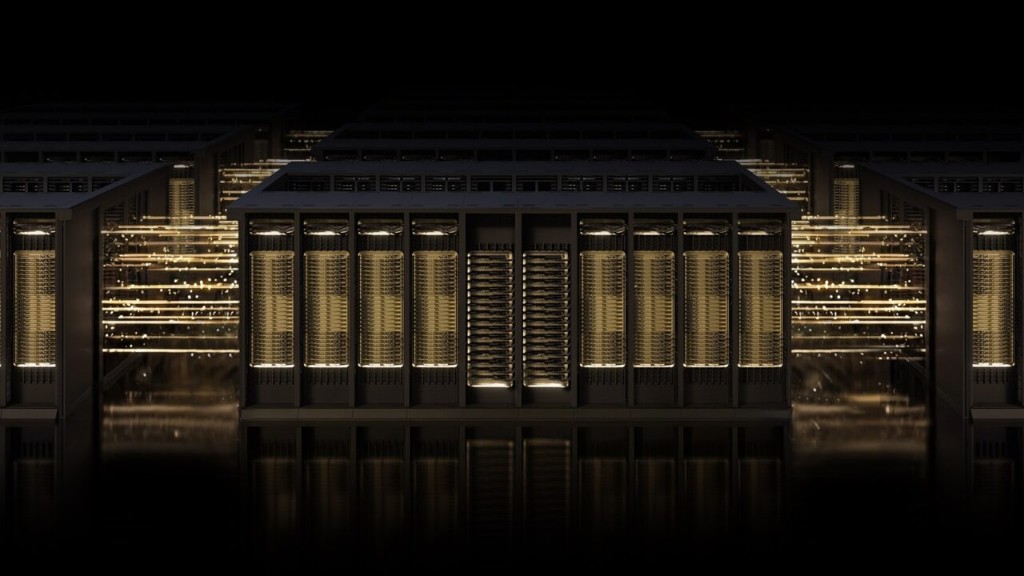
CoreWeave, Microsoft, and Nebius will be the first cloud service providers to deploy Vera Rubin infrastructure based on Spectrum-6, offering platform access to developers, startups, and enterprise users. This deployment timeline indicates that the commercial implementation of gigawatt-scale AI computing infrastructure is accelerating, having a direct impact on the landscape of computing power supply and the pace of related capital expenditures.
Networking Becomes the Core Bottleneck for AI Performance
The underlying logic behind NVIDIA's launch of Spectrum-6 stems from the structural contradiction between the communication characteristics of large-scale AI training and inference workloads and traditional network architectures.
Large-scale AI tasks require frequent data exchange among thousands of accelerators. Collective communication operations generate substantial east-west traffic, and the system typically handles traffic transmission for multiple concurrent tasks simultaneously. Traditional Ethernet was initially designed to carry north-south enterprise traffic and was not optimized for the synchronization-intensive communication patterns of AI workloads.
The Spectrum-X Ethernet platform was designed precisely to bridge this gap. According to NVIDIA, compared to generic Ethernet, Spectrum-X can deliver up to 1.6 times the AI network performance, maintaining up to 95% network efficiency at deployment scales exceeding 100,000 GPUs. The hardware-accelerated multi-plane topology of Spectrum-X can reduce the number of switches required in data centers by 40%. Coupled with a fivefold increase in energy efficiency and a tenfold increase in mean time between failures (MTBF) brought by silicon photonics technology, it further reduces operating costs.
Laurelle Roseman, Vice President of Global Partnerships at Nebius, stated:
"In gigawatt-scale systems, coordination determines overall performance: keeping every GPU synchronized at all times avoids letting one slow link drag down the entire workload. This is exactly the goal pursued by NVIDIA Spectrum-6, and the reason we are adopting it early."
Leading Players Bet Collectively on the New Platform
The adoption list for Spectrum-6 outlines the basic landscape of current global AI infrastructure construction forces. The collective follow-through by CoreWeave, Microsoft, Nebius, SpaceX AI, and Tesla means that this product has been validated at the level of large-scale commercial deployment, rather than remaining in the technical preview stage.
Min Jun, Director of Network Products at CoreWeave, said:
"Introducing NVIDIA Spectrum-6 and liquid-cooled Spectrum-X Ethernet infrastructure into our AI factories provides higher bandwidth, reliability, and efficiency, thereby helping us better serve customers with model training and deploy inference services faster."
For cloud service providers, the core value brought by Spectrum-6 lies in unifying more GPUs into a schedulable high-performance resource pool, directly impacting model training cycles and inference service response speeds. For AI companies building their own infrastructure, it means achieving higher system utilization in collective operation-intensive tasks and improving the stability of long-cycle training tasks—both ultimately pointing towards faster job completion and lower unit Token costs.
The Complete Ecosystem Puzzle of the Vera Rubin Platform
Spectrum-6 is not a standalone product but a networking layer component of NVIDIA's overall Vera Rubin computing platform. The platform integrates the Vera CPU, Rubin GPU, NVLink 6 switch, ConnectX-9 SuperNIC, BlueField-4 DPU, and Spectrum-6 Ethernet switch, forming a complete system with end-to-end co-design.
The combination of the Spectrum-6 switch chip and the ConnectX-9 SuperNIC forms the hardware foundation of the new-generation Spectrum-X Ethernet. At the software level, the platform combines intelligent switches with full-stack network software, supporting intelligent traffic load balancing and rapid bypass recovery from network failures.
In terms of form factor and thermal design, Spectrum-6 supports two specifications: pluggable and co-packaged optics, and supports liquid cooling solutions. It can be integrated into end-to-end liquid-cooled deployments in AI factories, enhancing overall energy efficiency performance.
NVIDIA defines this design approach as "vertical integration, horizontal openness": co-designing chips, systems, and software at the entire computing platform level, while remaining compatible with standard Ethernet, open network operating systems, and open protocols, supporting a broad ecosystem of cloud service providers, system manufacturers, and infrastructure partners. NVIDIA states that customers receive a complete AI factory platform, rather than disparate components that require self-integration and optimization.
