


Earnings Preview | Quarterly cash burn exceeds 40 billion! The market closely watches Microsoft's free cash flow, with Azure cloud growth as the only "lifeline"
Microsoft is about to release its financial report, with market expectations for revenue of approximately $87.6-87.7 billion, a year-on-year increase of 15%; adjusted earnings per share are expected to be around $4.21-4.24. Due to the impact of AI investments, quarterly capital expenditures are expected to exceed $40 billion, putting pressure on free cash flow. The market focus is on whether the growth rate of Azure cloud can offset the profit margin squeeze caused by high investments, validating the efficiency of AI investment returns
The Zhitong Finance APP noted that as large-scale cloud computing companies accelerate their layout in AI, large-scale capital expenditures are currently squeezing short-term free cash flow (FCF). As an industry benchmark, Microsoft's (MSFT.US) upcoming financial report on July 29 will be a key point for the market to test whether its "AI investments can efficiently convert into commercial returns."
The market generally expects Microsoft's revenue for the quarter to be around $87.6 billion to $87.7 billion, a year-on-year increase of about 15%, within the company's own guidance range of $86.7 billion to $87.8 billion; the consensus adjusted earnings per share is about $4.21 to $4.24, a year-on-year increase of about 16%.
Analysts widely expect that capital expenditures for the quarter will exceed $40 billion, driving capital expenditures for the calendar year 2026 to about $190 billion. Some analysts warn that rising costs of memory and components, coupled with the onset of data center depreciation, are exerting a phase pressure on operating profit margins. The market is eager to see that the massive investments can return in the form of sustainable profits and cash flow, rather than just remaining in infrastructure expansion.
After Alphabet released its financial report, the market's sensitivity to the capital expenditures of cloud computing giants significantly increased. Investors are keen to see normalized spending and obvious returns in the AI field. For Microsoft, whether the massive investment in the previous quarter has successfully translated into competitive advantages, business growth, and future cash flow is about to undergo a comprehensive market test.
Azure is the truly key core indicator
To assess Microsoft's quarterly performance, the core lies in Azure. As Microsoft's core cloud computing platform, it not only supports traditional data storage and application operations but has also become a hub for model training and deployment in the AI era. In the context of the market's high attention to the monetization capabilities of tech giants in AI, Azure's performance is a key variable determining the stock price direction.
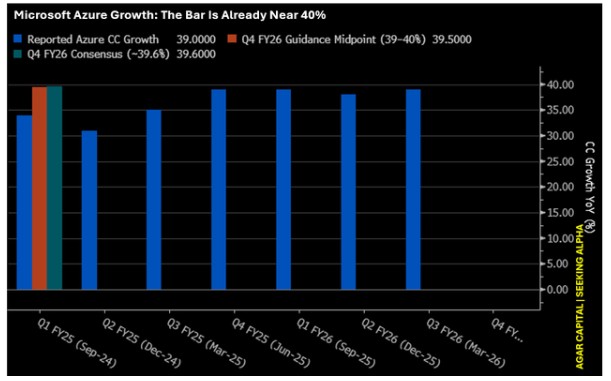
Analysts point out that the demand for cloud and AI workloads remains extremely strong. However, the issue of limited physical computing capacity is expected to persist until the end of 2026. If Azure's growth rate can maintain at 40% or above, it will strongly confirm that supply is being rapidly consumed; conversely, if the growth rate reaches the lower limit of guidance (around 39%), it may trigger market concerns about "computing power bottlenecks dragging down the speed of commercialization."
At fixed exchange rates, Azure achieved a growth rate of 39% in the last fiscal quarter. Since market expectations have been set extremely high, even achieving close to 40% strong growth may only be seen as a mediocre performance that meets expectations. Therefore, the market will focus more on the outlook for the next quarter.
Currently, the demand for AI computing power continues to exceed available capacity, and this limitation is expected to last at least until the end of 2026. This creates a clear supply-demand imbalance, but it also means that Microsoft must invest heavily in building data centers and purchasing servers in the current period, while some revenue will only be realized in the future What investors are most concerned about is whether these massive infrastructure investments can be quickly absorbed and continue to drive Azure's growth rate to break through 40%.
Pressure on Capital Expenditure and Free Cash Flow
As physical capacity constraints approach, Microsoft is prepaying large amounts of cash to expand capacity. The management previously provided a quarterly capital expenditure guidance exceeding $40 billion, with capital expenditures for the calendar year 2026 expected to reach around $190 billion. Of this, about two-thirds of the funds are allocated for the procurement of short-term computing power devices such as GPUs and CPUs, while the remaining one-third is for long-term infrastructure construction like data centers.
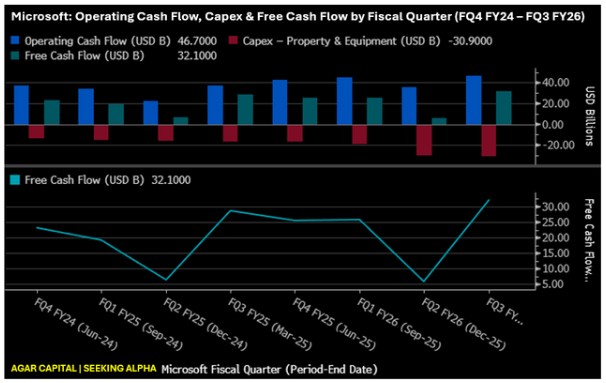
This expenditure structure has a direct impact on the company's cash flow. Unlike data centers that can be amortized over the long term, the technology of computing power chips like GPUs iterates rapidly and has a high obsolescence rate, requiring faster monetization. Although Microsoft's operating cash flow and revenue continue to grow, the significant rise in capital expenditures has put considerable pressure on free cash flow in the short term.
The temporary decline in free cash flow does not directly indicate a deterioration in the business model, but rather a timing issue. However, if subsequent revenue and profit growth cannot match the expansion of capital expenditures, the return on invested capital will face challenges. Additionally, part of the increase in capital expenditures is due to rising costs of raw materials and components, which has also raised market concerns about "unit expenditures failing to yield equivalent computing power growth."
Unfulfilled Orders and Profit and Loss Statement Resilience
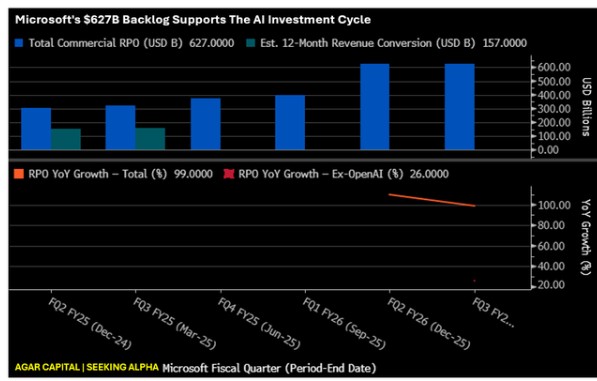
Despite the high capital expenditures raising market concerns, Microsoft still possesses multiple supporting factors. First, there is a remaining performance obligation (RPO) of up to $627 billion, of which approximately $157 billion will convert to revenue in the next 12 months. This indicates that Microsoft's massive capital expenditures are not blind expansions, but rather aimed at meeting the substantial customer demand from signed contracts.
Secondly, Microsoft's core profitability remains robust, with an operating profit margin maintained at a high level of 46.3%. The company expects that the annual revenue and operating profit growth will continue to outpace the growth of operating costs, demonstrating good operational leverage. Although the gross margin of the cloud business has slightly declined due to the increase in AI workloads, Microsoft is working to reduce computing costs and improve the efficiency of token output per dollar by developing proprietary models, optimizing algorithms, and launching self-developed hardware (such as the Maia 200 chip). As long as operating profit grows faster than operating expenses, high capital expenditures will merely be a timing issue rather than an indication of an unhealthy underlying business model.
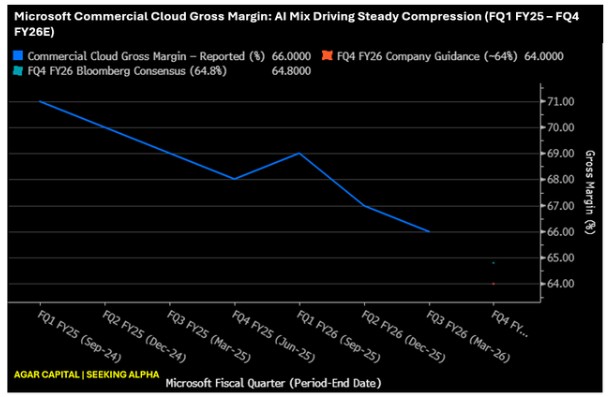 Microsoft's cloud gross margin has dropped to 66%.
In anticipation of the upcoming earnings report, the market is primarily focused on three potential scenarios. In the optimistic scenario, Azure's growth rate is expected to reach 40% to 41%, with next quarter's guidance raised to 41% to 42%. At the same time, capital expenditures show no unexpected growth, and the cloud gross margin rebounds to over 65%. The number of paid users for Copilot surpasses 27 million, and under this scenario, the stock price is expected to rise by 8% to 12%.
The baseline scenario reflects an Azure growth rate in line with expectations at 39% to 40%, with capital expenditures maintained in the range of $40 billion to $44 billion. Although performance remains solid, the lack of catalysts for revaluation will lead the market to continue observing spending efficiency, with the stock price expected to rise slightly by 3% to 6%.
In a pessimistic scenario, if Azure's growth rate falls below 38%, capital expenditures exceed $45 billion, and next quarter's guidance is below 40%, it will trigger market concerns about "imbalanced input-output ratios," leading to a significant drop in valuation.
Wall Street's stance remains "Strong Buy"
Wall Street's overall stance on Microsoft remains "Strong Buy," with about 95% of the over 60 tracked institutions giving buy or overweight ratings, while only a few hold or sell. The average target price over 12 months is concentrated in the range of $545 to $560, implying over 40% upside from the current price of around $380.
Specifically, Goldman Sachs maintains a buy rating with a target price of $610, modeling Azure's fixed exchange rate growth at 40% to 41%; Morgan Stanley has a target price of $600; Deutsche Bank $550, Truist $575, HSBC $567, Barclays $549, Citigroup $570, Wolfe $525, BMO $515, Oppenheimer $515, and Argus $510. Overall, there is a recent trend of "lowering target prices but maintaining ratings"—many institutions have adjusted their targets downward due to AI capital expenditures and memory price pressures, but have not wavered in their buy stance.
The core divergence in analysts' views centers on the capital expenditure narrative: bulls believe that the 19% to 21% stock price correction this year has overly reflected pessimistic sentiment, with Azure continuing to grow at over 40%, a $627 billion RPO backlog, and accelerated Copilot adoption providing fundamental support. They also expect an 18% revenue growth rate in fiscal year 2027 to outperform the consensus of 16.8%. The cautious camp emphasizes that Q4 capital expenditures will exceed $40 billion, potentially reaching $250 billion to $270 billion in fiscal year 2027. The pressure on free cash flow and the trend of cloud gross margin sliding from 67% to 66% is difficult to reverse in the short term, and the extremely high year-on-year base contributed by OpenAI in RPO also raises concerns about concentration
