


财报前瞻 | Meta 广告引擎轰鸣、“卖算力” 开辟变现新路,AI 资本支出再迎 “信任票时刻”
Meta 将于 7 月 29 日盘后发布 2026 年 Q2 财报。市场预期营收约 601.7 亿美元,同比增 26.6%,但每股收益微降。焦点在于 AI 巨额资本开支对利润率的侵蚀及广告业务能否持续高增。若摩根士丹利预测成真,Meta 广告收入或首超谷歌,成为行业转折点。
According to Zhitong Finance APP, after the market close on July 29, Eastern Time, Meta Platforms (META.US) will release its Q2 2026 financial report. This earnings season's most anticipated performance disclosure coincides with the heated controversy over AI spending among tech giants—just a week ago, Alphabet (GOOGL.US) saw its stock price plummet over 7% after raising its capital expenditure guidance, and the market is eagerly seeking evidence that the hundreds of billions of dollars invested in AI are translating into real revenue growth. As of last Friday, Meta's stock price was $595.19, down 9.7% year-to-date, and approximately 25% off its 52-week high of $796.25.
Core Expectations: High Revenue Growth, Slight Decline in Earnings Per Share
Wall Street consensus expectations indicate that Meta's Q2 revenue is expected to be approximately $60.17 billion, a year-on-year increase of 26.6%; adjusted earnings per share are expected to be $7.13, a year-on-year decrease of about 0.1%—the divergence between high revenue growth and slight profit decline directly reflects the erosion of profit margins due to massive capital expenditures in AI.
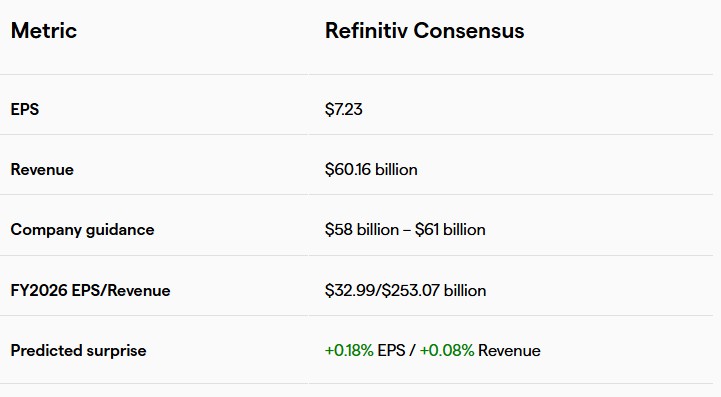
By business segment, advertising revenue is expected to reach $59.01 billion, a year-on-year increase of 26.7%; total revenue from the Family of Apps (FoA) is expected to be $59 billion, a year-on-year increase of 26.4%; Reality Labs revenue is expected to be $442 million, a year-on-year increase of 19.3%. Bank of America is even more optimistic, forecasting Q2 revenue of $60 billion and earnings per share of $7.50, both above consensus. Deutsche Bank has also raised its revenue forecast to $60.5 billion, slightly above Wall Street consensus.
Notably, Morgan Stanley previously predicted that Meta's Q2 advertising revenue is expected to surpass Google's search advertising revenue for the first time, ending the latter's long-standing dominance in the digital advertising space. If this prediction comes true, it will mark a historic turning point in the digital advertising industry.
Financial Report Focus
Advertising Business: AI-Driven "Profit Engine" Still Running at Full Speed
The advertising business is Meta's core foundation and a source of confidence supporting its massive AI spending. In Q1, the Family of Apps' advertising revenue reached $55 billion, a year-on-year increase of 33%, with ad impressions growing by 19% and average prices rising by 12%, achieving "volume and price increases."
In a report on July 26, Deutsche Bank described its channel checks on the advertising business as "overwhelmingly positive"—advertisers are seeing stronger conversion rates and better return on ad spend, thanks to Meta's investments in AI-driven ad ranking, search, and automation. Among these, the Advantage+ automated advertising product suite has become a key growth engine, with 82% of Meta advertisers currently using some form of Advantage+ automation. The annualized revenue from tools like the Value Optimization Suite has exceeded $20 billion, more than double that of a year ago Wells Fargo expects a 27% growth in advertising business in the second quarter and forecasts Q3 revenue guidance in the range of $60.5 billion to $63.5 billion (an increase of 18%-24% year-on-year).
The annualized revenue from the Advantage+ AI advertising tool has reached approximately $60 billion. AI-driven ad ranking and automation are helping Meta further penetrate the digital advertising ecosystem. However, the risk of diminishing marginal returns on AI investments cannot be ignored—the core suspense of this earnings report is whether the growth in advertising revenue can continue to cover the rising capital expenditures.
AI Capital Expenditure: The "Elephant in the Room" of $125 billion to $145 billion
The real suspense lies in AI spending. In April, Meta raised its full-year capital expenditure guidance for 2026 from $115 billion to $135 billion to $125 billion to $145 billion. The market generally expects Q2 capital expenditures to be around $33.7 billion, doubling year-on-year (from $16.5 billion in the same period last year).
Bank of America believes that Meta may further raise the upper limit of capital expenditures from $145 billion to $150 billion in this earnings report, citing rising memory costs. Wells Fargo has raised its 2027 capital expenditure forecast from $170 billion to $181 billion. JP Morgan even expects capital expenditures in 2027 to reach $202 billion, which could lead to a negative free cash flow of $4 billion in 2026.
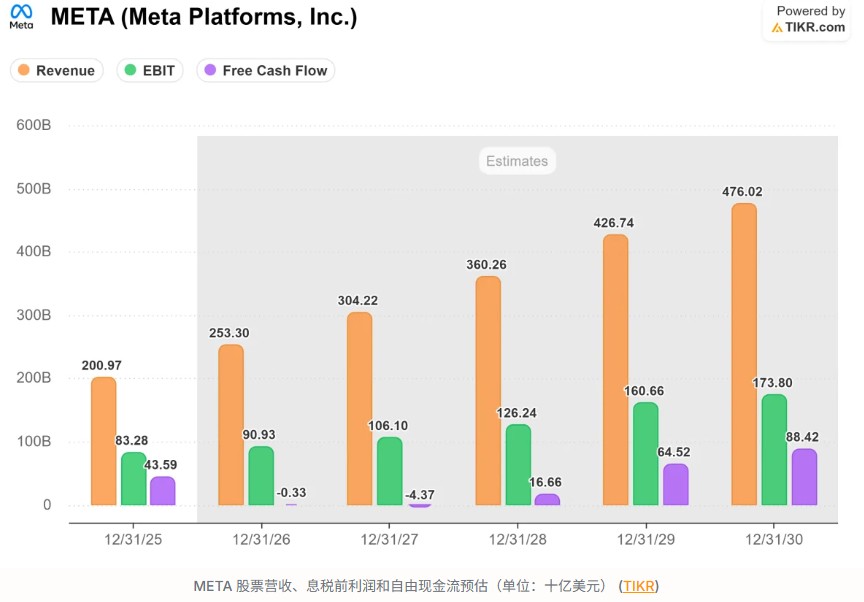
The pressure on free cash flow is the core anxiety for investors. This means that Meta is transitioning from a "light asset" social platform to a "heavy asset" AI infrastructure operator. The market is concerned about free cash flow—FactSet estimates that Q2 free cash flow may record a negative value of over $1 billion. Institutional forecasts indicate that Meta's full-year free cash flow for 2026 may shrink by 95.7%, leaving only about $1.85 billion, compared to $43.59 billion in 2025.
Wedbush analysts point out that the spending trajectory will determine whether Meta's free cash flow turns negative in 2026 or 2027. CFO Susan Li stated in the Q1 earnings call, "If the returns are not as expected, Meta retains the flexibility to slow down deployment or cut spending in the coming years."
Meta Compute: The New Narrative of "Monetizing" AI Computing Power
Another major highlight of this earnings report is more details about the AI cloud infrastructure business codenamed "Meta Compute." According to a report on July 1, Meta is planning to sell AI computing power and model access to external customers, potentially including two models: one is hosting full access to a series of AI model calls (competing with AWS Bedrock), and the other is renting out underlying GPU computing power (competing with CoreWeave and other "new cloud" service providers) This new business is seen as a key step for Meta to transform AI infrastructure from a "pure cost burden" into a revenue-generating asset. Analysts expect Meta to monetize excess computing power at a price of $10 billion to $15 billion per gigawatt annually. Bank of America noted in a report on July 20 that investors will focus on AI-related initiatives during the earnings call, including advertising improvements from AI model integration, opportunities from Muse Spark, and the potential for external computing power sales.
Bank of America analysts pointed out that this move could turn idle computing power from a "pure cost burden" into a revenue-generating asset. Reports indicate that Meta has signed a $21 billion agreement with CoreWeave and has a potential $27 billion AI infrastructure contract with Nebius.
Investors will pay attention to the official confirmation, timeline, and commercialization path of this business during the earnings call. If Meta Compute is realized, it could not only improve cash flow but also potentially reshape the market's valuation logic for Meta—from an "advertising company" to an "AI infrastructure provider."
Valuation and Market Sentiment: The Game at an 18x Price-to-Earnings Ratio
The current stock price is approximately $595, down about 25% from the 52-week high of $796. The forward price-to-earnings ratio is about 18 times, lower than Alphabet's 25 times. The Wall Street consensus target price is around $826, implying about 39% upside potential. There are 57 buy ratings, 6 hold ratings, and zero sell ratings. The predicted market shows an 87.1% probability that Meta will exceed expectations for the seventh consecutive quarter.
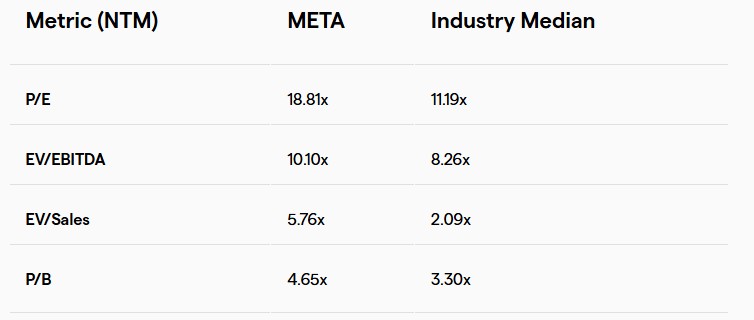
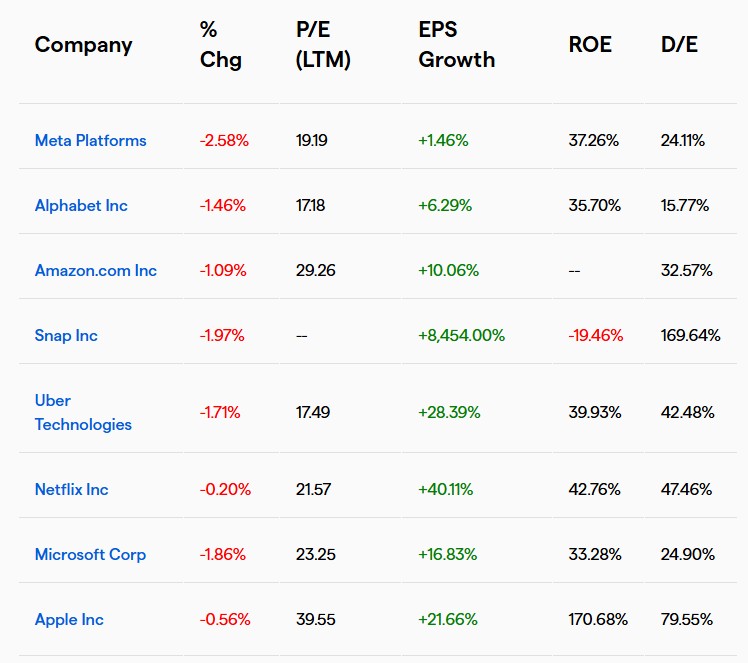
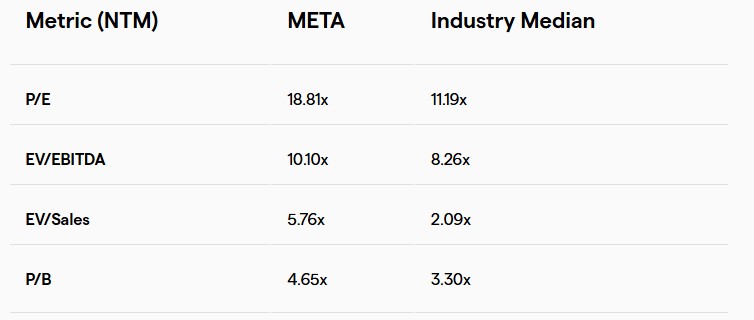
Currently, Meta's interest coverage ratio (TIE) has decreased by 26.74% year-on-year to 71.5 times. Although the decline is not significant, it remains healthy. However, Meta is increasing its debt levels to finance its expansion. At present, this is not a warning sign but is worth monitoring. From various perspectives, Meta demonstrates a premium far exceeding the industry average—its expected price-to-earnings ratio is about 1.7 times the industry median, and its enterprise value/sales ratio is about 2.75 times. The market positions Meta as a growth stock in AI infrastructure rather than an advertising platform. Therefore, capital expenditure guidance is more important than earnings per share exceeding expectations. Meta's debt-to-equity ratio (D/E, 24.11%) is significantly higher than Alphabet's 15.77%, which is worth noting given its capital expenditure path.
 Bank of America gives a "Buy" rating with a target price of $835: Advertising business growth is steady, and layoffs in May boosted profit margins. Revenue for the third quarter is expected to be between $60.5 billion and $63.5 billion, a year-on-year increase of 18% to 24%. In terms of artificial intelligence: content retrieval, integration of advertising models, Muse Spark, and potential Anthropologie computing transactions.
Citigroup expects performance to exceed expectations, with capital expenditure becoming the focus: Capital expenditure is expected to be around $205 billion by 2027 (an increase of 22%), related to the construction of 14 gigawatts of installed capacity. The capital expenditure of the three major hyperscale data center operators will reach $801 billion by 2027, enough to result in negative free cash flow for all three operators before 2028.
In summary, there may be no issues with Meta's advertising business. The real crux lies in how much Meta needs to invest to remain competitive in the field of artificial intelligence and how the market tolerates negative free cash flow. For investors focused on Meta stock, the question before the earnings report is whether this spending is translating into the kind of returns for advertisers described by Deutsche Bank, and Wednesday's report should provide a clearer answer.
Technical Aspect: Key Price Levels After Earnings Report
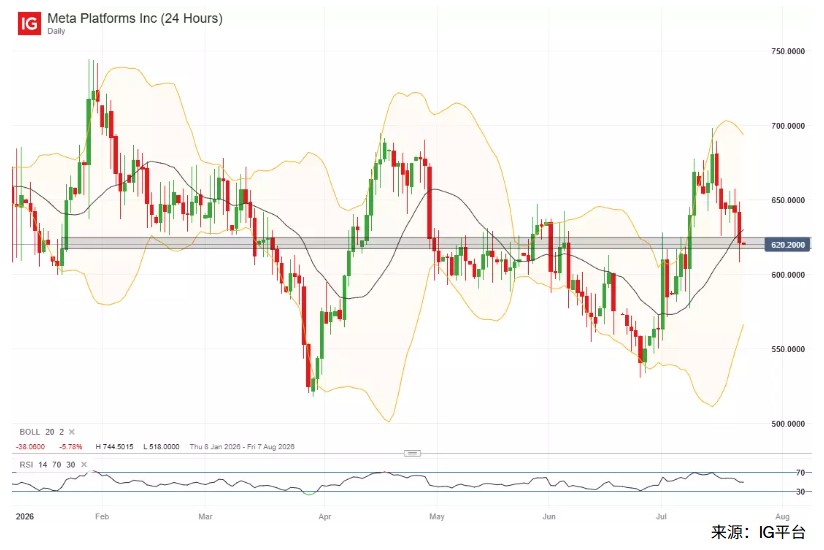
The options market is pricing in about an 8% volatility in Meta's stock price after the earnings report. The options gamma position shows that $750 is a resistance level, while $550 is a support level. Technically, Meta has recently tested the key area of $650 near the middle band of the Bollinger Bands. If it falls below $600 after the earnings report, the next target is in the range of $575 to $550; if performance exceeds expectations, the first resistance level is around $675. The stock price has repeatedly found support in the range of $525 to $540, but the RSI momentum indicator is forming a series of lower highs.
AI Capital Expenditure Logic Undergoing Another Test
Last week, Alphabet's performance easily exceeded expectations, but the parent company of Google and YouTube saw its stock price drop after raising its expected spending on artificial intelligence infrastructure. Tech companies are selling stocks and taking on debt to finance the construction and operation of AI data centers, raising concerns among investors about whether these investments will yield returns After Alphabet raised its spending expectations for the year by $15 billion, Microsoft, Meta Platforms, and Amazon are facing new investor concerns due to their debt-driven capital expenditure plans.
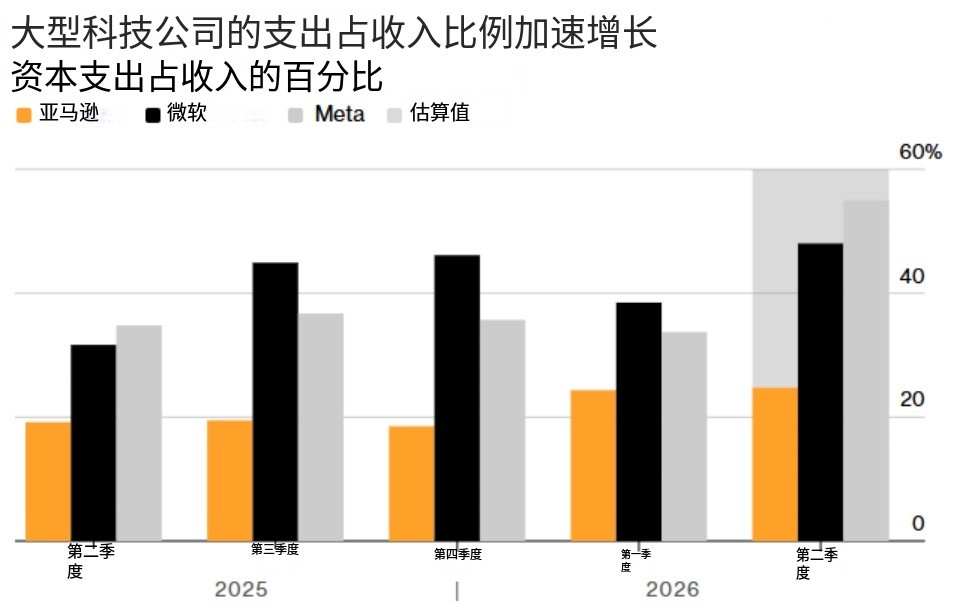
This week's earnings call will undoubtedly focus on whether the surge in artificial intelligence investment can deliver sufficient returns amid the ongoing geopolitical turmoil. According to Bloomberg Industry Research, among the S&P 500 companies that have reported earnings, the number of companies raising performance expectations exceeds those maintaining or lowering their forecasts.
Investors will closely monitor the progress of the "Big Seven" in the commercialization of artificial intelligence. Reports indicate that Meta, which will release its earnings on Wednesday, is planning to launch a cloud computing business and may sell the remaining computing capacity or access to its AI models. Meanwhile, Amazon, set to report earnings on Thursday, has increased the rental costs for hardware used to train and run AI models.
The capital expenditures of these tech giants have also impacted stocks in the semiconductor, memory, and data storage sectors, which have seen a slowdown in recent gains but have been among the best-performing sectors in the stock market this year. Meta's earnings report will essentially be a vote on "trust"—do investors believe that the billions of dollars invested in AI will ultimately yield returns?
