


SemiAnalysis: Kimi K3 Crushes NVIDIA's Strongest Open-Source Model as the U.S. Committee Model Fails
SemiAnalysis pointed out that Moonshot AI's Kimi K3 surpassed NVIDIA's open-source model Nemotron 3 Ultra in benchmarks. The firm believes NVIDIA's "committee model" has led to groupthink and internal friction, while the free-market competition mechanism in Chinese AI labs has shown clear advantages
The open competition among Chinese AI labs is bearing fruit.
On Wednesday, renowned semiconductor and AI research firm SemiAnalysis published an article stating that Moonshot AI's newly launched Kimi K3 model significantly outperformed NVIDIA's flagship open-source model Nemotron 3 Ultra in benchmarks. SemiAnalysis directly called out NVIDIA CEO Jensen Huang, arguing that the "Nemotron Committee" development model he spearheaded has proven not to be the right path for U.S. open-source AI, and urged NVIDIA to rethink its strategic direction.
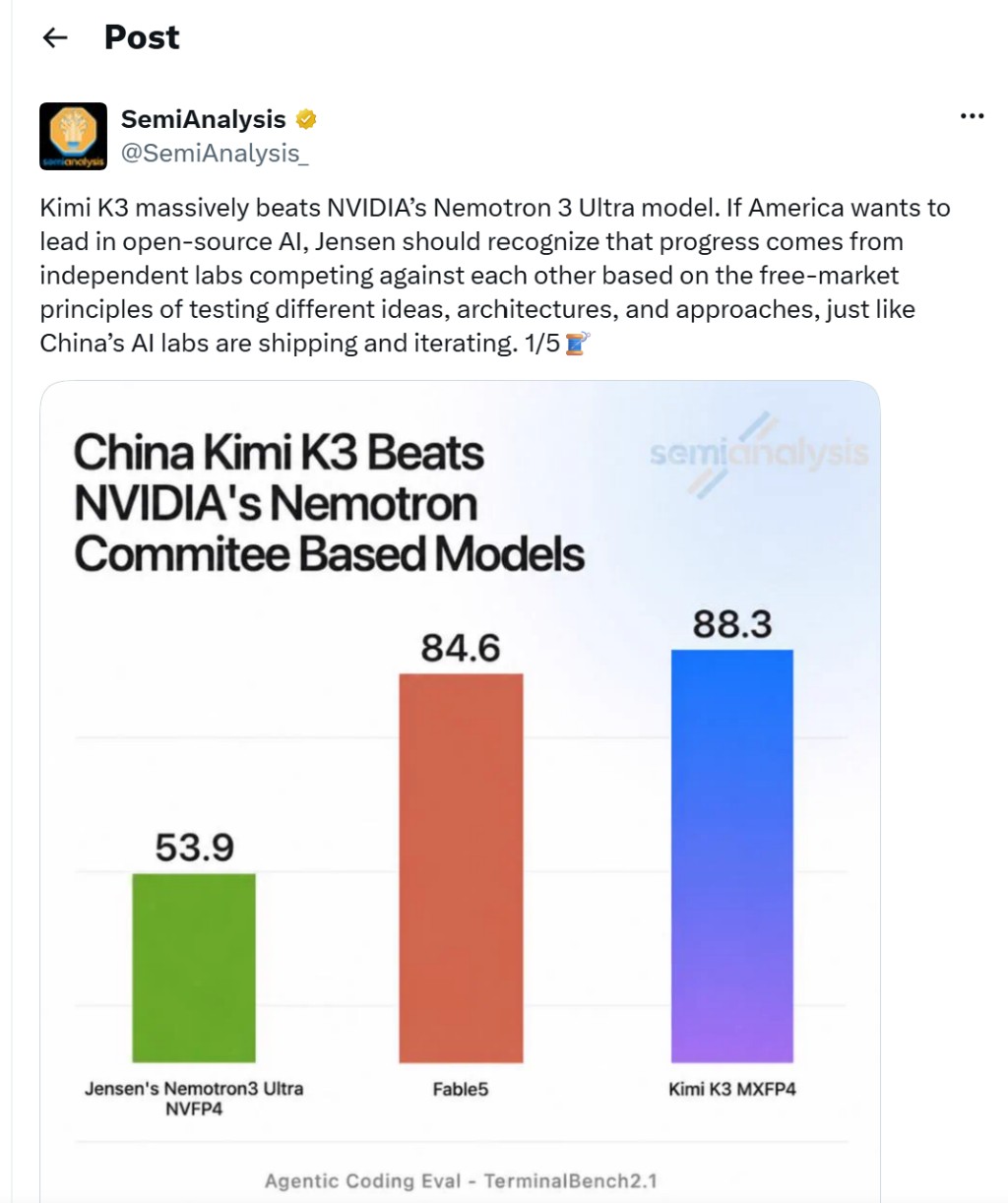
SemiAnalysis believes that Chinese AI labs have gained a clear advantage in the open-source field through continuous iteration and rapid delivery driven by free-market competition, whereas if the U.S. continues with its current committee-style collaborative model, it will keep falling behind in this race.
Committee Model Breeds "Groupthink"
SemiAnalysis attributed the failure of the Nemotron committee model to its structural flaws. The firm stated that when Jensen Huang created the Nemotron Committee, this mechanism restricted the free flow of different technical approaches, creating groupthink—while the core value of open source lies precisely in the ability to experiment freely, forming a fundamental contradiction.
The problems did not stop there. SemiAnalysis revealed that Mistral made errors during the pre-training phase of Nemotron. Because NVIDIA adopted a single-committee architecture, once one member company made a mistake, it dragged down the entire committee's final performance and triggered a chain reaction of dissatisfaction among members.
Even more alarming is the crisis of trust. SemiAnalysis stated that, to its knowledge, some alliance members were unwilling to share their best ideas, highest-quality datasets, and evaluation plans with the alliance, leading to internal friction. The firm believes that committee-style training is "extremely clearly" not the way forward.
Chinese Model Offers a Reference
SemiAnalysis used the competitive ecosystem of Chinese AI labs as a comparative reference. The firm pointed out that while Chinese AI labs compete with each other, they also draw on each other's verified successful experiences, giving rise to various innovative achievements such as KDA, MSA, and DSA in the process.
In SemiAnalysis's view, Kimi K3's crushing lead over Nemotron 3 Ultra is a direct manifestation of the superiority of this competitive mechanism—only when independent labs compete in testing different ideas, architectures, and technical routes can genuine technological progress be driven.
SemiAnalysis Proposes a Reform Roadmap
SemiAnalysis is not advocating for NVIDIA to completely abandon the committee model, but rather proposed more specific improvement plans. The firm suggested that if Jensen Huang truly wishes to promote committee-style training, he should at least form three independent committees that are isolated from and do not communicate with each other, to avoid groupthink.
These three alliances should innovate independently and compete with each other in dimensions such as data, reinforcement learning, pre-training, and evaluation. SemiAnalysis believes that this arrangement would align more closely with American free-market values and better approximate the actual operating methods of Chinese AI labs—iterating through competition, and differentiating into true technological advantages through iteration.
