


Citi: Tencent's Sharp Decline Driven by "Fear and Misinterpretation of Slowing Gaming Revenue"
Citi believes that Tencent's sharp stock price drop stems from a combination of three factors: market capital rotation, misinterpretation of gaming revenue data, and the drag on profits from AI investments, constituting an overreaction. The core issue lies in mistaking the seasonal decline in iOS gross bookings for an overall revenue downturn. In reality, supported by deferred Revenue Recognition and strong PC performance, its second-quarter gaming revenue is expected to exceed expectations, with fundamentals remaining robust
Citi Research believes that TENCENT's stock price plummeted by more than 7% in a single day on July 22, primarily due to market fear and misinterpretation of second-quarter gaming revenue data, rather than a substantive deterioration in fundamentals. Citi maintains its Buy rating on TENCENT, with a target price of HKD 758, and characterizes this decline as an "overreaction," viewing it as an enhanced buying opportunity.
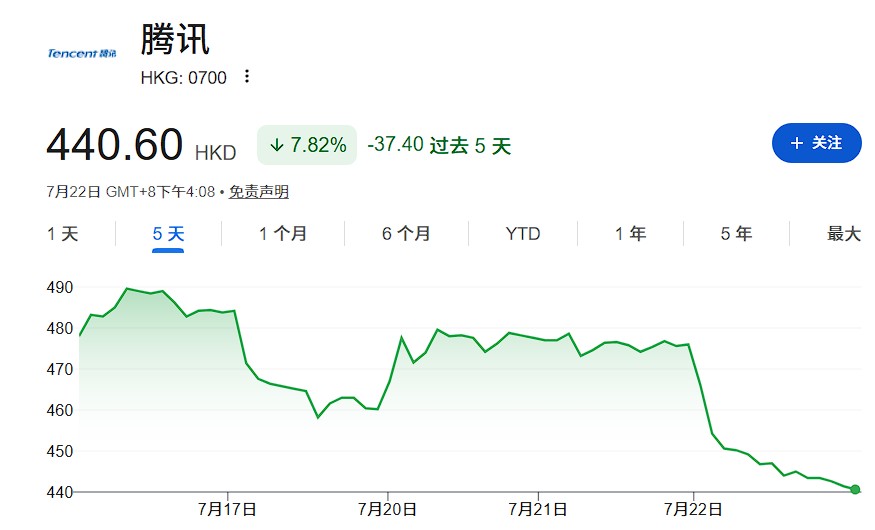
According to a quick comment report released on July 22 by Citi research analysts Alicia Yap and Nelson Cheung, this sell-off was triggered by the convergence of three factors: market capital rotating towards the AI hardware sector, Bloomberg citing broker reports that TENCENT's second-quarter gaming "revenue" would decline, and renewed market concerns that TENCENT's increased AI investments would drag down profits. Citi believes that these factors collectively amplified negative market sentiment, but the key judgment on gaming revenue involved a misinterpretation of the data.
Citi pointed out that the data tracked by Sensor Tower reflects only the normal seasonal decline in iOS gaming gross bookings, which is not equivalent to the gaming revenue ultimately disclosed by TENCENT. Considering the deferred Revenue Recognition mechanism and the strong performance of PC games, Citi expects TENCENT's actual disclosed gaming revenue for the second quarter to exceed market expectations. TENCENT's current stock price is HKD 440.60, implying approximately 72% upside potential based on Citi's target price.
Three Factors Trigger Sell-off, Market Sentiment Dominates Decline
The Citi report noted that TENCENT's stock price fell by more than 7% during the Asian trading session on July 22, due to the resonance of multiple factors.
First, the broader market saw capital rotating from the internet and gaming software sectors to the AI hardware sector, with internet and gaming stocks becoming targets for position reduction amid hedging operations.
Second, Bloomberg reported on the day, citing broker research reports that TENCENT's upcoming second-quarter gaming "revenue" was slowing down or even declining, sparking widespread market attention.
Third, market concerns reignited regarding TENCENT's continued increased investment in AI infrastructure, thereby compressing profit margins.
Citi believes that the superposition of these three factors, against the backdrop of a considerable rebound in TENCENT's stock price recently, further amplified the momentum for profit-taking, ultimately leading to a decline significantly exceeding what fundamentals could explain.
Gross Booking Data Misinterpreted, Deferred Revenue to Smooth Quarterly Volatility
The core argument of the Citi report is that the market's pessimistic expectations for gaming revenue are built on a misinterpretation of tracking data.
According to Sensor Tower data, TENCENT's domestic iOS gaming gross bookings declined by approximately 19% quarter-on-quarter and about 1% year-on-year in the second quarter, a trend consistent with typical seasonal patterns after the Spring Festival. However, Citi emphasizes that Sensor Tower only tracks iOS gross bookings and does not cover the larger Android user base, where gaming consumption behavior may differ significantly.
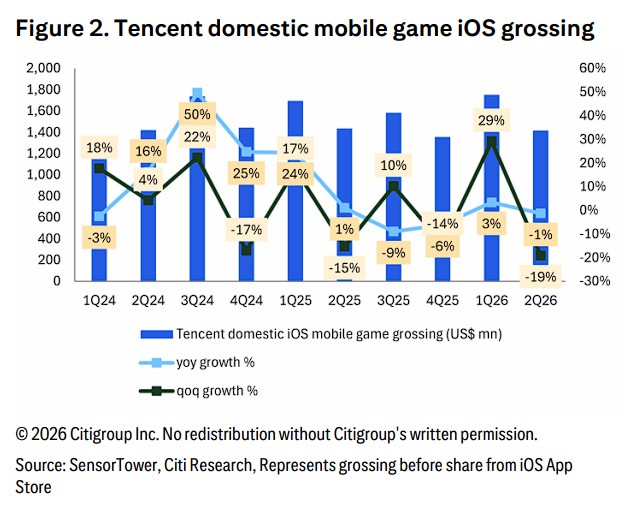
More importantly, TENCENT's finally disclosed gaming revenue benefits from the rolling recognition mechanism of deferred revenue—deferred revenue accumulated over previous quarters, along with the strong gross bookings recorded in the first quarter, will be reflected in the second-quarter financial results, thereby effectively supporting the revenue figures. Citi currently predicts that TENCENT's domestic gaming revenue for the second quarter will grow by 8% year-on-year and decline by 3.9% quarter-on-quarter, corresponding to revenue of approximately RMB 43.6 billion.
Citi also conducted a stress test: even if calculated based on last year's second-quarter quarter-on-quarter decline of 5.8%, the year-on-year growth rate of domestic gaming revenue for this year's second quarter would still reach approximately 6%, corresponding to about RMB 42.7 billion, with a relatively limited gap compared to Citi's baseline forecast.
Fundamentals Unchanged, Annual Growth Logic Still Holds
Citi explicitly stated in the report that even if TENCENT's second-quarter gaming revenue falls short of market consensus expectations, it should not shake the judgment on the fundamentals of its gaming business.
Citi believes that the core advantage of TENCENT's gaming business lies in its diversified layout and the continuous promotion of its globalization strategy. The stable performance of its core game IPs is sufficient to support stable growth in gaming revenue and profits on an annual basis, and single-quarter fluctuations in gross bookings and revenue should not be overly interpreted as trend signals.
In terms of valuation, Citi uses the Sum-of-the-Parts (SOTP) method to arrive at a target price of HKD 758, corresponding to forecast P/E ratios of approximately 22.8x and 21.5x for 2026 and 2027, respectively.
In the valuation of various business segments, online games contribute HKD 194 (26% of the target price), online advertising contributes HKD 202 (27%), social networks contribute HKD 187 (25%), fintech contributes HKD 88 (12%), cloud and enterprise services contribute HKD 42 (6%), and the investment portfolio (calculated with a 30% discount) contributes HKD 46.
Citi reiterates its Buy rating and characterizes this stock price correction as an enhanced buying opportunity.
