


AI market faces a major test with Google's earnings report! Cloud business growth rate and capital expenditure guidance become the focus
Google is about to release its financial report, with the market focusing on the growth rate of its cloud business and capital expenditure guidance. Investors are looking forward to strong growth in the cloud business to demonstrate the return on AI investments, with expected Q2 revenue of $116.98 billion and cloud sales projected to increase nearly 65% year-on-year to $22.4 billion. As a giant in AI infrastructure, Google's performance and its annual capital expenditure plan of up to $190 billion are seen as key indicators for observing global AI transaction trends
According to the Zhitong Finance APP, as investment in the artificial intelligence (AI) sector surges dramatically, investors are looking forward to Google's (GOOGL.US) upcoming earnings report, which is expected to show strong growth in its cloud computing business, thereby proving that the company's substantial investments in AI are yielding clear returns. As one of the world's largest "super cloud service providers" in terms of AI infrastructure investment, Google's performance and capital expenditure guidance will also be seen as a key barometer for observing global AI transaction trends.
Currently, the market generally expects Google's Q2 revenue to be $116.98 billion, a year-on-year increase of 21%; earnings per share are expected to be $2.91, a year-on-year increase of 26%. Among the key metrics in this significant earnings report, the growth of its cloud business may attract the most attention. Given that the growth rate of this business has been accelerating in recent years, demonstrating that this trend continues will be crucial, especially in the context of Google's indication that this earnings report will include information about further increasing spending plans. The market expects Google's cloud business sales in the second quarter to grow nearly 65% year-on-year to $22.4 billion, while the year-on-year growth rate for this business in the first quarter was 63%.
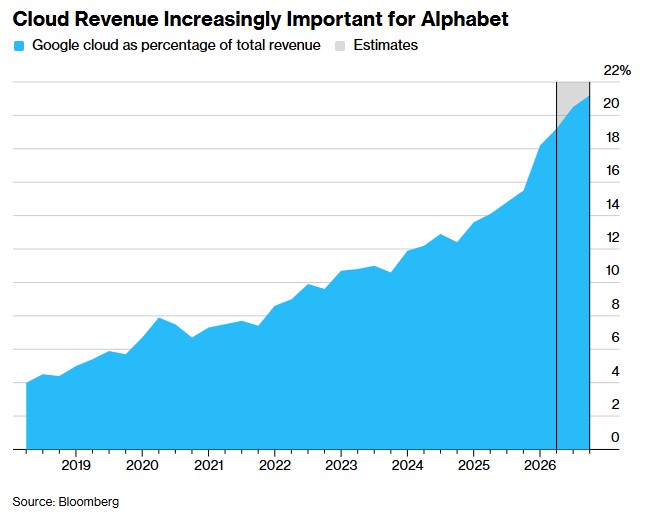
Cloud business revenue is becoming increasingly important for Google
Evercore ISI analyst Mark Mahaney stated in a report on July 19 that this forecast is "very reasonable and has significant upside potential, as industry feedback indicates that demand for AI infrastructure remains extremely strong."
While the cloud business is expected to continue performing strongly, the market will undoubtedly also consider Google's capital expenditure plans when viewing this earnings report. In its first-quarter earnings report, Google indicated that the company expects its capital expenditures to reach up to $190 billion this year, and that capital investments in 2027 will be "significantly" higher than this year.
Recently, Google completed an $85 billion equity financing, which was further expanded shortly after its announcement in early June, leading Wall Street to anticipate that the company's future capital expenditures may be even higher. According to aggregated market expectations, Google's capital expenditures are expected to reach $262 billion by 2027, nearly three times the level of 2025.
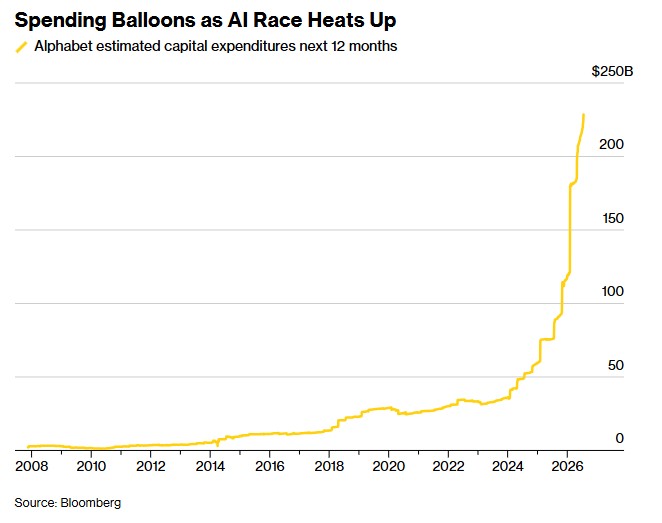
As the AI competition heats up, Google's capital expenditures are swelling
Google is generally regarded as one of the companies most capable of investing in AI. Jonathan Kofsky, a portfolio manager at Janus Henderson Investors who holds Google stock, stated, "Google has proven that it can achieve good returns from its investments. But the question is whether the company can continue to achieve such returns." He added, "If Google can demonstrate accelerated growth in its cloud business while its search business continues to perform strongly, this will reassure investors about the reasonableness of the company's spending and the overall return prospects of the stock." David Miller, Chief Investment Officer of Catalyst Funds, who also holds Google stock, stated: "These capital expenditures are very large, but investors currently believe that as long as the data can prove that these investments will ultimately yield returns, such spending is reasonable." "If Google can exceed last quarter's cloud business growth level, it will indicate that the company's investments are still quite prudent."
In addition to the cloud business, Google's search business continues to deliver strong performance. The company has launched several AI tools that have received positive market feedback. Wall Street remains optimistic about its semiconductor business. On Monday, Google's stock price was boosted by a report that the company is developing a server chip specifically designed to optimize its Gemini AI model. Gemini is considered one of the industry-leading AI models, although reports indicate that the release of the latest version of Gemini has been delayed as the company seeks to further enhance its capabilities, particularly in code programming.
As investors grow increasingly concerned about whether the massive funds that large tech companies are investing in building AI capabilities will yield meaningful returns, market sentiment is shifting. Chip manufacturers, as the main beneficiaries of these massive expenditures, have seen their stock prices surge, while the "Magnificent Seven" stocks that provide substantial funding have seen little noticeable increase in their stock prices. After a cumulative increase of about 66% in 2025, Google's stock price saw a relatively limited increase of only 11% in 2026, and has already dropped 14% since reaching an all-time high in May.
Among the "Magnificent Seven," only Apple (AAPL.US), which has avoided the AI spending race, and chip giant Nvidia (NVDA.US) have performed better than Google this year. However, Google's performance still exceeds that of other major AI-investing companies in the "Seven," with Amazon (AMZN.US) up 7.3% since 2026, Meta Platforms (META.US) down 2.5%; Microsoft (MSFT.US) has dropped 18%, becoming one of the largest tech stocks that have severely dragged down the performance of the S&P 500 index this year.
Additionally, Google's current stock price corresponds to a forward price-to-earnings ratio of about 23 times for the next 12 months, slightly above the average level of the past 10 years (21 times). In contrast, the S&P 500 index currently has a forward price-to-earnings ratio of about 20 times, while the Nasdaq 100 index, which has a high proportion of tech stocks, has a price-to-earnings ratio of about 23 times.
Although Google's stock valuation is the highest among major AI investment companies, the market does not consider its valuation excessive, especially in light of the company's future growth potential. Miller stated: "From the profit margins we expect and the growth rates we see, this valuation multiple is very reasonable. I believe many investors would not mind paying such a valuation for high-margin, high-growth revenue. The value logic is actually very clear."
Therefore, if Google's upcoming second-quarter financial report satisfies investors and is sufficient to prove that its substantial computing power investments can continue to translate into incremental revenue from advertising and cloud business, it is expected to dispel market doubts about the returns on its billion-dollar AI investments, thereby opening up upward valuation space. However, if, amid growing market concerns about excessive AI investments, Google's financial report signals a contraction in capital expenditures or AI conversions falling short of expectations, the entire AI industry chain's valuation will come under pressure
