


TSMC Rises Nearly 4% Premarket, Plans to Raise Wafer Prices 5%-10% in 2027
TSMC shares rose nearly 4% in pre-market trading as the company finalized a 5%-10% wafer price increase for 2027, driven by rising costs and strong AI demand. Advanced AI chip orders may see surcharges up to 15%. This follows TSMC's Q2 earnings beat, with revenue of NT$1.27 trillion, and its announcement of an additional $100 billion investment in Arizona facilities to capture AI growth.
TradingKey - On July 21 Eastern Time, TSMC ( TSM) rose nearly 4% in pre-market trading. Market sources reported that the world's largest chip foundry has reached a final agreement with customers for a 5% to 10% increase in wafer prices in 2027, covering both advanced and mature processes. As of press time, TSMC's US shares were trading at approximately $417.35 in pre-market, up 3.74%.
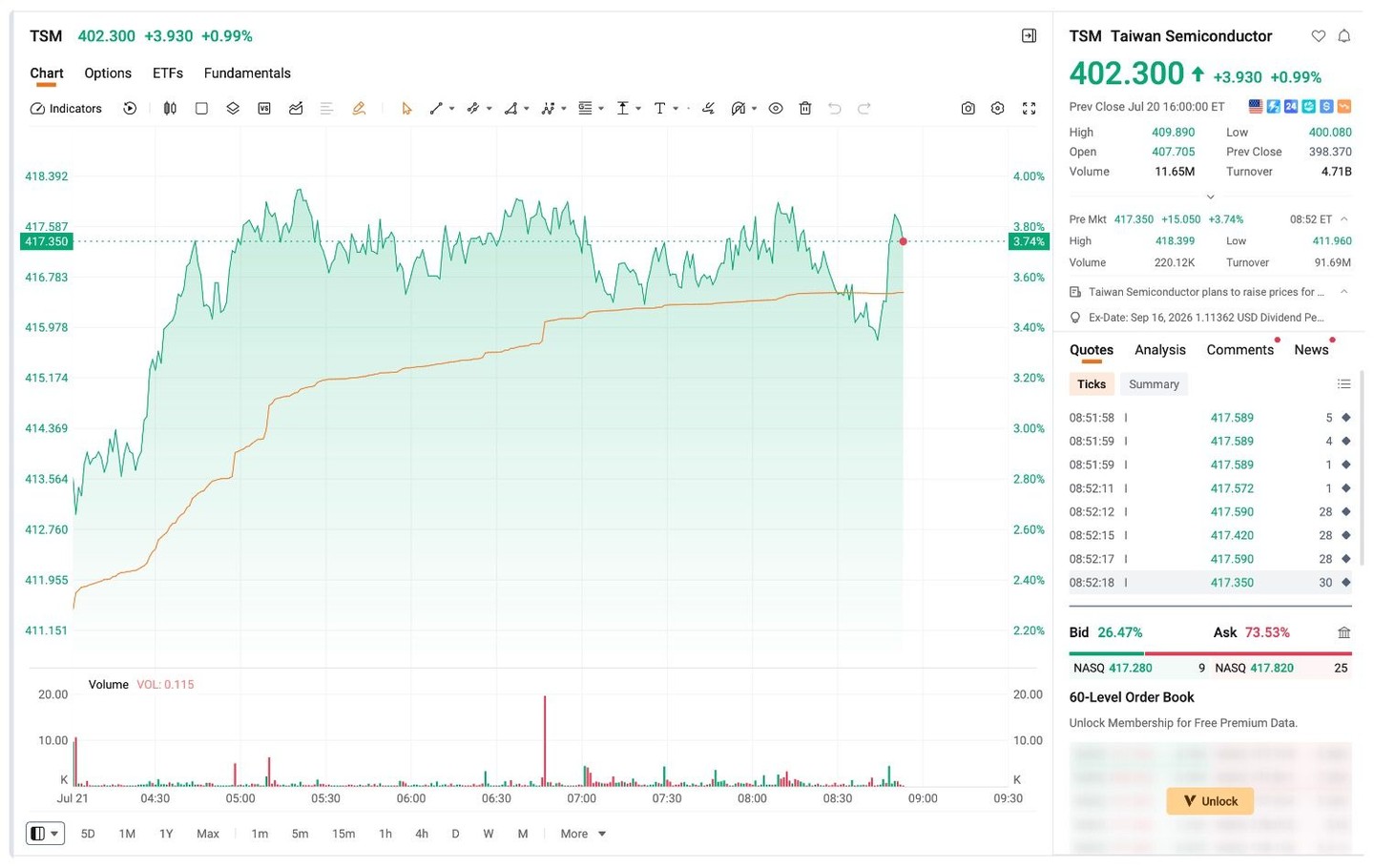
[Source: Futu]
According to a report by Nikkei Asia, TSMC completed price adjustment negotiations with customers this month, with the new prices expected to take effect in 2027. The price hikes are mainly due to rising costs of raw materials, chip-making equipment, and new overseas factories.
Nvidia ( NVDA) and other high-end AI clients may face even larger increases. For high-performance computing chip orders exceeding previously agreed quantities, a 10% to 15% surcharge will be added on top of the base price increase. This means the total increase for some advanced AI chip orders could exceed 10%.
TSMC's Q2 earnings report showed that advanced processes of 7nm and below accounted for 77% of wafer revenue, while mature processes like 12nm to 28nm accounted for 23%. Currently, the latest 2nm technology has entered the revenue sequence (accounting for about 3%) and has begun to accelerate its ramp-up, which is expected to continue releasing growth dividends over the next few quarters.
TSMC's clients cover major global tech companies such as Nvidia, Apple ( AAPL ), AMD ( AMD ) , Qualcomm ( QCOM ), Amazon ( AMZN) and Google ( GOOGL ), and other global tech giants. This price hike is likely to pass down through the supply chain tier by tier, impacting the end-user costs of AI chips and consumer electronics.
On July 16, TSMC Chairman and CEO C.C. Wei officially announced at an institutional investor conference that the company will inject an additional $100 billion into its Arizona facility, driving its cumulative investment in the US to a record $265 billion. Wei emphasized that TSMC is accelerating the construction of its US factories to fully capture the AI 'megatrend'.
Subsequently, TSMC CFO Wendell Huang made a bold statement in an exclusive interview with CNBC, frankly stating that TSMC's aggressive expansion is aimed at locking in all dividends, saying they have "no intention of leaving any food on the plate for others (leaving no chance for competitors)."
In TSMC's second-quarter earnings report released last week, revenue reached NT$1.27 trillion (approximately $40.2 billion based on the quarter's spot exchange rate), exceeding Wall Street's expectation of NT$1.26 trillion. Adjusted earnings per share came in at NT$27.25, which also beat expectations.
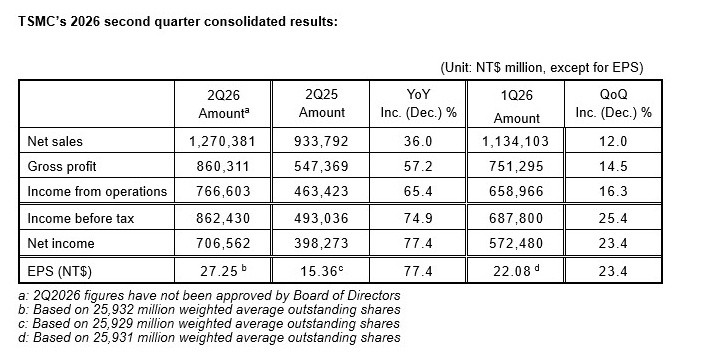
[TSMC Q2 Financial Data, Source: TSMC Official Website]
TSMC's confidence in this round of price hikes stems from the certainty of AI demand. With better-than-expected earnings, full capacity utilization, and the accelerated ramp-up of 2nm technology, there are no signs of weakness in its fundamentals. Once the price hikes take effect in 2027, the average selling price (ASP) midpoint will systematically shift upward, and the profit structure is expected to continue improving.
Find out more
