


Why Did Memory Stocks Plummet Again?
Memory chip stocks experienced a "roller coaster" ride this week, with Micron Tech plunging 10% in a single day on Wednesday and SK Hynix's ADR dropping sharply by 9%. Warren Buffett's criticism of the AI speculative bubble triggered a reversal in market sentiment, while GF Securities Hong Kong simultaneously lowered its Q3 DRAM price hike expectations due to strong customer resistance to a 30% increase. Although fundamentals remain strong, the dual pressure of supply expansion and downgraded demand specifications is shaking market confidence in the sustainability of high prices
Memory chip stocks faced severe volatility this week, as multiple negative signals converged, putting sudden pressure on the previous rally driven by AI demand.
On Wednesday, Micron Tech's stock price plummeted 10% in a single day, while SK Hynix's American Depositary Receipts (ADR) fell synchronously by 9%, wiping out much of the gains from the previous trading session. The direct trigger for this round of selling was Warren Buffett's warning that speculation in AI themes is rampant and that it is becoming increasingly difficult to find true value in the market, although he did not name any specific companies.
Meanwhile, during a monthly conference call, GF Securities Hong Kong lowered its forecast for DRAM price growth in the third quarter, citing strong customer resistance to price hikes approaching 30%.
This decline reflects the core contradiction currently facing the memory sector: while fundamental data remains robust, expectations of supply expansion and the risk of downgraded specifications on the demand side are eroding market confidence in the sustainability of high prices.
Buffett's Remarks Trigger Sentiment Reversal
Micron Tech's performance this week can be described as a "roller coaster." On Monday, July 13, the stock fell 4.3% to close at $937; on Tuesday, July 14, it rebounded 4.7% after KeyBanc raised its target price to $1,750, predicting that memory shortages would continue until 2027, with the intraday high touching $994.80; on Wednesday, July 15, Buffett's comments caused market sentiment to take a sharp downturn, with the stock price falling to around $865 at one point, bringing its market capitalization back to approximately $1.05 trillion.
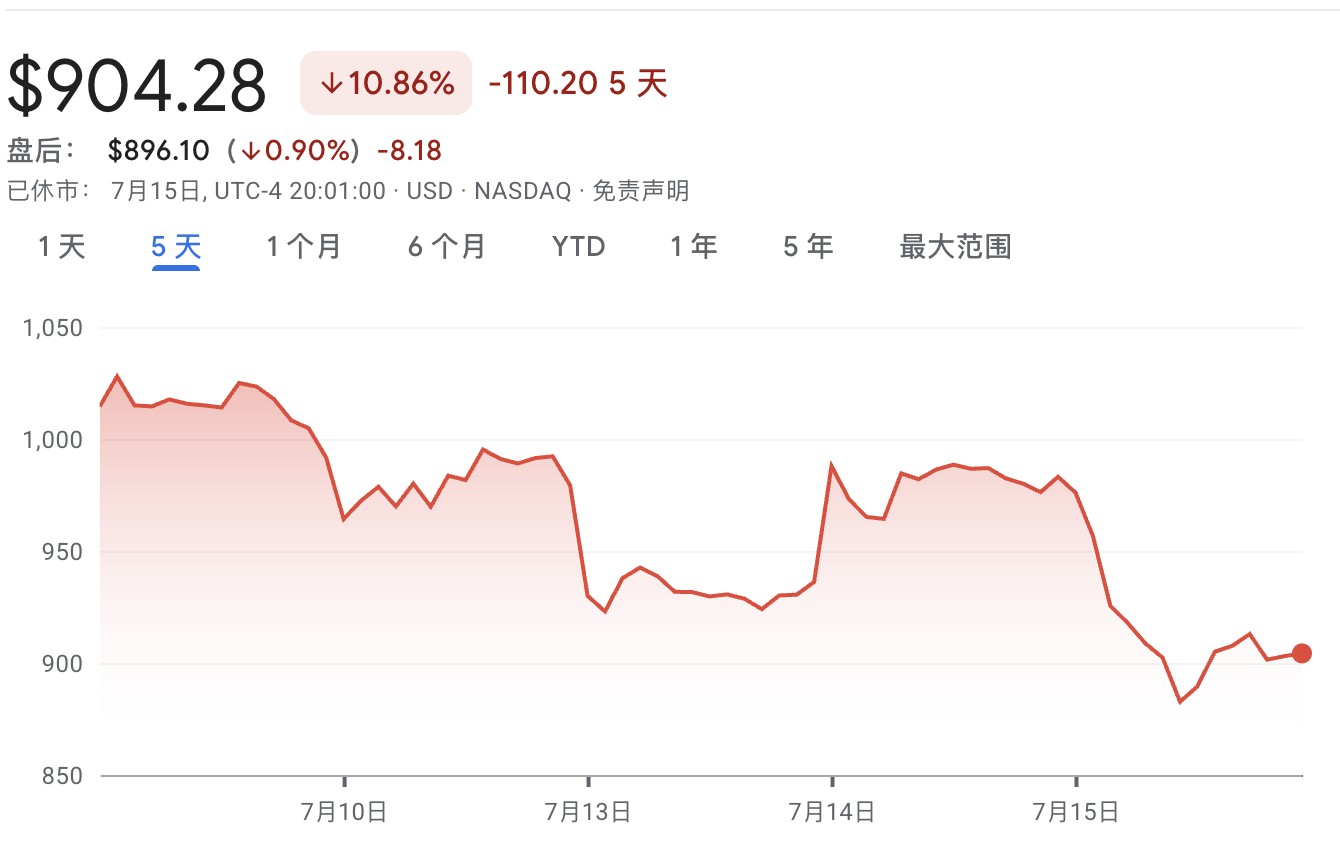
Buffett stated that when everyone is keen on "gambling" on themes like AI, finding truly valuable investments becomes "increasingly difficult." Although these remarks were not directed at Micron Tech, they precisely hit the weak spot in the recent trading pattern of memory stocks—investors reacted to every piece of news as if betting on price movements, rather than making long-term judgments based on fundamentals.
A market observer pointed out that the market performance of SK Hynix following its listing on Nasdaq last week is a microcosm of this "gambling mentality": investors initially bought heavily after the company's CEO Arvind Krishna stated that customer spending had shifted toward memory products, but then quickly sold off due to concerns that SK Hynix's production expansion plans would depress industry pricing.
DRAM Price Hikes Face Resistance
GF Securities Hong Kong revealed in its monthly conference call that customers strongly resisted DRAM price increases approaching 30%, leading the firm to slightly lower its Q3 DRAM price growth forecast. This stance contrasts with KeyBanc's earlier prediction of a 15% to 20% DRAM price hike in Q3, indicating that bargaining power on the demand side is constraining pricing expectations on the supply side.
GF Securities Hong Kong also noted that the DDR5 specifications for general-purpose servers are expected to be downgraded by about 50% compared to previous expectations. DRAM suppliers are promoting new RDIMM and MRDIMM products with capacities of 96GB or 64GB, with the latter expected to become the new mainstream specification.
Furthermore, according to GF Securities Hong Kong's analysis on July 2, the LPDDR5X capacity for Nvidia's VR200 NVL72 racks has been significantly reduced. In extreme scenarios, it could even drop to one-quarter of the original specifications, compressing the LPDDR5X cost from a potential rise to $1.2 million down to approximately $293,000. The firm also predicted that Nvidia's Vera CPU racks would similarly adopt a 96GB SOCAMM solution, reducing total memory capacity from the 1.5TB shown in specifications to 768GB, which may also delay delivery times.
NAND and HBM Become New Points of Divergence
Despite a cautious outlook for DRAM, GF Securities Hong Kong's attitude toward NAND flash has turned markedly optimistic. The firm pointed out that demand for KV cache offloading continues to exceed expectations, and an emerging trend of using NAND to replace expensive DRAM has appeared in the market, both of which support NAND demand.
KeyBanc analyst John Vinh maintained a positive judgment on the overall memory market, expecting NAND prices to rise by 30% to 40% in Q3 and another 15% in Q4; HBM prices are expected to more than double next year. HBM is a key supporting memory for AI processors, and Micron Tech, as one of Nvidia's HBM suppliers for AI processors, is deeply embedded in the AI hardware supply chain.
GF Securities Hong Kong holds an optimistic view of SK Hynix's Q2 performance, expecting its revenue to reach 85 trillion Korean won, with a gross margin of 63%.
SK Hynix ADR Premium Faces Pressure to Narrow
SK Hynix's ADR fell 9% to $176.46 on Wednesday, while its local shares in South Korea closed up 8.8% on the same day, showing a clear divergence in performance. After surging 27% on Tuesday, SK Hynix's ADR forward P/E ratio rose to approximately 6.2x, nearing the valuation level of its competitor Micron Tech—whereas the previous discount of ADRs relative to local shares was one of the important reasons for some investors to buy.
Currently, the premium of SK Hynix's ADR relative to its local Korean shares once exceeded 50%. The Korea Securities Depository is expected to open two-way conversion between local shares and ADRs on July 29, at which point this premium space may narrow significantly, posing potential pressure on ADR holders.
Strong Fundamentals Cannot Mask Cyclical Concerns
Despite severe short-term sentiment fluctuations, Micron Tech's fundamental data remains impressive. The company's revenue in the latest fiscal quarter reached $41.5 billion, a year-on-year increase of 346%; net profit soared nearly 1,400% to $28.2 billion; and adjusted earnings per share were $25.11. Micron Tech has signed supply commitment agreements totaling $22 billion with 16 strategic customers, including "take-or-pay" clauses, cash deposits, and price floors, providing the company with a demand anchor beyond daily market fluctuations.
However, the cyclical risks of the memory industry remain unresolved. Micron Tech's capital expenditure this year is approximately $27 billion, while SK Hynix and Samsung Electronics are also expanding production on a large scale. Once supply catches up with demand, current pricing power will face a severe test. Whether the core assumption of the current bullish logic—that supply tightness will last longer than historical cycles—holds true remains the greatest uncertainty in the market.
