


SoftBank's Attempt to Borrow Against OpenAI Collateral Hits Another Wall, Market Begins to Question Its Solvency
Negotiations for a $6 billion margin loan secured by SoftBank Group Corp.'s equity stake in OpenAI have stalled, causing the stock to plunge nearly 10% in a single day upon the news. Lenders are wary of valuing unlisted assets, while SoftBank faces $40 billion in Bridge Loans maturing in 2027. The tension between Masayoshi Son's bold AI bets and the reality of mounting debt is becoming increasingly difficult to ignore
SoftBank Group Corp.'s financing plans, secured by its equity stake in OpenAI, have faced successive setbacks, raising external concerns about the Japanese tech giant's solvency.
According to Bloomberg, negotiations between SoftBank and potential lenders for a reduced $6 billion margin loan have stalled due to growing concerns among lenders regarding the valuation of the collateral.
This comes just weeks after SoftBank was forced last month to cut the original $10 billion loan size by 40%. Sources stated that SoftBank is currently evaluating various alternative financing options, although the margin loan option has not been completely ruled out.
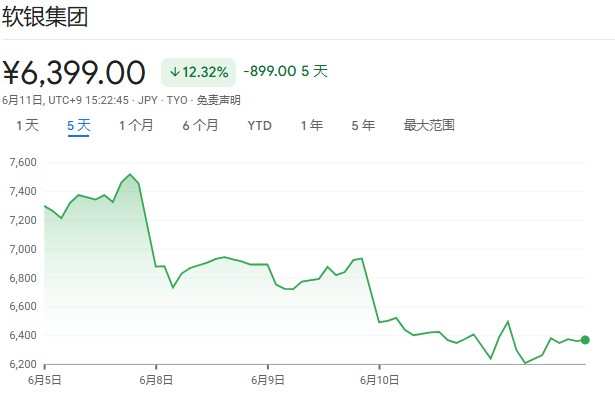
News of the stalled negotiations caused SoftBank's stock to plummet as much as 9.7% during Wednesday's trading session. Nevertheless, the stock has still gained approximately 45% year-to-date, previously benefiting from a surge in quarterly profits driven by a significant increase in the valuation of its OpenAI investment. On June 1, SoftBank surpassed Toyota Motor Corporation to become Japan's most valuable listed company.
Valuation Challenges Make Lenders Hesitant
The core issue behind the breakdown in negotiations is the difficulty lenders face in assigning a reasonable valuation to OpenAI, a private company. According to Bloomberg, citing insiders, some potential lenders who were previously negative began to re-examine the feasibility of the loan after OpenAI disclosed last month that it was preparing for an IPO—but this shift was insufficient to close the deal. SoftBank reportedly had obtained around $5 billion in indicative commitments before the negotiations stalled, but insiders expressed doubts about the binding nature of these commitments.
OpenAI has secretly filed for an IPO in the United States and is working with Goldman Sachs and Morgan Stanley, potentially aiming to complete its listing as early as this autumn. Hua Cheng, Head of Asian Credit Research at AllianceBernstein, stated, "Margin loans are just one piece of a larger puzzle. Unless we see a significant deterioration in SoftBank's financing capabilities, we will not view it as an isolated risk signal. The ideal scenario would be for OpenAI to complete its IPO this year, allowing SoftBank to sell part of its stake to repay debt, which aligns with the expectations of credit investors."
Pressure from Debt Maturing in 2027 Looms Large
Behind the financing hurdles lies a larger and more urgent debt pressure. To support its investment in OpenAI, SoftBank utilized $40 billion in Bridge Loans, which must be repaid by March 2027. SoftBank stated that this borrowing "could be repaid by leveraging existing assets and other financing methods," but the specific path remains unclear.
Meanwhile, SoftBank's holdings in Arm Holdings and Intel have surged 197% and 192% respectively this year, theoretically serving as new collateral assets. However, if even OpenAI, a core asset, struggles to secure loans from lenders, the financing terms available for other assets are likely to be even more limited. SoftBank may also consider issuing additional bonds to supplement liquidity, but no decision has been made yet.
The Cost of Masayoshi Son's Big Bet on AI
As financing difficulties emerge, Masayoshi Son's AI betting strategy itself is facing increasing skepticism. With competitor Anthropic recently achieving a series of technical breakthroughs, some investors have begun to question SoftBank's commitment to invest over $60 billion in OpenAI, causing unease even among officials within SoftBank.
Masayoshi Son has not scaled back. Last month, SoftBank announced plans to invest up to €75 billion in France to build AI data center infrastructure. This figure far exceeds SoftBank's current available capital, reigniting market concerns about its capital discipline. Masayoshi Son, who nearly went bankrupt after the dot-com bubble burst, is reenacting that history with even bigger bets—and this time, creditors' patience appears to be waning.
