


Computex Reveals Three Key Signals: NVIDIA Confirms Sufficient Taiwan Semiconductor Capacity, AI PC Chips Debut Jointly, Supply-Demand Imbalance to Persist Through 2027
Morgan Stanley believes that NVIDIA has confirmed securing sufficient Taiwan Semiconductor capacity to support growth through 2027, although market supply and demand will remain tight by then. NVIDIA and MediaTek jointly launched the RTX Sparks AI PC chip, with shipments of 5–8 million units expected in 2026, contributing 5%–10% growth to MediaTek's EPS. The Vera CPU targets $20 billion in revenue, with the Arm architecture serving as the core support for Agentic AI
Wall Street’s attention is firmly fixed on the Computex conference being held in Taipei, China.
On June 3, according to Zhuifeng Trading Desk, Morgan Stanley’s latest research report at this year’s Computex revealed three core signals dominating the logic of tech investment in the coming years: the rise of Agentic AI, the certainty of Taiwan Semiconductor’s capacity, and the AI PC chips jointly developed by MediaTek and NVIDIA.
The most crucial reassurance came from NVIDIA—which explicitly stated that it has secured sufficient Taiwan Semiconductor capacity to support strong growth in 2027, and that the market will remain in a state of “shortage” with demand exceeding supply by that time.
In addition, the Vera CPU, with revenue expectations as high as $20 billion, and the AI PC chips expected to deliver significant earnings per share (EPS) increments, are paving clear profit pathways for related supply chain companies. This means that in this non-zero-sum incremental market, the hardware dividends of computing power and edge AI have only just begun.
NVIDIA Secures Taiwan Semiconductor Capacity for 2027; Supply-Demand Imbalance Persists
The market’s greatest concern regarding computing power bottlenecks has been completely shattered.
NVIDIA explicitly stated that it has obtained sufficient Taiwan Semiconductor capacity to support its strong growth in 2027. The company has successfully convinced Taiwan Semiconductor and other suppliers that demand will remain robust.
This releases an extremely critical expectation—although the supply chain is actively expanding production, market demand will likely still exceed supply by 2027.
At the same time, management particularly emphasized that the AI semiconductor market is an ever-expanding pie, and current competition is not a zero-sum game nor merely a battle for market share.
The firm believes this means the entire AI GPU supply chain (such as Taiwan Semiconductor responsible for foundry services, ASE responsible for packaging, KYEC responsible for testing, and equipment supplier AllRing) will continue to benefit from this long-term supply-demand mismatch.
NVIDIA and MediaTek Jointly Launch AI PC Chips; Pricing and Shipment Volumes Revealed
Is edge AI computing necessary? NVIDIA provided the answer with concrete actions. During the keynote speech, NVIDIA officially released the RTX Sparks AI PC WoA SoC (System-on-Chip) jointly designed with MediaTek.
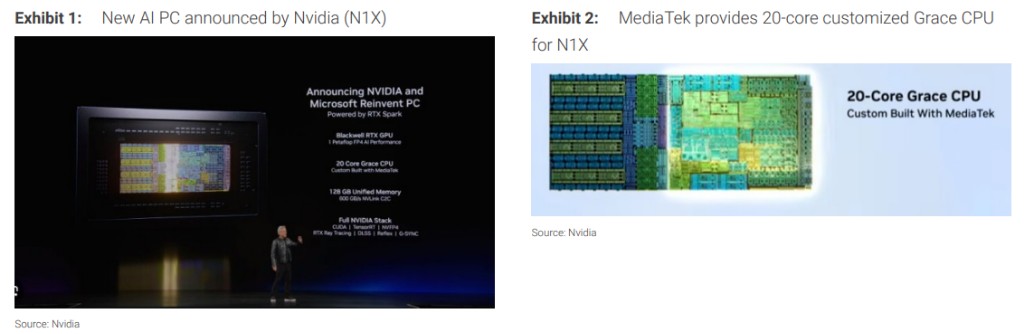
Among them, MediaTek provided a 20-core custom version of the Grace CPU for the high-end N1X chip. MSI and ASUS will formally launch devices equipped with RTX Spark (N1X) in the third quarter of 2026, a timeline that aligns perfectly with Microsoft’s new AI Windows system scheduled for release in the second half of 2026.
Regarding pricing and volume ramp-up, which are of greatest concern to the market, Morgan Stanley estimates, after verification with PC brands, that: AI PCs equipped with the N1X chip will be priced as high as $2,899, while PCs equipped with the N1 model will be priced at $1,799.
Shipments of N1X/N1 SoCs are expected to reach 5 million to 8 million units in 2026. Assuming an average patent licensing fee of $40 per chip, this will contribute 5% to 10% growth to MediaTek’s earnings per share (EPS) in 2026.
At the same time, this will also directly drive performance expectations for the WoA AI PC supply chain (such as Macronix, which provides NOR Flash).
Agentic AI Ignites Demand for Arm Architecture; Vera CPU Targets $20 Billion in Revenue
NVIDIA, Arm, and Qualcomm consistently emphasized during their keynote speeches that server CPUs based on the Arm architecture will be the core support for future Agentic AI demand.
At the investors’ lunch, NVIDIA CEO Jensen Huang responded positively to the revenue expectation of up to $20 billion for the Vera CPU. Management pointed out that this demand comes not only from AI server head nodes but also from standalone CPU servers.
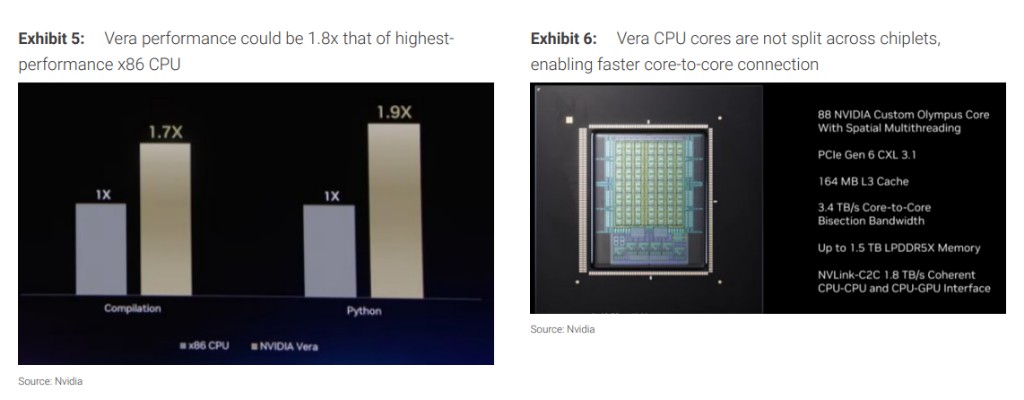
From a technical fundamentals perspective, Vera’s performance reaches 1.8 times that of the highest-performance x86 CPUs, and its cores are not split across chiplets, enabling faster inter-core connections. Leveraging this absolute performance advantage, NVIDIA can command higher product pricing for Vera, excluding memory sales.
Supply chain verification data shows that preparations for 2.5 million to 4 million units are currently underway. In addition, the Rubin GPU has entered the wafer fabrication production stage, with no significant delays observed. Regarding technology route selection, NVIDIA made its stance clear to the market: it will rely on copper cable connections for as long as possible, adopting CPO (Co-Packaged Optics) technology only when necessary.
