


Microsoft Build in Full Swing: Web IQ Aims to Be the Bing for Agent Search, Quantum Chip Upgrade Targets Practicality by 2029, and 'Lobster' Comes to Windows PCs
Web IQ provides trusted, up-to-date structured information, enabling agents to directly access structured networks and supporting a multi-agent collaboration ecosystem. The Majorana 2 quantum chip increases the qubit count to 12 and significantly extends individual qubit coherence time to over 20 seconds, aiming to achieve scalable, practical quantum computers by 2029—halving the original timeline. Scout is viewed as a personal AI assistant inspired by 'Lobster.' NVIDIA showcased its 'local-cloud' AI stack at Build, turning Windows PCs into agent development platforms. The conference also unveiled multiple agent infrastructure components, such as the Microsoft Agent Framework for building multi-agent systems, the MXC security sandbox, and Project Solara for building agent device platforms. Microsoft also announced enhancements to the AI development environment in Windows 11
Microsoft is simultaneously betting on the AI internet, Quantum Computing, and local intelligent assistants.
At the annual Build developer conference held on Tuesday, May 2 (US Eastern Time), Microsoft released a series of major products and technologies: it launched Web IQ, a search infrastructure for the era of AI Agents; unveiled the new generation quantum chip Majorana 2, advancing the target for practical quantum computers with commercial value to 2029; and announced a new AI assistant, Scout, along with a toolchain enabling developers to deploy 'Lobster (OpenClaw)'-style autonomous agent systems on Windows PCs.
NVIDIA also emerged as a key player on the Microsoft Build stage. NVIDIA CEO Jensen Huang joined Microsoft CEO Satya Nadella’s keynote via video link, showcasing a unified agent AI technology stack covering Windows devices, local computing, edge deployment, and the Azure cloud. This stack includes next-generation local AI development devices, Windows local model execution capabilities, and a new suite of tools allowing developers to seamlessly scale from PC to cloud-based agent deployment.
From search, models, and operating systems to quantum hardware and AI computing platforms, the Microsoft Build conference sent a clear signal: Microsoft is no longer content with being merely an AI application company but is building a full-stack ecosystem for next-generation intelligent computing.
A comprehensive review of this year’s Build announcements reveals a significant shift: Microsoft’s strategic landscape has clearly expanded beyond chatbots and Copilot.
Microsoft is now concurrently advancing: AI Models (MAI series), Agent Internet (Web IQ), Agent Operating Systems and Local AI (Scout, Windows Agent toolchain), Quantum Computing Hardware (Majorana 2 chip), and the Azure Cloud and Enterprise AI Ecosystem.
In other words, Microsoft is attempting to secure several key entry points for future intelligent computing: search, agents, PCs, cloud, and potentially quantum computing. What was displayed at Build was not just more AI features; it resembled Microsoft’s comprehensive bet on the next generation of computing platforms.
Web IQ: Not a Search Engine, but the Information Foundation for the Agent Era
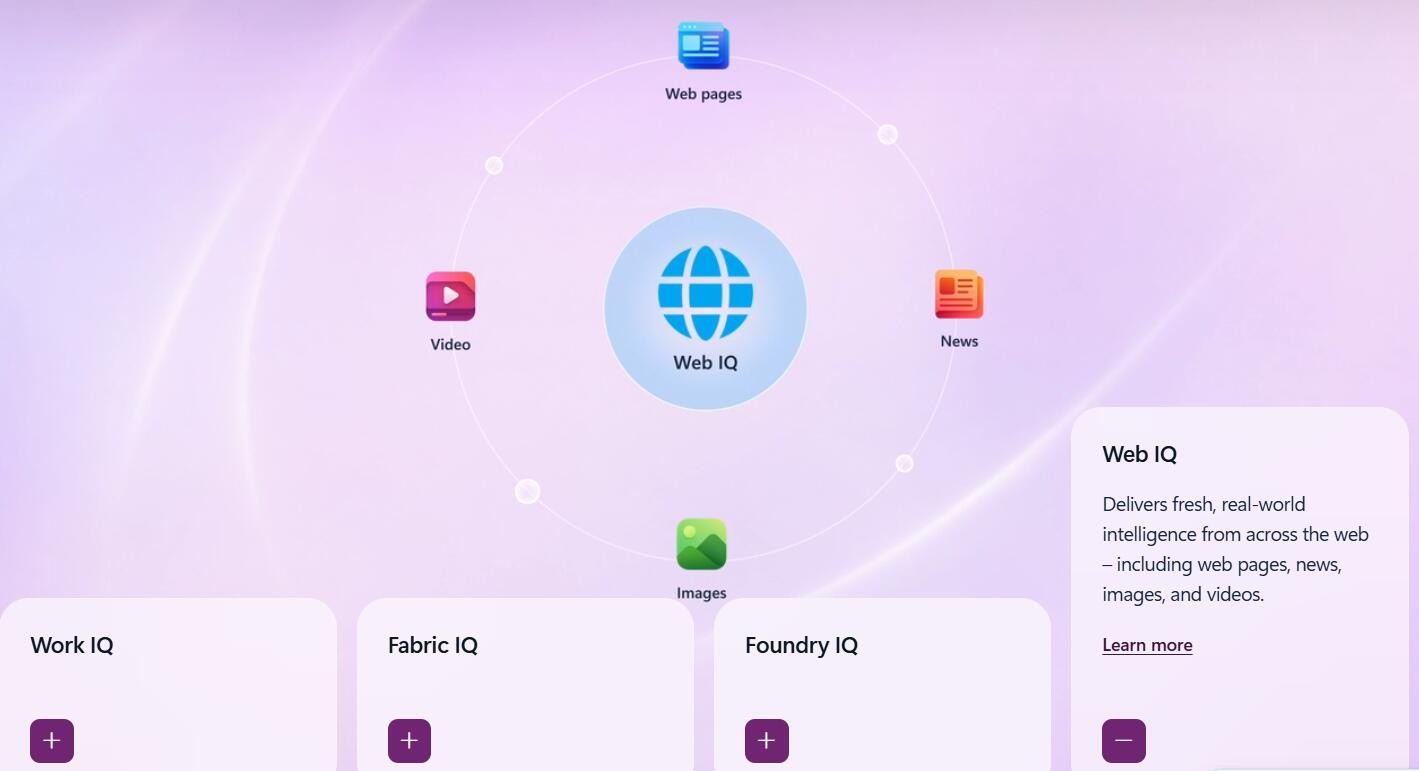
Microsoft launched Web IQ, a search engine designed for AI systems. The Web IQ suite includes a series of AI-native Grounding APIs.
Microsoft defines Web IQ as the 'web intelligence layer for AI agents,' targeting not traditional web search users but directly providing real-time, trusted, and structured internet information to AI agents, Copilot, and automated agents. Simply put, Microsoft aims to create not just Bing for human users, but Bing for AI agents.
According to Microsoft’s official blog, Web IQ is essentially a service layer providing AI agents with real-time access to internet knowledge. Microsoft emphasizes that Web IQ is not web search in the traditional sense but infrastructure that 'helps AI systems understand, reason, and act.'
Microsoft stated:
Web IQ enables AI Agents to obtain the latest, trusted, and structured information and execute complex tasks based on this data.
This positioning means Web IQ’s primary users are no longer ordinary individuals but AI agents themselves.
In the traditional search era, users entered keywords, and search engines returned links; in the agent era, AI needs to directly read, understand, and invoke internet information to complete tasks.
For example: AI travel agents automatically compare hotels and flights; AI procurement agents automatically screen suppliers; AI office assistants automatically find, summarize, and execute workflows; AI development agents automatically read documentation, call APIs, and generate code.
What Capabilities Does Web IQ Have?
Based on information disclosed by Microsoft, Web IQ possesses several key capabilities:
1. Access to Real-Time Internet Information
Microsoft emphasizes that Web IQ, built on the Bing indexing system, provides AI agents with real-time updated internet information rather than relying solely on training data.
This means agents can access: breaking news; real-time prices; dynamic inventory; live web content; the latest API documentation; and current corporate information.
Microsoft particularly highlights its fact-grounding capability, which helps AI reduce hallucination issues.
Previously, Microsoft had repeatedly stated that Bing’s real-time indexing capability is one of the important moats of its AI ecosystem.
2. Direct Agent Invocation of Structured Network Capabilities
Microsoft stated that Web IQ does not simply return web pages but provides 'executable information structures' to AI agents.
In other words, future AI will not only 'know the answer' but also be able to: invoke website services; automatically complete transactions; understand page semantics; operate online tools; and collaborate with external agents.
This aligns closely with Microsoft’s previously promoted MCP (Model Context Protocol) strategy.
Microsoft is driving the evolution of the internet from 'browsers reading web pages' to 'AI agents reading services.'
3. Support for Multi-Agent Collaboration Ecosystems
Microsoft repeatedly emphasized 'multi-agent systems' at the Build conference.
One of the significant implications of Web IQ is enabling multiple agents to share internet context. For example: one agent handles search; another handles reasoning; another handles execution; and another handles verification.
Microsoft believes that such team-based agent collaboration will become the core architecture of next-generation AI applications.
New Generation Quantum Chip Majorana 2 Released, Halving the Timeline for Practical Quantum Computers
Beyond the AI software ecosystem, another major announcement at this year’s Build came from the field of quantum computing. Microsoft officially launched the new generation quantum chip Majorana 2.
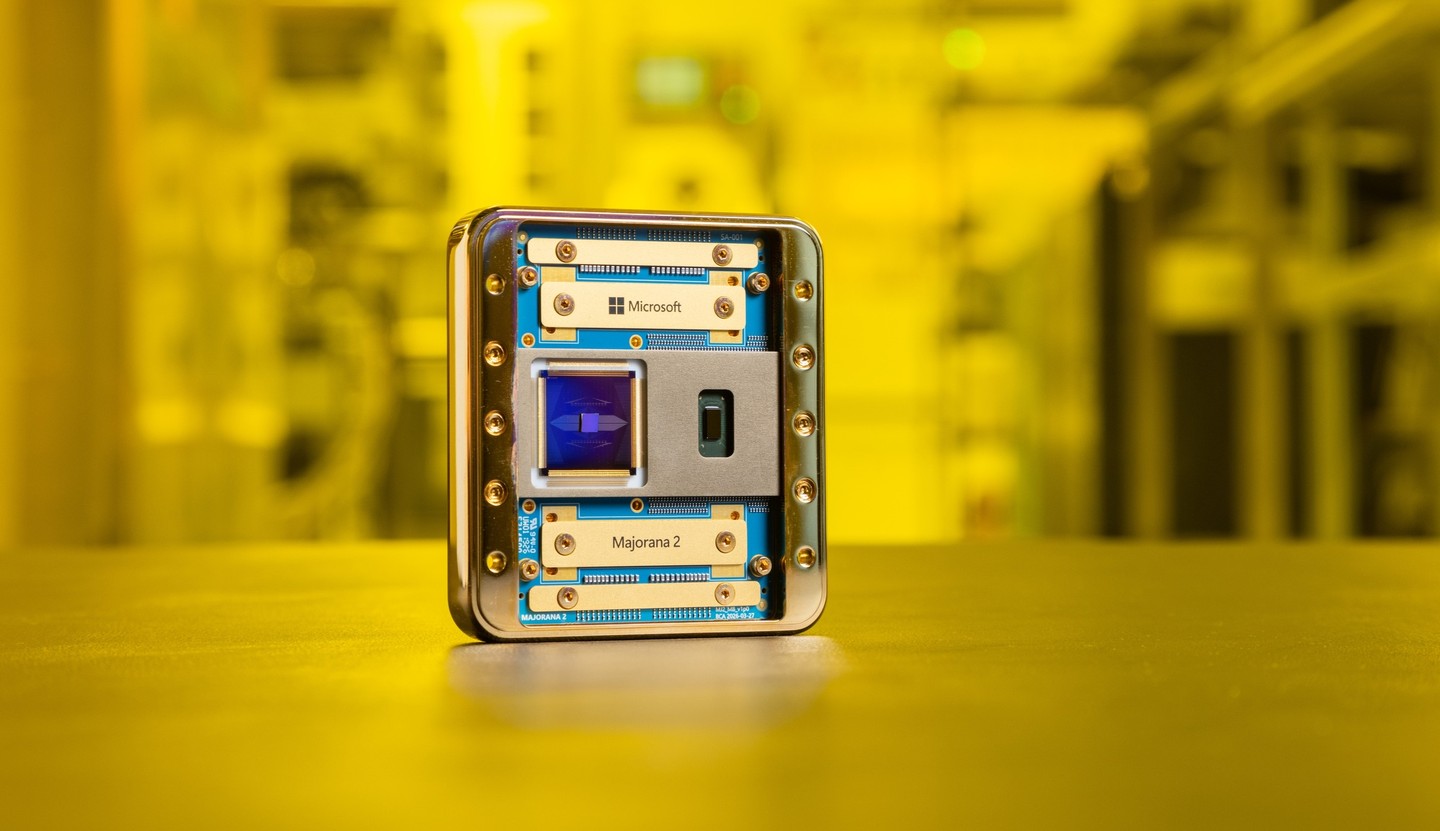
This is the subsequent version of the Majorana project, which sparked controversy in the quantum computing community last year, and represents the latest achievement in Microsoft’s pursuit of the 'topological qubits' route.
Unlike the mainstream quantum approaches of Google and IBM, Microsoft has long bet on a more radical path: using Majorana quasiparticles to build more stable, lower-error-rate qubits.
According to data disclosed by Microsoft, the new Majorana 2 features several key improvements:
- Qubit count increased to 12, up from 8 in the previous generation;
- Individual qubit coherence time exceeds 20 seconds, compared to less than 12 milliseconds for the previous generation;
- Adjustments to the chip material architecture, introducing lead-based superconducting materials to replace parts of the old design.
In the field of quantum computing, qubit stability has always been the core bottleneck determining whether the technology can move toward commercialization.
Microsoft believes that topological qubits are naturally more noise-resistant and less prone to errors, making them more suitable for future large-scale quantum systems. Due faster-than-expected recent progress, Microsoft has halved its original timeline, with the current goal being to achieve scalable, practical quantum computers by 2029.
Chetan Nayak, Microsoft executive overseeing quantum hardware business, stated,
Based on the rapid progress in quantum chips, 'we are accelerating the roadmap toward scalable, practical quantum computers. We have halved the timeline, and our current goal is to strive to achieve this by 2029.'
However, the Majorana project remains controversial. After the first-generation chip was released last year, some quantum researchers questioned whether Microsoft had sufficiently demonstrated its technological breakthroughs, and some early related research faced retractions.
Microsoft emphasizes that its project is under continuous review by the US DARPA team and that detailed data is open to collaborative evaluators.
What Is the Relationship Between Microsoft’s New AI Assistant Scout and 'Lobster'?
Another notable move at this year’s Build was the launch of the new personal AI assistant, Scout.
In terms of positioning, Scout clearly reflects Microsoft’s bet on the 'local agent' direction. Unlike traditional chatbots, Scout is closer to a personal digital assistant capable of autonomous action. Its capabilities include: browsing and understanding the local environment; invoking tools; executing multi-step tasks; long-chain planning; and running continuously on-device.
Notably, Scout is widely considered to be inspired by the recently popular open-source project known domestically as 'Lobster'—OpenClaw.
The core concept of the 'Lobster' mode is to allow AI agents to directly operate the operating system like real computer users, rather than being confined to answering questions within a chat box.
The toolchain released by Microsoft further pushes this capability into the Windows ecosystem.
Reports suggest that the emergence of Scout indicates Microsoft is launching new development capabilities to help developers deploy autonomous AI systems similar to 'Lobster' on Windows PCs, enabling agents to run directly in the local computer environment.
This means that AI on future Windows devices may not just answer questions but also be able to: operate software; automatically complete workflows; use browsers; manage files; and execute complex tasks.
To some extent, this is also Microsoft’s early layout for the 'Agent PC' era.
NVIDIA Showcases 'Local-Cloud' AI Stack at Build: Windows PCs to Become Agent Development Platforms
Beyond Microsoft’s own products, NVIDIA’s presence at this year’s Build conference was equally strong.
Jensen Huang, broadcasting from Taipei, highlighted in a joint demonstration with Microsoft CEO Satya Nadella a unified AI deployment system they are co-developing—allowing developers to seamlessly migrate Agent workloads between Windows PCs, local devices, edge environments, and the Azure cloud.
NVIDIA stated that Huang and Nadella discussed the expanded partnership between the two companies, covering specifics such as: NVIDIA’s RTX Spark PC chips for Windows and the DGX Station desktop AI supercomputer; NVIDIA open-source models on Microsoft Fabric, Microsoft’s data analytics platform accelerated by NVIDIA GPUs, and Microsoft Foundry, Microsoft’s AI and agent development platform; NVIDIA’s OpenShell secure runtime for agents in GitHub Copilot; and the next-generation AI factory powered by NVIDIA.
NVIDIA’s core logic is that future AI development should not be limited to the cloud.
Developers need a unified software and hardware stack that allows models to: run locally on Windows PCs; perform on-device inference during the development phase; deploy to edge devices; and seamlessly scale to Azure cloud training and production environments.
One important component of this demonstration was the Surface RTX Spark Dev Box and the RTX Spark platform, jointly promoted by Microsoft and NVIDIA.
This platform adopts NVIDIA’s AI chip architecture, providing developers with high-performance local AI computing power capable of supporting ultra-large models on personal devices. Some devices can run models with up to 120 billion parameters, reducing developers’ reliance on continuous cloud calls.
Meanwhile, NVIDIA also emphasized its ongoing promotion of a unified agent software stack with Microsoft, including:
- Windows local AI runtime environment;
- Azure AI Foundry compatible deployment;
- NVIDIA AI Enterprise ecosystem;
- NIM microservices and model toolchains;
- Consistent local-to-cloud agent development workflows.
What Other Major Announcements Were Made at Build?
In addition to Web IQ, Microsoft released several agent infrastructure components at this year’s Build conference.
- Project Solara: Agent Device Platform
Microsoft launched Project Solara, aiming to build a new type of 'agent-centric' device platform.
According to relevant reports, Microsoft is exploring a device interaction method 'without traditional apps,' where users will increasingly perform operations through AI agents rather than opening specific applications.
This direction aligns with Microsoft’s strategy in recent years of deeply embedding Copilot into Windows.
- MXC: Agent-Level Security Sandbox
Microsoft also released the MXC (Microsoft eXecution Container) sandbox system.
This is an operating system-level security container for AI agents, allowing agents to execute code, invoke tools, and access files in a controlled environment.
Microsoft emphasizes that as AI agents become increasingly capable of autonomous execution, security isolation mechanisms will become crucial.
Reports indicate that OpenAI and NVIDIA have already participated in the related ecosystem.
- Microsoft Agent Framework
Microsoft also heavily promoted the Microsoft Agent Framework at the Build conference.
This framework helps developers build: multi-agent systems; agent workflows; agent orchestration; agent observability; and agent governance systems.
Microsoft clearly hopes to compete with LangChain, AutoGen, and the Anthropic MCP ecosystem in the field of agent development frameworks.
- Windows AI Development Environment Upgrade
Microsoft also announced that Windows 11 will further strengthen its AI development environment, with enhancements specifically reflected in: improved Linux development experience; AI inference optimization; local model execution capabilities; and integration of agent development toolchains.
Microsoft is attempting to reshape Windows as the 'preferred platform for AI development.'
