


Loss per order reduced by RMB 2, quarterly loss narrowed by nearly RMB 10 billion—Meituan turns subsidy war into efficiency war
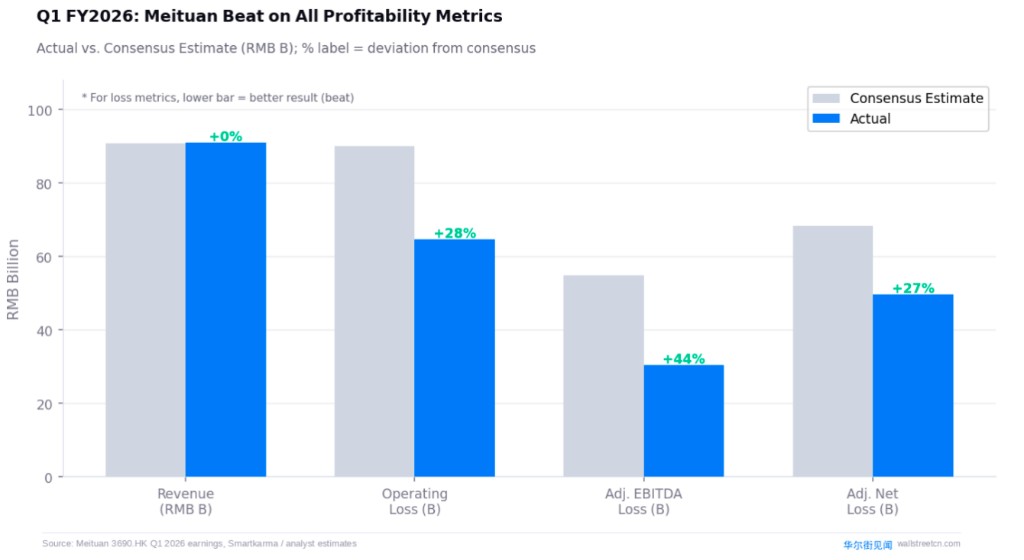
Meituan's operating loss in the first quarter narrowed significantly to RMB 6.5 billion, with its Core Local Commerce segment reducing losses by RMB 8 billion. The loss per order dropped to RMB 1.0-1.1, significantly outperforming competitors. Although Wang Xing warned of potential negative year-over-year growth in order volume for the second half of the year, Morgan Stanley and UBS raised their earnings forecasts and maintained buy ratings, reflecting market recognition of Meituan's successful transition from a subsidy war to an efficiency war
On the day following the release of its financial report, Meituan's stock price rose by more than 9%.
Supporting this surge was a better-than-expected performance in loss reduction: the operating loss of Core Local Commerce shrank from RMB 10 billion in the previous quarter to RMB 2 billion, a reduction of RMB 8 billion, which is more than double the market expectation. Looking at a longer timeframe, the company's overall operating loss narrowed sharply from RMB 16.1 billion in the fourth quarter of last year to RMB 6.5 billion, representing a quarterly loss reduction of nearly RMB 10 billion.
The market voted its confidence in this loss reduction. However, Wang Xing proactively cooled expectations for the second half of the year during the conference call, stating, "Order volume in the second half may see negative year-over-year growth." He immediately explained that this was merely a normal fluctuation caused by a high base, and that Gross Transaction Value (GTV) growth would be more resilient than order volume growth. In other words, Wang Xing was actively managing expectations rather than sounding an alarm.
Morgan Stanley and UBS maintained their buy ratings after the earnings release and both raised their medium-to-long-term earnings forecasts. Nomura remained relatively cautious with a target price of HKD 92, believing the road to recovery still has bumps. This divergence actually reflects the dual nature of the first-quarter report: the short-term, better-than-expected intensity of loss reduction coexists with the uncertainty of slowing growth in the second half of the year.
How much less was lost per order in the food delivery subsidy war
To understand Meituan this quarter, one must first understand a key figure: loss per order.
This is a core metric spawned by the subsidy wars in the food delivery industry, referring to the net loss borne by the platform for each completed food delivery order. It directly measures the combined result of subsidy intensity and operational efficiency. In the fourth quarter of last year, the loss per order for Meituan Food Delivery plus Instashopping was around RMB 1.6, a product of the most intense phase of competition—Meituan was forced to follow Alibaba's Ele.me in its subsidy offensive, losing money on every order.
By the first quarter of this year, this figure was compressed to RMB 1.0–1.1. The market had originally expected RMB 1.3–1.4.
What does this gap mean? Ele.me's loss per order in the same period was slightly above RMB 3. The efficiency gap between the two parties expanded from RMB 1.6 in the previous quarter to RMB 2.0. Put more plainly: while both are engaged in a subsidy war, Meituan loses nearly RMB 2 less per order than its competitor, and this advantage is expanding, not narrowing.
Revenue from Core Local Commerce grew by only 0.1% year-over-year, essentially remaining flat. This number looks poor, but it requires an explanation of the underlying accounting logic: subsidies provided to consumers are partly deducted directly from revenue rather than recorded as costs. The greater the subsidy intensity, the lower the reported revenue growth rate—this is a "visual distortion" caused by accounting treatment and does not mean real demand is stagnating. Judging by indicators such as GTV, order volume, and core user frequency, the fundamental business base is still growing.
Goldman Sachs analyst Ronald Kung pressed Wang Xing on competitive changes in the first quarter during the conference call. Wang's answer was: "Competition has returned to fundamentals, namely operational efficiency and user experience." The subtext is that orders bought by burning cash are unsustainable; what truly retains users is service quality—which happens to be Meituan's moat.
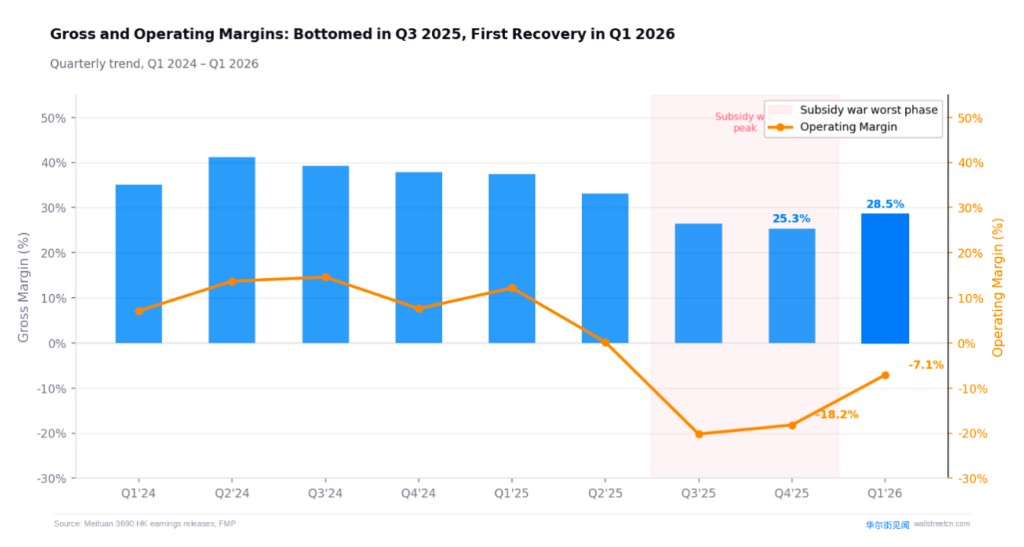
Looking at a longer timeline, Meituan's gross margin reached as high as 41.2% in the second quarter of 2024, fell to a trough of 26.4% in the third quarter of 2025, and rebounded to 28.5% this quarter. This marks the first warming trend after hitting bottom for two consecutive quarters. The direction is clear, but there is still a distance of more than 12 percentage points to historical normal levels, meaning the road ahead is long.
In-store business—Douyin's traffic cannot penetrate Meituan's moat
The monthly active merchants on Douyin's in-store business have already surpassed Meituan in certain metrics. This has been a stone weighing on Meituan's stock price.
Under questioning from Jefferies analysts, CFO Chen Shaohui gave her judgment on the competitive landscape: "Local in-store services are not just a traffic-driven business; they are built on fulfillment capabilities in the physical world and consumer trust."
Meituan's core assets in the in-store business are not exposure volume, but billions of real user reviews, a verified merchant information system, online booking and queueing systems, and consumer protection mechanisms covering non-standard services such as beauty, healthcare, and elderly care. Douyin can buy traffic, but replicating this trust infrastructure takes time.
In the first quarter, the in-store and hotel & travel businesses achieved stable growth. Order volumes in categories such as leisure and entertainment, sports and fitness, and pet services grew rapidly; emerging service retail tracks such as medical aesthetics, home-based elderly care, and home renovation are also trending upward. Management expects that profit margins in the in-store business will remain stable in the near term and have room for long-term recovery—this statement is relatively conservative, but at least indicates no further deterioration.
Regarding the hotel and travel business, management mentioned that the recent increase in aviation fuel surcharges might cause short-term disruptions to long-distance travel and high-star hotels. However, short-distance leisure travel and low-star hotels have shown strong resilience, highly overlapping with Meituan's core advantage areas.
Xiaoxiang Supermarket—Promoted from a new business subsidiary to the second growth curve
In the first quarter of this year, Meituan did something interesting: it separated commodity sales revenue from the New Businesses segment and disclosed it as an independent line item. This may look like just an accounting adjustment, but the underlying message is clear—the strategic status of Xiaoxiang Supermarket (grocery retail) has risen to a level requiring its own spotlight.
Data disclosed separately this time shows that commodity sales revenue was approximately RMB 21 billion, a year-over-year increase of about 41%, covering 55 cities, with the proportion of private-label products in GTV continuing to rise. Within the overall +21.3% revenue growth of the New Businesses segment, Xiaoxiang Supermarket was the most important contributor.
The overall operating loss of the New Businesses segment narrowed from RMB 4.6 billion in the fourth quarter of last year to RMB 2.1 billion, with the loss ratio improving from -17.1% to -7.8%. This pace of improvement exceeded most people's expectations. There were two drivers behind this improvement: first, the enhanced operational efficiency of Xiaoxiang Supermarket and seasonal tailwinds; second, the ramp-up efficiency of Keeta (the overseas food delivery business).
Keeta has currently entered Hong Kong, Saudi Arabia, Brazil, and other Middle Eastern markets. Hong Kong and Saudi Arabia have entered a phase of significant efficiency improvement; in new markets, Keeta's ramp-up speed is faster than Meituan's own pace in mature markets at the same stage. This means that the operational experience accumulated through overseas expansion is being substantially converted, not just copy-pasted.
Xiao Tuan takes the center spot on the navigation bar, AI moves from PowerPoint to financial reports
R&D investment this quarter was RMB 7 billion, a year-over-year increase of 22%, which is 16 percentage points higher than the revenue growth rate. Most of this money was used for AI.
More noteworthy is that the implementation of the AI strategy is shifting from "storytelling" to "traceability."
The AI assistant "Xiao Tuan" has been moved to the central position of the bottom navigation bar in the App—in mobile terms, this is a prime traffic entry point. Wang Xing described that Xiao Tuan can now handle cross-scenario composite commands, such as "Recommend restaurants suitable for guests who don't eat spicy food between two locations," and can dynamically update recommendations based on real-time adjustments by users. During the May Day holiday, Xiao Tuan's session volume increased significantly compared to the Spring Festival. Users are not just using it to claim coupons but are increasingly relying on it to explore new services and destinations.
On the merchant side, "Smart Shopkeeper" has served over 700,000 catering merchants, and "Digital Employees" have served over 300,000 service retail merchants. These two products began spreading from single-point applications to chain stores this quarter.
A new partnership deserves special mention: Meituan is about to integrate Agent-to-Agent with Tencent's AI assistant "Yuanbao"—when users raise local service needs within the WeChat ecosystem, they can seamlessly jump to Meituan to complete transactions. This is a new opening for traffic entry and a non-confrontational counterattack against Douyin's traffic advantage: not fighting for the entry point, but embedding itself into others' entry points.
Management provided a clear explanation of the logical link between AI and Unit Economics (UE) improvement: AI tools help Meituan match order structures more precisely without increasing manual intervention, tilting towards medium-to-high average transaction values, thereby making the retention benefit of each yuan of subsidy higher. This is the intrinsic connection between the increase in R&D investment and the improvement in loss per order.
Variables for the second half of the year—Will negative order growth be a problem?
Wang Xing stated in the conference call that affected by the high base from the same period last year, food delivery order volume in the second half of the year may see negative year-over-year growth.
This statement must be understood in context. In the second half of 2025, the industry was in the most intense phase of the subsidy war, with all platforms using subsidies to boost volume, resulting in artificially inflated order numbers. In the second half of this year, as subsidies shrink, the denominator for order volume changes, making the year-over-year figures inevitably look poor, but this does not mean real demand is shrinking.
The more critical indicator is GTV. As the order structure shifts from low-value orders to medium-to-high average transaction values, GTV growth will be more resilient than order volume growth. Wang Xing described this trend as "consumers are increasingly willing to pay for quality"—a positive signal for merchants investing in high-quality supply.
How far is Core Local Commerce from breaking even? Look at the trend in gross margin: 28.5% this quarter, compared to 37.4% in the same period last year, with the peak at 41.2% in the second quarter of 2024. To return from the current level to the historical reasonable range (35%+), the proportion of cost of sales needs to decrease by 6–7 percentage points. At the current pace of improvement, an optimistic estimate suggests it will take 3–4 quarters.
Management stated that if the competitive environment remains rational, the UE for food delivery in Q2 will be "significantly improved" compared to Q1, and food delivery is expected to approach break-even. UBS and Morgan Stanley hold similar judgments and have accordingly raised their earnings per share forecasts for 2027–2028.
Meituan is in a verification period—proving that its efficiency advantage is real and that losses are cyclical rather than structural. The first-quarter report submitted a clearer answer than expected, but the market wants to see the next one.
Risk Warning and Disclaimer
The market carries risks; investment requires caution. This article does not constitute personal investment advice, nor does it take into account the specific investment objectives, financial status, or needs of individual users. Users should consider whether any opinions, views, or conclusions in this article align with their specific circumstances. Investment based on this content is at the user's own risk.
