


Earnings Preview | Apple's Intel deal provides a "divine assist," can Applied Materials' Q2 performance support its high valuation?
Applied Materials will release its second-quarter earnings report on May 14, and Wall Street is optimistic about its performance growth, expecting earnings per share to be between $2.66 and $2.68, with revenue reaching $7.83 billion. The earnings report will reveal the capital expenditure situation of giants like Intel and Taiwan Semiconductor in the chip manufacturing sector, with a focus on the impact of AI hardware on the advanced packaging field. Analysts believe that Applied Materials' high market share in the advanced packaging market will make it the biggest beneficiary of structural growth
According to Zhitong Finance APP, Applied Materials (AMAT.US) is scheduled to release its second-quarter financial report on May 14 (Thursday). Currently, Wall Street holds a highly optimistic expectation for Applied Materials' performance growth, generally believing that its earnings per share will fall within the range of $2.66 to $2.68, with revenue expected to reach $7.83 billion. The company previously provided a second-quarter guidance range of revenue between $7.15 billion and $8.15 billion, and earnings per share between $2.44 and $2.84. As the company is at the top of the industry chain, its performance guidance not only concerns the rationality of its own valuation but also directly reveals the capital expenditure efforts of giants like Intel and Taiwan Semiconductor in the next-generation chip manufacturing field.
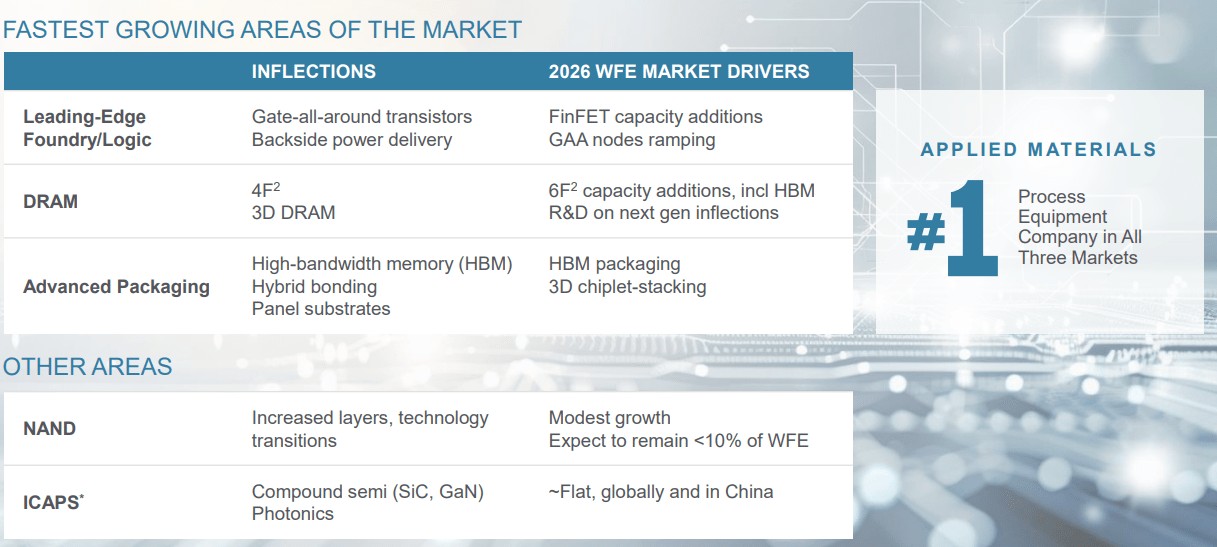
The core highlight of this quarter's financial report is the deep transmission of AI hardware dividends from logic chips to advanced packaging. With the explosive demand for high-bandwidth memory (HBM) in high-performance computing, the manufacturing focus of AI chips is no longer limited to process miniaturization but also involves the complexity of heterogeneous integration.
Market analysis points out that Applied Materials' extremely high market share in the advanced packaging equipment market makes it the biggest beneficiary of this wave of structural growth. Investors are closely watching specific data on the growth rate of packaging business orders in the financial report to verify whether the AI wave has transformed as expected from a single computing power explosion into sustained demand for manufacturing equipment, thereby bringing the company longer-term revenue momentum.
At the same time, the technological revolution in the underlying architecture of semiconductors is providing new profit growth points for Applied Materials. As first-tier foundries like Intel and Taiwan Semiconductor fully advance to processes of 2 nanometers and below, traditional transistor architectures are transitioning to Gate-All-Around (GAA) architectures.
Applied Materials' management previously revealed that the introduction of GAA technology would significantly increase equipment sales per wafer by approximately $1 billion. Therefore, the conversion speed of GAA-related orders in this quarter's report will become a key signal for measuring its profit certainty over the next two to three years. Combined with recent rumors of Intel reaching an $11 billion financing deal with Apollo Global Management, Applied Materials' order reserves in the high-end logic chip market are seen as having stronger financial guarantees.
Analysts are optimistic about Applied Materials capitalizing on chip expansion dividends
On the eve of the financial report release, Jack Bowman, a senior columnist and macro analyst at Seeking Alpha, published an article systematically outlining the investment logic of Applied Materials and gave it a "buy" rating—although he admitted that the current price is relatively high for him personally, he prefers to enter if the stock price drops after the financial report.
Bowman positions Applied Materials as the "shovel and pick" in the semiconductor field—selling shovels. He pointed out that Applied Materials aligns with his long-held logic regarding ASML (ASML.US): not pursuing short-term stock price explosiveness but rather seeking long-term winning capability. The key to "shovel and pick" type investments is not to be the fastest stock off the starting line but to be able to traverse cycles and survive to the end.
 and Intel (INTC.US) to produce iPhone chips domestically in the United States. Transforming existing wafer fabs or building new production lines requires a large amount of new equipment, which is precisely the main business of Applied Materials.
More importantly, Intel's existing wafer fabs do not produce mobile phone chips, meaning this will be a brand new incremental demand rather than a replacement of existing supply. Bowman specifically mentioned that this wave of growth has a clear political color, and the fact that the government directly holds shares in Intel has also played a role in boosting this trend.
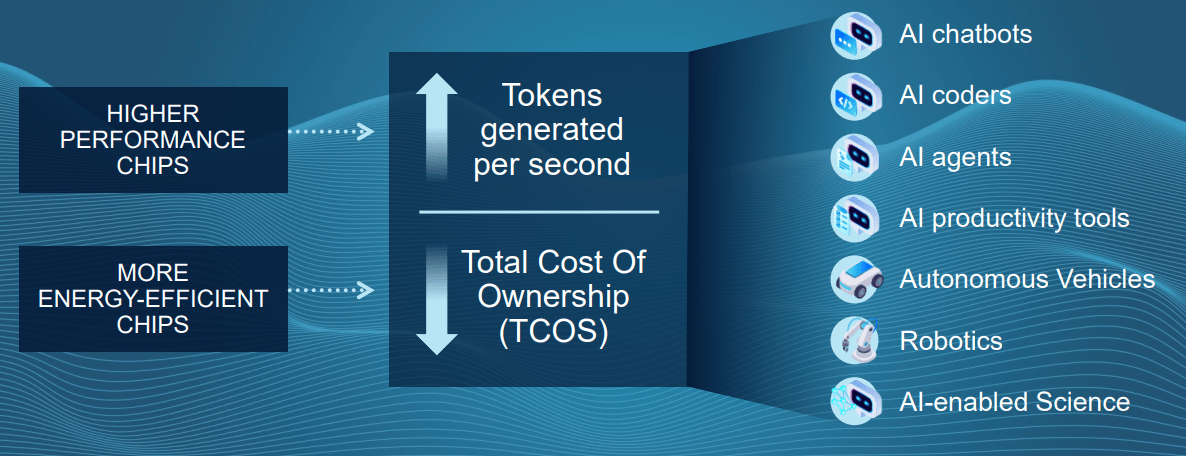
In addition to the Apple-Intel deal, Bowman believes that Applied Materials also benefits from broader structural trends. The equipment from Applied Materials covers the entire chip market—robots, autonomous vehicles, DRAM, high bandwidth memory (HBM), and other storage components are almost ubiquitous. Global memory manufacturers and packaging companies are in a frenzy of expansion, and the combination of supply shortages and explosive demand is a comprehensive positive for Applied Materials.
However, the core financial metric that Bowman is most concerned about is not revenue, but profit margins. He clearly stated that Applied Materials' operating profit margin has been relatively stagnant over the past year, but this situation is changing as the memory business flourishes. If the Q2 operating profit margin can rebound to over 34%, he will directly upgrade his rating to "Strong Buy."
The "Valuation Game" of Applied Materials
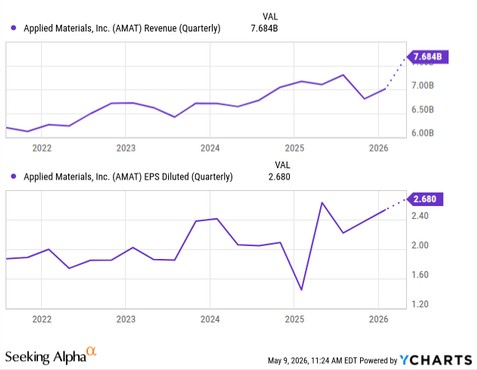
The market currently expects Q2 revenue of $7.83 billion, higher than the company's own guidance midpoint of $7.65 billion; the expected earnings per share is $2.71, also above the previous guidance of $2.68. Bowman analyzes that analysts have set a very high bar here—if Applied Materials aims for its own targets, it may be difficult to meet analysts' expectations, leading to disappointment in the market. However, he also pointed out that events such as the memory shortage last quarter, the ongoing construction of new and old wafer fabs, and the AI agent boom have led him to believe that the market's pricing for exceeding expectations is reasonable.
On the financial front, Bowman gave a very high evaluation of Applied Materials' robustness. He cited a set of data: over the past decade, Applied Materials has invested $25 billion in R&D and $8 billion in capital expenditures, but has allocated 90% of its excess free cash flow to shareholders, with a compound annual growth rate of 16% in dividends. Cash and cash equivalents have exceeded long-term debt, and the balance sheet is strong enough to support potential acquisitions In his view, during an era where everyone is shouting "bubble," Applied Materials has a financial buffer that many other semiconductor companies do not possess—this means it lacks that dazzling growth signal, but even if the bubble bursts, it may still maintain growth in the long term.
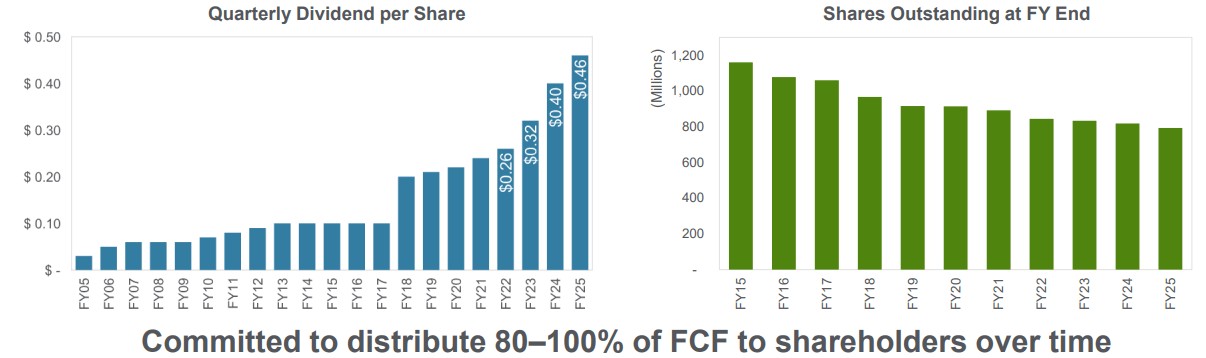
Figure 4
However, Bowman also issued a clear risk warning. Applied Materials' current forward price-to-earnings ratio is close to 40 times, significantly higher than the three-year average of 22 times. He referred to this as the biggest danger signal for deciding whether to buy before the earnings report—"buying based on a report that needs a 40 times price-to-earnings ratio to justify it is fundamentally different from buying based on a report that needs a 22 times price-to-earnings ratio to justify it."
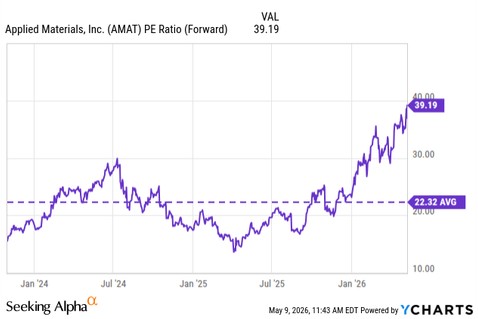
Figure 5
Ultimately, Bowman gave Applied Materials a "buy" rating, but strategically leaned towards caution: in terms of personal positions, he believes the current price is too high and has added Applied Materials to his watchlist, waiting to intervene if the stock price drops after the earnings report; however, for long-term investors, he suggests that if they are willing to endure short-term performance volatility, they could even buy before the earnings call. "Semiconductor investors looking to add shovels and picks to their portfolios should definitely consider Applied Materials," he wrote
