


Coinbase: From Crypto Brokerage to Financial Infrastructure—Where Does the Old Story Stand?
If the "Everything Exchange" strategy continues to be validated over the next 4-6 quarters, Coinbase will no longer be a beta stock tied to crypto spot trading volume, but rather a financial infrastructure platform with a moat of recurring revenue. The consensus on Wall Street is bullish, but the divergence lies in how long it will take for the company to truly tame the cyclicality of its trading revenue
① "Double Miss" Does Not Obscure Operational Quality: Q1 total revenue was $1.413 billion, down 31% year-over-year, missing the market consensus expectation of $1.53 billion; adjusted EPS was a loss of $0.17, also missing the expected $0.29. However, adjusted EBITDA remained positive at $303 million, marking the 13th consecutive quarter of positivity—despite the broader crypto market dropping over 20%, Coinbase remained profitable.
② GAAP Loss of $394 Million Is an Accounting Illusion: The loss stemmed almost entirely from a $482 million fair value loss on crypto asset investments (mark-to-market under new FASB standards). Stripping out this non-cash item, the company actually generated a profit of approximately $88 million this quarter. The quality of 13 consecutive quarters of positive EBITDA far outweighs the volatility of GAAP net income.
③ "Everything Exchange" Is Delivering: Annualized derivatives revenue exceeded $200 million, hitting a new high. Prediction markets reached $100 million in annualized revenue in less than two months after launch. Non-crypto contracts (silver, gold, crude oil) grew fourfold quarter-over-quarter. These new asset classes are not included in the trading volume KPI (which only counts spot), meaning the appearance of a 50% drop in trading volume masks the real progress in revenue diversification.
④ Take Rate Rising Against the Trend Is the Most Counterintuitive Data Point: The blended take rate rose from 0.315% in the same period last year to 0.374%. On the consumer side, it increased from 1.39% to 1.58% (as users migrated to higher-fee core trading). On the institutional side, it surged from 3.1 basis points to 8.2 basis points (contributed by Deribit). Trading volume was halved, but every dollar of trading left more money for Coinbase.
⑤ USDC Flywheel Crosses the Cycle: Stablecoin revenue was $305 million, up 11% year-over-year. The average USDC holdings within Coinbase products reached a record high of $19 billion. The revenue-sharing contract with Circle automatically renews and is non-terminable—this may be the most undervalued contract in the crypto industry.
⑥ Layoffs of 700 Employees + AI Transformation: Pull requests (PRs) per engineer increased 78% year-over-year, and integration test coverage tripled in six months. The full-year adjusted expense guidance is $4.3–4.6 billion, approximately $500 million lower than the annualized run rate in Q4 2025. Management's wording is clear: this is not just cost-cutting, but a structural transformation into an AI-native company.
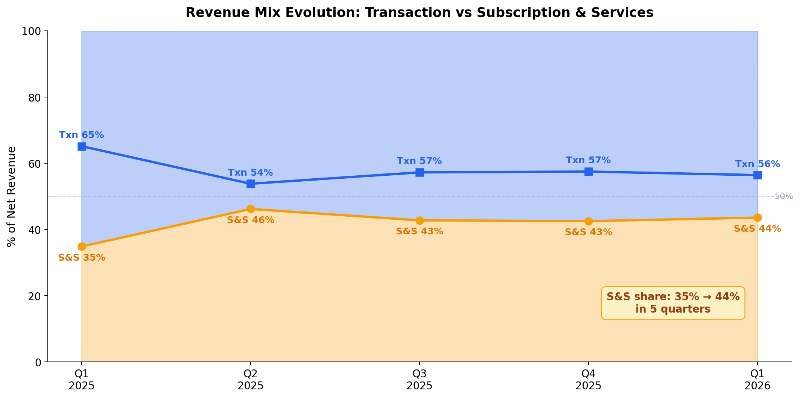
From a market capitalization of $100 billion at its direct listing in 2021, to an 86% plunge in share price during the crypto winter of 2022, followed by an SEC lawsuit in 2023, a recovery driven by Bitcoin ETF catalysts in 2024, and an SEC settlement plus the $4.3 billion acquisition of Deribit in 2025, every cyclical fluctuation for Coinbase has been accompanied by questions about its survival. This time, it has once again proven its viability—adjusted EBITDA has been positive for 13 consecutive quarters—but the 4% after-hours drop indicates that merely "surviving" is no longer enough. The "double miss" in revenue (both revenue and EPS missed expectations) shows that trading revenue still accounts for 56% of net income, and the pull of the crypto spot cycle on the top line has yet to be fully hedged.
The narrative shift worth watching is hidden in the revenue structure. The proportion of subscription and services revenue rose from 33% in the same period last year to 41%. Derivatives and prediction markets went from zero to a combined annualized revenue of $300 million. If the "Everything Exchange" strategy continues to be validated over the next 4-6 quarters, Coinbase will no longer be a beta stock tied to crypto spot trading volume, but a financial infrastructure platform with a moat of recurring revenue. The average target price given by 28 analysts is approximately $304, implying about 58% upside from the current share price. JPMorgan raised its target price to $290 before the earnings report and maintained an Overweight rating. The consensus direction on Wall Street is bullish, but the divergence lies in how long it will take for this company to truly tame the cyclicality of trading revenue.
Below is a detailed analysis of the earnings report
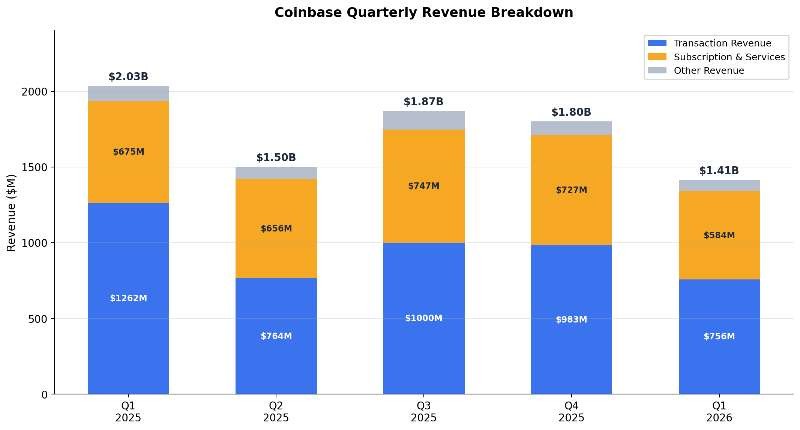
The True Meaning of the Revenue "Double Miss": Crypto Market Drag, But Operations Are Not Out of Control
Q1 total revenue was $1.413 billion, down 31% year-over-year and 21% quarter-over-quarter, missing the Wall Street consensus expectation of $1.53 billion by about 8%. Trading revenue of $756 million (down 40% year-over-year) was the main drag—global crypto spot trading volume shrank by 44% during the same period, and Coinbase's trading volume halved from $401 billion to $202 billion. But even in this environment, Coinbase's global crypto trading market share reached a record high of 8.6%, expanding about fivefold compared to Q1 2023. Users concentrating on head platforms during the crypto winter is a pattern that repeats in every downward cycle.
Horizontal comparison illustrates the point even better. Robinhood's crypto trading revenue for the same period was $134 million, plummeting 47% year-over-year, a deeper decline than Coinbase's -40%. Robinhood masked weakness in crypto with strong growth in stocks, options, and event contracts (total revenue still up 15% year-over-year to $1.07 billion)—which is precisely what Coinbase is doing through its "Everything Exchange" strategy.
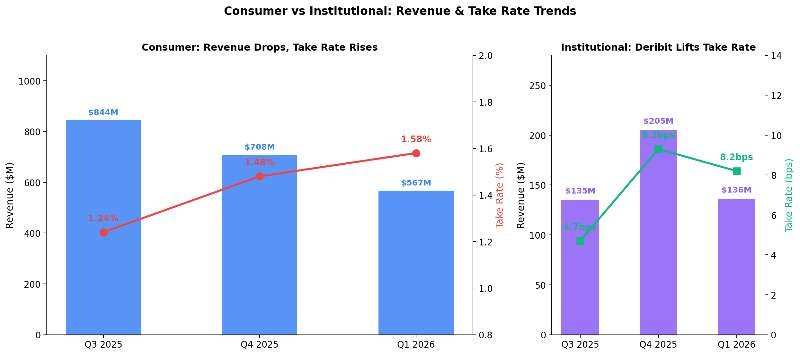
Breakdown of Trading Revenue: Consumer Side Under Pressure, Institutional Side Led by Deribit
Consumer trading revenue was $567 million, down 48% year-over-year. Consumer trading volume shrunk from $79 billion to $36 billion (-54%). However, the consumer take rate rose from 1.39% to 1.58%—this is because the user structure shifted from low-fee Advanced trading to higher-fee core trading. During market downturns, those who remain are core users willing to pay for convenience, while price-sensitive traders exit first, which instead pushes up the monetization efficiency per transaction.
Institutional trading revenue was $136 million, up 37% year-over-year, the only trading revenue line with positive growth. The incremental gain came almost entirely from Deribit—the derivatives exchange acquired for $4.3 billion in August 2025 contributed approximately $68.5 million in incremental derivatives trading revenue this quarter. Although institutional trading volume dropped from $322 billion to $166 billion (-48%), the institutional take rate surged from 3.1 basis points to 8.2 basis points, nearly tripling—derivatives naturally have a higher fee structure than spot.
Subscription and Services: The Stark Contrast Between Stablecoins and Blockchain Rewards
Subscription and services revenue was $584 million, down 14% year-over-year, but this surface figure masks severe internal divergence.
Stablecoin revenue was $305 million, up 11% year-over-year, growing counter-cyclically. The driver was the rise in USDC holdings within Coinbase products to a record high (quarterly average of $19 billion), along with growth in off-chain USDC balances—together contributing about $87.4 million in incremental revenue, partially offset by $57.5 million swallowed by falling interest rates (-67 basis points). The CFO specifically emphasized a detail on the conference call: the USDC revenue-sharing contract with Circle automatically renews every three years and is non-terminable. This means that as long as USDC supply continues to grow, Coinbase has a recurring revenue line almost unaffected by crypto price fluctuations—Coinbase captures about 50% of the total economic benefits of USDC, making this contract one of the most strategically valuable commercial arrangements in the crypto industry.
Blockchain rewards revenue was $101 million, down 49% year-over-year, nearly halved. The core reason was the decline in crypto asset prices (mainly Solana and Ethereum), which caused the same amount of staked tokens to convert into smaller USD revenue, compounded by a decline in protocol reward rates themselves. Management pointed out that the native unit count of staking balances is still growing (with increments from Solana and Cosmos), but the drag from the price side far outweighs the growth in volume.
Coinbase One paid subscriptions surpassing 1 million users is a milestone worth noting. These subscribers generate higher trading volumes and higher revenue, representing the most active user group on the platform. With the entire crypto market sluggish, 1 million people willing to pay a monthly fee to Coinbase indicates that product stickiness is being established.
Expense Side: The Cost of R&D Expansion and Signals of AI Transformation
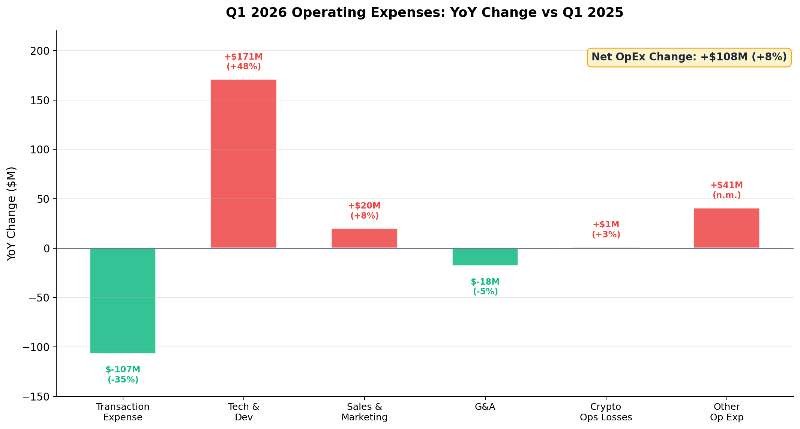
Total operating expenses were $1.434 billion, up 8% year-over-year but down 5% quarter-over-quarter. The scissors difference between expense growth and revenue contraction led to operating profit turning from $706 million in the same period last year to an operating loss of $21.4 million this quarter.
Technology and development expenses of $526 million (up 48% year-over-year) were the largest incremental item, with their share of revenue soaring from 18% to 39%. A 23% increase in headcount, one-time integration costs from the Deribit acquisition, and amortization of acquisition-related compensation jointly pushed up this figure. Sales and marketing expenses were $267 million (+8%), including a $58.9 million increase in USDC incentive spending (a direct cost of USDC balance growth), but general marketing spending was cut by $43.9 million—digital advertising was reduced, retaining only offline placements such as Super Bowl ads.
The layoff of 700 employees announced on May 5 is a post-quarter event, expected to incur one-time restructuring costs of $50–60 million in Q2. Management's full-year adjusted expense guidance of $4.3–4.6 billion, excluding USDC reward growth, is basically flat with 2025 levels—in other words, business scale is expanding, but labor costs are being absorbed by AI tools. PR output per engineer grew 78% year-over-year, and integration test coverage tripled in half a year—these are not slogans, but actual efficiency improvements already reflected in the expense structure.
The Truth Behind the GAAP Loss: Noise from Crypto Accounting
Q1 GAAP net loss was $394 million, superficially appearing as a sharp deterioration from the net profit of $65.6 million in the same period last year. But breaking it down, the $482 million "fair value loss on crypto asset investments" explains almost the entire gap. This is a direct result of the FASB's fair value accounting standard for crypto assets, effective in 2024—Coinbase holds about $1.6 billion in crypto investment assets (mainly Bitcoin), which are revalued at market price at the end of each quarter, with price fluctuations directly recorded in the income statement. This $482 million is not a cash outflow and does not affect operations, but under GAAP metrics, it makes an operationally healthy quarter look like a disaster.
Adjusted EBITDA was $303 million, with a margin of 21.5% (45.7% in the same period last year). Margin compression mainly reflects the decline on the revenue side rather than loss of control on the cost side—if revenue returns to last year's levels, the current expense structure is sufficient to support an adjusted margin of over 40%.
Capital Position and Shareholder Returns
Cash and equivalents totaled $10.4 billion (including payment stablecoins like USDC), with total available resources of $12 billion. Long-term debt stands at $7.3 billion, of which $1.3 billion in convertible bonds due in 2026 will mature on June 1. Management explicitly stated they would repay this with cash. In Q1, 6 million shares were repurchased for $1.1 billion, cumulatively offsetting about 90% of the share dilution caused by employee compensation issuance since Q4 2024. The remaining repurchase authorization is approximately $2.1 billion.
"Everything Exchange": Conversion from Concept to Numbers
The "Everything Exchange" strategy announced at the end of 2025 saw quantifiable progress for the first time in Q1. Retail derivatives annualized revenue exceeded $200 million—considering this product line did not exist less than two years ago, the growth rate is impressive. Prediction markets were even faster: launched in late February, they reached $100 million in annualized revenue by March, becoming the fastest-growing product in Coinbase's history. Non-crypto contracts (silver, gold, crude oil futures) grew fourfold quarter-over-quarter. Although the absolute volume is still small, the direction is correct.
The strategic value of these new product lines goes beyond the revenue figures themselves. Their trading volume is not included in Coinbase's "trading volume" KPI (which only counts crypto spot), meaning that when the market sees trading volume halved by 50%, actual trading activity is stronger than this number suggests. Coinbase currently has 12 product lines with annualized revenue exceeding $100 million, and prediction markets are about to become the 13th—expansion in product breadth is reducing the company's dependence on any single asset class.
Deribit's integration is expected to be completed within 2026, at which point spot, futures, and options will be unified on one platform. The timeline for crypto options trading in the US market has not been announced, but management stated there would be "news soon."
USDC and Base: The Flywheel of Payment Infrastructure
USDC market capitalization has exceeded $300 billion. Coinbase is the largest distribution platform (holding over 25% of USDC in its products) and captures about 50% of USDC economic benefits. Base chain's share of all stablecoin transactions reaches 62%. In the AI agent economy sector, over 90% of on-chain agent stablecoin transaction volume occurs on Base, with 99% settled using USDC. The X42 protocol (an open standard for agent commerce) has joined the Linux Foundation, with Cloudflare, AWS, Stripe, Shopify, and Google all as contributors.
This vertically integrated stack of "USDC + Base + X42 + Coinbase Developer Platform" is a unique asset distinguishing Coinbase from all competitors—no other company simultaneously possesses stablecoin economic interests, L2 chain dominance, and agent commerce protocol standards. If the AI agent economy explodes as expected in the next 2-3 years, Coinbase's positioning advantage in this track far exceeds its market share in crypto trading.
Outlook: The Clarity Act Is a Catalyst for Valuation Repricing
The Clarity Act (Crypto Market Structure Act) is expected to be signed into law this summer. Chief Legal Officer Paul Grewal stated on the conference call that the latest language of the bill retains activity-based reward mechanisms (crucial for Coinbase's staking and USDC reward businesses) while prohibiting passive bank-style deposit yields. After the Genius Act (Stablecoin Act) passed, over 200 large US companies announced stablecoin integration in the following months—the passage of the Clarity Act is expected to release larger-scale institutional capital inflows and space for product innovation.
Regarding Q2 guidance, subscription and services revenue is guided at $565–645 million (midpoint allows for quarter-over-quarter growth), and R&D + administrative expenses are guided at $820–870 million (down 4-9% quarter-over-quarter). Management provides no guidance for trading revenue, stating its "inherently non-linear" characteristics depend on crypto market trends.
Among 28 analysts, buy ratings constitute the majority, with an average target price of approximately $304 (lowest $140, highest $440), implying 58% upside from the post-earnings share price of about $193. JPMorgan raised its target price from $252 to $290 before the earnings report; Benchmark slightly lowered its target from $267 to $260. The analyst consensus direction is clearly bullish, but the divergence centers on one core question: When will Coinbase's revenue truly break free from the constraints of the crypto spot cycle? Derivatives and stablecoins are building the answer, but this quarter's "double miss" reminds everyone—trading revenue still accounts for 56% of net income, and the transformation is far from complete.
The most memorable number from this earnings report is not the 31% revenue decline, but the 41% share of subscription service revenue. Two years ago, this figure was less than 25%. The day it breaks 50%, Coinbase's valuation framework will be completely rewritten—from a beta stock of crypto trading volume to a compound growth stock of financial infrastructure.
