


Oil Prices Rise for Six Consecutive Days; Trump's 'Line Drawing' Fails This Time
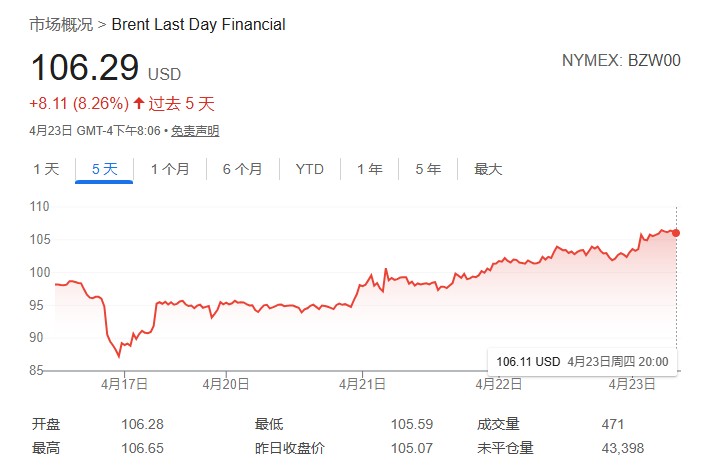
Oil prices rose for the sixth consecutive day, with Brent crude reaching approximately $106 per barrel in early trading and a weekly gain of about 16%. Reports indicate that President Trump's aggressive posts on social media and ongoing maritime blockades are viewed by US officials and Iranian negotiators as major obstacles to peace talks. Meanwhile, divisions have emerged within Trump's advisory team: one faction advocates continuing pressure until Iran's oil storage facilities become full, while another fears that high oil prices could negatively impact the midterm elections
President Trump's social media attacks seem to be overturning his own negotiating table.
On Friday, April 24, oil prices rose for the sixth consecutive trading day. West Texas Intermediate (WTI) climbed to around $97 per barrel, while Brent crude reached approximately $106 per barrel in early trading, marking a cumulative weekly increase of about 16%. The core logic driving this rally is singular: prospects for US-Iran negotiations have once again been clouded, and markets are now pricing in a more prolonged standoff.
According to recent media reports, Trump's series of posts on Truth Social, along with his continued enforcement of maritime blockades on Iranian ports, are undermining negotiation efforts conducted through intermediaries such as Pakistan—according to two US officials familiar with the matter. Iranian negotiators also believe these posts aim to humiliate Tehran's leadership, making them less willing to reach an agreement.
Dennis Kissler, Senior Vice President at BOK Financial Securities, stated: "Tensions are tightening further—the market is now pricing in a more intense and longer-lasting confrontation."

Trump's Posts Become a 'Stumbling Block' for Negotiations
In his posts, Trump wrote: "Iran does not want to close the Strait of Hormuz; they want it open so they can earn $500 million per day." He also described Iran's new president as "far less radical and much smarter than his predecessor."
Mohammad Bagher Ghalibaf, Speaker of the Iranian Parliament and chief negotiator, characterized these posts as "media warfare and public opinion manipulation." Iranian President Masoud Pezeshkian stated on Wednesday that while Iran welcomes negotiations with the United States, "blockades and threats are the primary obstacles to genuine negotiations."
In response, a White House spokesperson, speaking on condition of anonymity, said: "President Trump has no intention of protecting the face of Iran's leadership; he takes negotiations seriously, with the goal of ensuring America's long-term national security."
Alex Vatanka, a senior fellow specializing in Iran issues at the Middle East Institute, bluntly stated: "Trump's posting style is undermining his own position that diplomacy should work. For the Iranian regime, effective methods are quiet and low-key, not high-profile attacks on Iran's leaders via media or social media."
Divisions Within the Advisory Team
As Trump continues to "post" on social media, media outlets citing US officials report clear strategic splits within his advisory team.
One faction believes blockades should continue to buy time. Their reasoning: since Iran cannot export oil normally, its storage tanks may become "full" within weeks, forcing it to make greater concessions. To this group, Trump's social media posts serve to "run down the clock."
On Thursday, Trump told reporters in the Oval Office that he agrees with this assessment and is in no rush to reach an agreement: "Do you know who is under time pressure? It's them. Because if their oil cannot move, their entire oil infrastructure will 'explode'—they have nowhere to store it."
Another faction holds the opposite view. These advisors believe it is now the right time to seek a way forward. They worry that if the disruption at the Strait of Hormuz persists too long, high oil prices will cause deeper economic damage domestically and trigger political backlash in November's midterm elections. To this group, Trump's tough rhetoric may be eroding progress previously built by negotiators.
Where Negotiations Are Stuck
The US and Iran remain deadlocked on several core issues, including Iran's nuclear capabilities and Israel's military actions against Lebanon.
According to combined reports from CCTV News and Xinhua News Agency, a ceasefire agreement between the US and Iran took effect just over two weeks ago. The first round of negotiations held in mid-April in Pakistan ended without results. This week, Iran refused to send a delegation to Islamabad for the second round of talks. JD Vance had prepared to lead a delegation but ultimately did not travel due to the cancellation. Although Trump announced on Monday that the ceasefire would be extended, negotiations themselves remain stalled.
Iran's demands include: lifting sanctions, guarantees limiting negotiations on nuclear and missile programs, security assurances against further military strikes, and some form of formal control over shipping in the Strait of Hormuz. The United States and Israel have clearly stated they will not accept the latter two demands.
According to Bloomberg's report last week, some Gulf Arab nations and European leaders believe that reaching an agreement on broader issues will take at least six months. Currently, parties are exploring a possibility: first reach a temporary agreement to reopen the strait and end the blockade, leaving other disputes for subsequent negotiations.
Traffic through the Strait of Hormuz has nearly come to a halt, with only occasional movements by Iranian-related vessels. On Thursday, US troops boarded a supertanker carrying Iranian oil in the Indian Ocean, intensifying the maritime blockade. Meanwhile, on Wednesday, Iran fired upon ships and detained two vessels.
