


Morgan Stanley: Apple Quietly Hoarding TSMC Capacity, Possibly for Self-Developed AI Server Chips
Morgan Stanley's latest research report reveals that Apple is quietly hoarding a massive amount of TSMC's advanced packaging capacity, far exceeding the needs of its Mac business. Morgan Stanley believes this capacity is intended for Apple's self-developed AI server chip "Baltra," built specifically for private cloud. This will shift Apple's AI infrastructure from traditional Opex toward Capex
According to Chasing Wind Trading Desk, Morgan Stanley released a research report on April 10, revealing Apple's massive layout in the field of Private Cloud Compute (PCC) by tracking capacity anomalies deep within the supply chain.
It reveals that Apple's strategic focus is shifting from reliance on third-party cloud services to large-scale internal asset-heavy Capex, providing a key anchor for assessing Apple's subsequent cost control and profitability trends.
Massive Wafer Orders Expose AI Ambitions
Apple is quietly buying out TSMC's advanced packaging capacity.
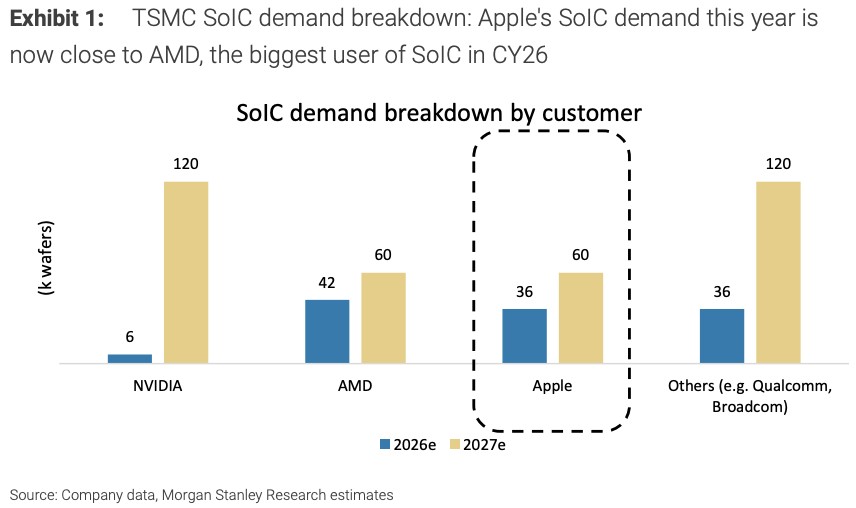
Apple's SoIC (System on Integrated Chips) orders at TSMC will reach 36,000 wafers in 2026 and surge to 60,000 in 2027.
This figure is highly unusual: for context, current largest SoIC customer AMD's demand in 2026 is only 42,000 wafers.
Combined with IDC data, Apple's high-end Mac shipments account for a very low proportion of annual volume, and its actual SoIC capacity consumption would not exceed 1,600 wafers at most. Clearly, such colossal wafer orders are not for selling computers.
Targeting "Baltra" Self-Developed Computing Servers
Since regular consumer-grade chips have been ruled out, where is this expensive advanced capacity heading?
Morgan Stanley's inference points directly to Apple's secretive internal project — a self-developed AI server chip (internal codename "Baltra") specifically designed for Private Cloud Compute.
"Based on the absolute scale of Apple's orders... we believe most of the SoIC capacity is intended for Apple's Private Cloud Compute (PCC) 3nm AI ASIC ('Baltra').
This will replace the currently used M-series Ultra processors to achieve better AI inference performance and efficiency."
Shift Toward Capex and the Core Uncertainty
This aggressive underlying hardware bet not only validates previous rumors about Apple's multi-year collaboration with Broadcom but also sends a clear signal to Wall Street: Apple has high confidence in the explosion of inference demand for Apple Intelligence.
Most AI workloads will be locked to run on Apple's own chip servers, which will shift its AI infrastructure from traditional Opex toward more long-term Capex.
However, behind this grand narrative of vertical integration, Morgan Stanley also maintains a sober observation: although the strategic intent to control costs is clear, the actual performance and energy efficiency of Apple's self-developed AI ASIC under large-scale deployment remains the biggest unknown in this computing gamble.
