


Three Recovery Paths for Hormuz: Ceasefire Agreement Shaky, Yet the Market Picks the Most Optimistic One?
A US-Iran ceasefire has been reached, but the blockade of the Strait of Hormuz has become more severe than before the ceasefire – by the day after the ceasefire, energy vessels transiting the strait fell to near zero. JPMorgan warns that the market is betting on a full recovery in June, pricing in the most optimistic scenario with little room for error. If this is delayed by a month, oil prices face an upside risk of $15 to $20 per barrel
The US and Iran announced a two-week ceasefire, and the market immediately bet on a rapid resumption of traffic through the Strait of Hormuz. However, data presented a starkly different signal – on the day of the ceasefire (April 7th), only 7 energy-related vessels transited the strait, accounting for 15% of pre-war energy transit volume; by April 8th-9th, the transit volume had fallen to near zero. The ceasefire agreement is in place, but the strait is effectively more congested than the day before.
According to the "Chase Wind" trading desk, Parsley Ong, J.P. Morgan's Head of Asia Energy & Chemicals Research, clearly stated in a recent report that the current oil forward curve largely reflects an "aggressive reopening" scenario, where energy flows through Hormuz reach 50% of pre-war levels in May and 100% in June. However, if a 100% recovery is delayed until July, oil prices face an upside risk of $15 to $20 per barrel relative to the current forward curve. In other words, the market is pricing in the most optimistic scenario, leaving very little room for error.
The volume of cargo stranded on the west side of the strait is already considerable. As of April 9th, 346 energy vessels were stranded, of which 241 were fully loaded, carrying a total of 104 million barrels of crude oil and condensate, 5.5 million barrels of LPG, and 1.3 million tons of LNG. The smooth departure of these cargoes would contribute more to replenishing global inventories than releasing onshore reserves. Meanwhile, upstream production in the entire Middle East region has cumulatively halted by 1.13 million barrels/day. The reasons for these production halts are mostly not due to damaged facilities, but rather export blockages leading to full storage tanks and forced well shut-ins.
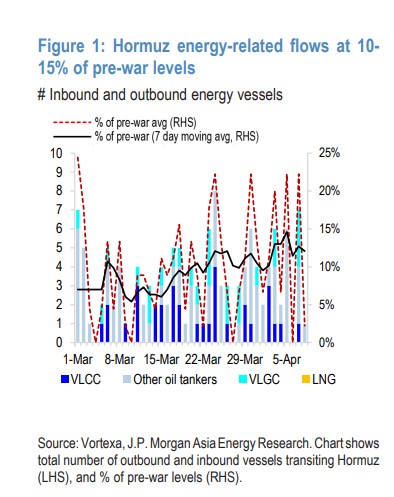
Energy Transit Volume Nears Zero; Physical Bottlenecks Limit Recovery Speed
Before the conflict, 120 to 140 various ships transited the Strait of Hormuz daily, with about 45 related to energy. After the ceasefire, the actual physical limitations are proving more difficult to circumvent than geopolitical factors. Currently, the only available transit corridor is the Larak-Qeshm area, which, due to channel width constraints, can theoretically allow a maximum of 12 to 15 ships to pass per day.
The prioritization is also an unresolved variable: who gets priority, departing or arriving vessels; who gets priority, energy ships or container/bulk cargo ships; and among departing energy ships, what is the proportion of crude oil carriers versus LPG carriers – none of these have clear answers. Of the 12 ships that transited on April 7th, 7 were energy vessels, with 5 departing and 2 arriving, representing only 9% of the pre-war daily average transit volume.
The situation for LNG is particularly dire. The only LNG carrier to have transited the strait since the ceasefire was an empty vessel, currently anchored offshore Oman LNG. Two fully loaded Qatari LNG carriers (Al Daayen and Tasheeda) approached the strait entrance on April 6th before turning back. There are currently 16 LNG carriers within the strait, 13 of which are fully loaded, carrying approximately 1.3 million tons of LNG in total. Of this, 50% was originally destined for South Korea, 12% for India, and 16% for Pakistan.
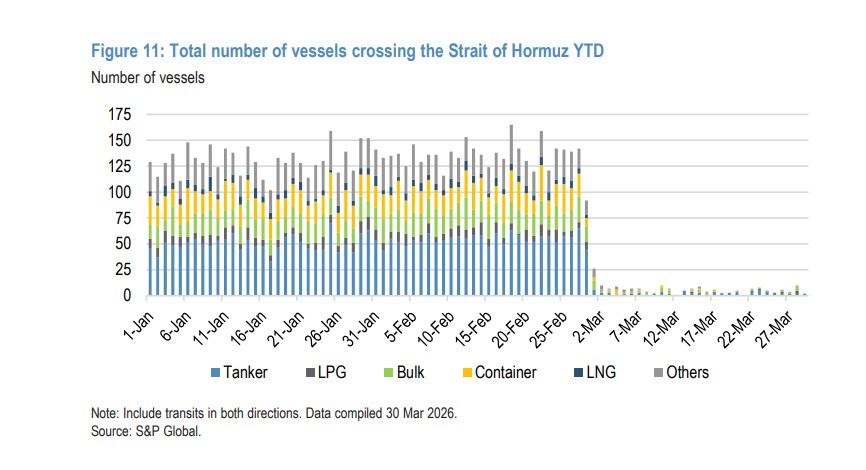
Market Pricing in "Full Recovery by June"; A Month's Delay Means $15-$20 Upside for Oil
JPMorgan has designed three scenarios to assess the impact of different recovery paces on global oil inventories and prices.
"Aggressive Reopening": 50% recovery to pre-war levels in May, 100% in June. This is largely what the current forward curve reflects.
"Intermediate" Scenario: 50% recovery by June, 100% by July – only one month later than the aggressive scenario, but with a corresponding oil price upside of $15 to $20 per barrel.
"Slow" Scenario: Transit volume further drops to 5% of pre-war levels in April, recovering to 50% in July, and reaching 100% only in August. Along this path, global oil inventories will bottom out at 6.9 billion barrels in August, still 12% below pre-war levels two years later. However, a supply shock of this magnitude would likely trigger significant increases in US shale oil production and demand destruction – if supply growth exceeds demand growth by 3 million barrels/day starting from April 2027, global inventories would roughly return to pre-war levels by the end of 2028. The core difference among the three scenarios is not "whether" recovery will happen, but "at what speed" it will happen, and this question currently has no answer.
Subsidies Are Draining, Controls Are Tightening; Asian Governments' Fiscal Buffers Are Thinning
The energy price shock is rapidly eroding the fiscal space of governments worldwide.
Japan's monthly expenditure for subsidizing gasoline and diesel price caps is 500 billion yen, with the national treasury having only 1 trillion yen left as of the end of March; Malaysia's monthly fuel subsidy expenditure has risen from 700 million ringgit before the conflict to 4 billion ringgit; Indonesia's energy subsidy budget for 2026 is 381 trillion Indonesian rupiah, and authorities estimate an additional 100 trillion rupiah will be needed.
The response direction across countries is largely consistent: export bans to secure domestic supply, price caps to control inflation, and electricity rationing to reduce demand. South Korea has extended its price caps of 1,934 Korean won per liter for gasoline and 1,923 won for diesel until April 23rd; India has implemented priority allocation for LPG, with hospitals, food processing, and agriculture at the front of the line, and limited supply for other industries; Bangladesh mandates retailers to close by 7 PM and compresses office hours from 9 AM to 4 PM; Indonesia has set a daily fuel rationing limit of 50 liters for private cars starting April 1st. The common logic behind these policies is to pass the pressure of scarcity downwards rather than solving the supply problem itself.
11.3 Million Barrels/Day Halted; Restarting Is Not as Simple as Turning a Valve
Among the upstream production losses in the Middle East, Iraq contributed 3.4 million barrels/day (from 9 southern oil fields), Kuwait 1.4 million barrels/day, the UAE 2.2 million barrels/day, Saudi Arabia 2 million barrels/day, and Qatar 0.5 million barrels/day. Most of these production halts were due to full storage tanks and export blockages forcing well shut-ins, rather than direct facility destruction, theoretically allowing for a quick restart.
However, several cases of infrastructure damage require longer repair times. The Fujairah port in the UAE suffered drone attacks on March 14th and 16th, causing oil storage tanks to catch fire and partially halting loading operations; the Pearl GTL plant in Qatar was hit by missiles, causing severe damage to one of the two trains with a daily production of 300,000 barrels, expected to be highly complex to repair; Iran's South Pars condensate processing facility was attacked, reducing daily output by 170,000 barrels. This means that even if the Strait of Hormuz channel is fully reopened, the recovery of some production capacity will still take time and will not automatically rebound with the ceasefire.
