


On the Eve of Weekend US-Iran Negotiations, European Stocks Open Mixed; S&P 500 Records Best Weekly Performance in Nearly a Year, Dollar Strengthens Slightly
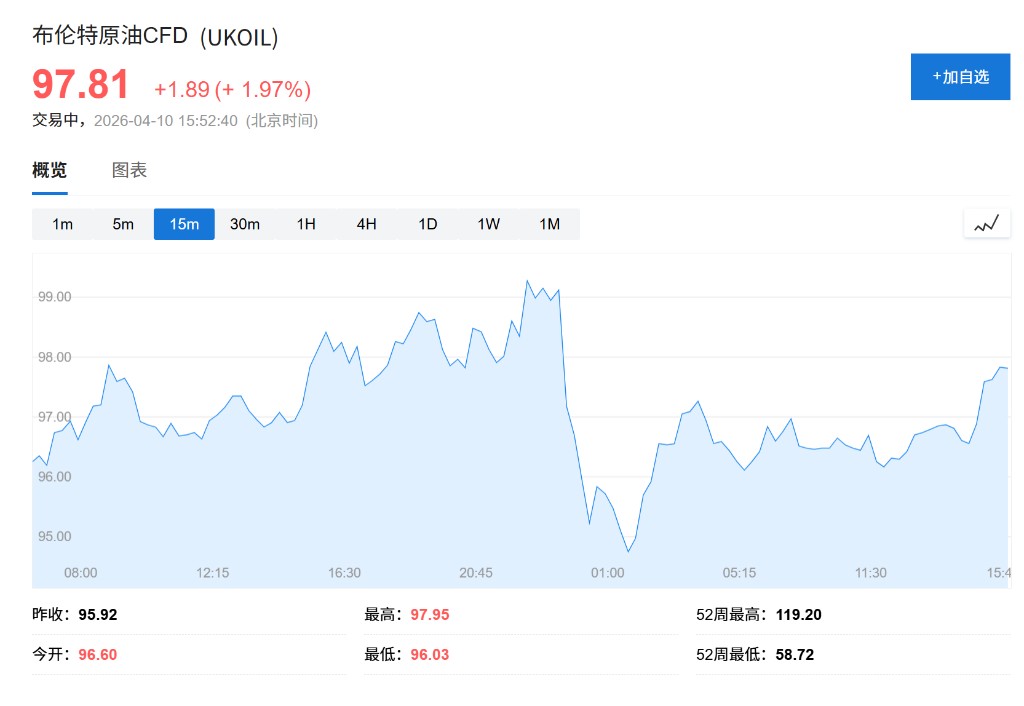
US stock index futures were largely flat on Friday. The European Stoxx 50 opened up 0.14%, the DAX Stock Index rose 0.46%, and the UK FTSE 100 fell 0.11%. Brent crude prices recovered slightly by 1.5% to $97 per barrel on Friday, but remain at lows following a sharp decline this week. US Treasury prices are poised to end a four-day winning streak, and the dollar strengthened slightly by 0.1%, though it still recorded its largest weekly drop since January
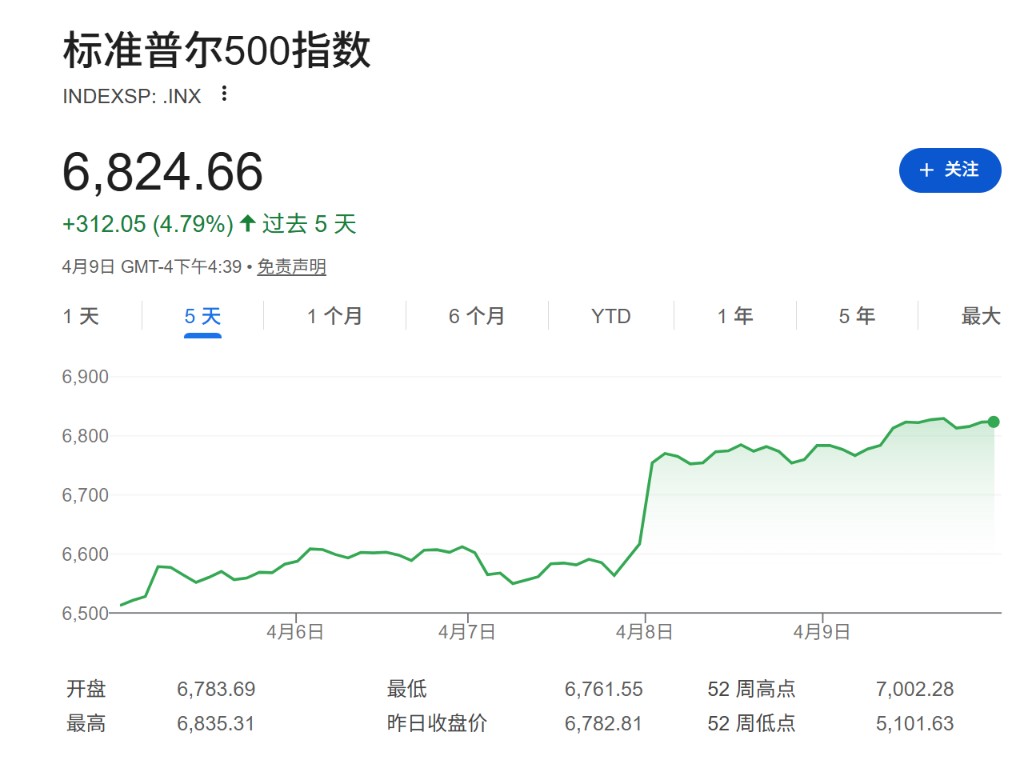
After a turbulent week, global stock markets entered a wait-and-see mode on Friday. Despite a significant rebound driven by a US-Iran ceasefire agreement this week, which propelled the S&P 500 to its strongest weekly performance in nearly a year, investors are closely awaiting the outcome of US-Iran negotiations over the weekend to determine whether this fragile truce can evolve into a lasting agreement.
US stock index futures were largely flat on Friday. As of now, the S&P 500 has risen approximately 3.7% this week, the Dow Jones Industrial Average is up 3.6% for the week, and the Nasdaq Composite has gained nearly 4.3%, positioning it for its best weekly performance since November 2025. The European Stoxx 600 index rose slightly by 0.1%, following a general upward trend in Asian markets. Brent crude prices recovered slightly by 1.5% to $97 per barrel on Friday, but remain at lows following a sharp decline this week.
According to Xinhua News Agency, Trump expressed "optimism about the progress of negotiations" on Thursday, but simultaneously warned Iran to stop collecting tolls in the Strait of Hormuz. The two-week ceasefire agreement reached on Tuesday had triggered a sharp rise in stock prices and a plunge in oil prices; however, the actual implementation of the ceasefire remains in doubt—the Kuwaiti Ministry of Foreign Affairs disclosed on Thursday evening that Iran and its proxy armed groups launched a new wave of drone attacks that day, targeting multiple important facilities within Kuwait.
Beyond geopolitical uncertainties, investors on Friday will also focus on US March Consumer Price Index (CPI) data to assess the extent to which the energy price shock caused by the Iran war is being transmitted to inflation. US Treasury prices are poised to end a four-day winning streak, and the dollar strengthened slightly by 0.1%, but still recorded its largest weekly drop since January.
- European stocks opened mixed, with the European Stoxx 50 up 0.14%, the DAX Stock Index up 0.46%, the UK FTSE 100 down 0.11%, and the French CAC 40 up 0.04%.
- US stock index futures were largely flat.
- The Nikkei 225 closed up 1.8% at 56,924.11. The TOPIX closed down 0.04% at 3,739.85. The South Korean KOSPI closed up 1.4% at 5,858.87.
- The US Dollar Index rose 0.1%.
- The Japanese yen fell 0.2% to 159.29 against the dollar.
- The Korean won extended its decline against the dollar to 0.7%.
- US 10-year Treasury yields rose 2 basis points to 4.30%.
- Japanese 20-year Treasury yields rose 4 basis points to 3.325%.
- WTI crude oil rose 2% intraday to $99.84 per barrel, and Brent crude oil rose 1.9% intraday to $97.73 per barrel.
- Spot gold fell 0.3% to $4,752.73 per ounce.
- Bitcoin fell 0.9% to $71,763.04.
Fragility of Ceasefire Agreement Continues to Suppress Market Sentiment
The core driver of market movements this week has consistently been the existence and evolution of the US-Iran ceasefire agreement. On Tuesday night, Trump agreed to extend the deadline for Iran to reopen the Strait of Hormuz by two weeks. Buoyed by this news, the three major US stock indices all jumped over 2% on Wednesday, with the Dow Jones recording its largest single-day gain since April 2025.
However, the fragility of the ceasefire was soon exposed. Hostilities continued in the region on Wednesday, and both sides only largely paused most strikes thereafter. Israeli Prime Minister Benjamin Netanyahu subsequently agreed to "negotiate as soon as possible" with Lebanon, but Iranian Parliament Speaker Mohammad Bagher Ghalibaf immediately pointed out that Israel's continued strikes on Lebanon constitute a violation of the US-Iran ceasefire agreement. The news of drone attacks on Kuwait further cast a shadow over the prospects of a ceasefire.
Bloomberg strategist Garfield Reynolds pointed out that investors seem eager to ignore the concerns about the fragility of the US-Iran ceasefire as long as Trump does not signal a resumption of hostilities, but this also means that the current stock market rally shows signs of overheating— the market is focusing on the potential for a truce, yet ignores the impact of the ongoing supply shock caused by the war.
Hao Hong, Chief Investment Officer at Lotus Asset Management, stated, "The market is beginning to price in some sort of agreement over the weekend. My quantitative models suggest that the technical rebound should last for several more days. The market is starting to look ahead, beyond the war itself."
Some Institutions Maintain Positions, Focusing on Negotiation Direction
In the face of uncertain weekend prospects, market participants are divided on their approach to position adjustments. Rajeev De Mello, Global Macro Portfolio Manager at Gama Asset Management SA, commented, "I am not reducing positions before the weekend, as the current overarching direction seems to be negotiation rather than combat."
Kyle Rodda, Senior Financial Markets Analyst at Capital.com, wrote in a research note, "Headline risks related to the war remain the primary driver of market volatility, but inflation data also constitutes significant event risk."
Stephen Parker, Co-Global Investment Strategy Head at J.P. Morgan Private Bank, holds a relatively optimistic view on the sustainability of the rebound. In an interview with CNBC, he said, "The magnitude of the pullback in US equities may not seem large compared to the shock experienced in energy markets, but I believe this reflects market expectations that energy prices will decline." He further added:
" Our base case scenario is that energy prices will continue to gradually decline over the next three to six months, economic growth will be mildly impacted, and inflation will rise slightly, but overall this remains a positive environment for equities, especially as we enter the earnings season, where we expect very positive results. "
CPI Data Constitutes Additional Event Risk
Beyond geopolitics, US March CPI data, due for release on Friday, is another significant market catalyst for the day. According to a Bloomberg survey of economists, the CPI is expected to rise by 0.9% month-on-month, the largest monthly increase since 2022; a Dow Jones survey of economists projects a year-on-year increase of approximately 3.3%. Additionally, durable goods orders and factory orders data will also be released on the same day.
The US Treasury market has already priced in some of the expected inflationary pressures, facing pressure after a four-day rally. Analysts suggest that this inflation data will provide an important reference for assessing the extent to which the energy price shock triggered by the Iran war is being transmitted to consumer spending, thereby influencing market expectations regarding the Federal Reserve's policy path.
Linkage of Asian, European Markets, and Commodities
In Asian markets, Japanese Prime Minister Sanae Takaichi stated on Friday that Japan plans to utilize oil reserves equivalent to 20 days of consumption starting in May. According to Reuters, as of April 6th, Japan's oil reserves were sufficient for approximately 230 days of use. This move is interpreted by the market as a precautionary measure by the Japanese government to cope with energy supply uncertainties.
In Europe, investors will also be watching Germany's monthly inflation data, to be released on the same day, to assess the impact of the Iran war on European consumer prices. European stock markets closed lower on Thursday, reflecting the continued suppression of market sentiment due to the ceasefire's fragility; they rebounded slightly after opening on Friday, with the UK FTSE 100, French CAC 40, and DAX Stock Index all showing slight gains.
