


Middle East War Escalates, Gold Plummets Again, When Will the King of Safe Havens Return?
Trump declared escalation of the war, and spot gold fell 3%. Since the outbreak of the Middle East conflict, gold prices have continued to fall, with a decline of about 12% in March, and its safe-haven attribute has been questioned. Goldman Sachs believes that the current decline is due to short-term factors such as the reshaping of inflation expectations, repricing of interest rate paths, and forced liquidation of positions, rather than structural failure. The return of gold as a safe haven requires waiting for real interest rates to fall and speculative positions to be further digested
Gold is experiencing an identity crisis. This traditional safe-haven asset has fallen rather than risen after the outbreak of war in the Middle East, leading the market to deeply question its safe-haven properties.
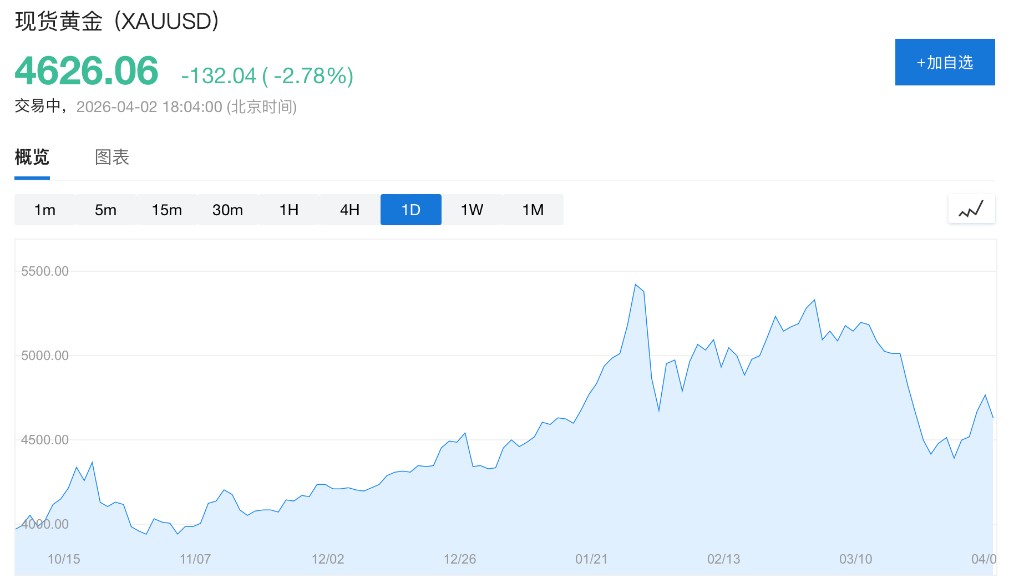
On Thursday, Trump stated, "Extremely severe strikes will be launched against Iran in the next two to three weeks." The market experienced renewed volatility, with spot gold falling 3% to $4,626 per ounce. Since the outbreak of the Middle East conflict, gold prices have fallen by approximately 15%, with a monthly decline of about 12% in March.
In their latest report, Goldman Sachs commodity research analysts Lina Thomas and Daan Struyven pointed out that this decline is primarily driven by three factors: high oil prices are boosting inflation expectations, the market is repricing the Federal Reserve's interest rate path to no rate cuts throughout the year, coupled with the forced liquidation of early bullish option positions, which amplified the decline. The current pullback is more due to technical and short-term macroeconomic factors, and does not shake their medium-term bullish outlook for gold.
Safe-Haven Logic Fails: Why War Depressed Gold Prices
This decline in gold prices does not mean gold has lost its hedging function, but rather it is a normal market reaction to the nature of inflation shocks.
Two types of stagflation scenarios have distinctly different impacts on gold.
The first is a scenario where institutional credibility is damaged. When the market questions the central bank's willingness or ability to curb inflation, such as the combination of fiscal expansion and misguided Fed policy in the 1970s, gold tends to rise significantly. The second is stagflation driven by supply shocks, where energy supply disruptions suppress economic growth while simultaneously pushing up prices. Historically, gold has typically underperformed the broader market in the initial stages of such scenarios.
The current Middle East conflict is closer to the latter. The inflationary risk brought by energy supply shocks has led the market to price in monetary policy tightening, pushing up real interest rates, thereby reducing demand for gold ETFs. Simultaneously, adjustments in the stock market have further triggered gold liquidations related to margin calls.
According to MarketWatch, when gold prices hit a high of $5,626 per ounce in January of this year, the market had accumulated large speculative long positions, and demand for call options reached historical highs. After the conflict broke out, deleveraging rapidly ensued, and traders who had previously used gold longs to hedge short positions in "Magnificent Seven" stocks, software stocks, or Bitcoin began to close out their positions.
Furthermore, physical selling by some countries has also added pressure. Turkey was forced to sell gold to support its currency; the Polish central bank, one of the largest strategic gold buyers globally in recent years, has publicly discussed selling gold for defense spending; and Middle Eastern oil-producing countries, facing obstructed oil exports and a shortage of dollar revenue, may also be forced to use their gold reserves to pay for imports.
Three Pillars of Support: Goldman Sachs Maintains $5,400 Target
Goldman Sachs maintains its baseline forecast of gold prices reaching $5,400 per ounce by the end of 2026 and outlines three core driving forces.
First, speculative positions have been largely cleared, and valuation attractiveness has improved. Net speculative long positions on Comex have fallen to the 39th percentile historically, and the call option positions accumulated since January have been largely liquidated. The market is currently pricing in a more hawkish monetary policy shock than historical experience suggests.
Historical patterns show that negative oil supply shocks typically lead to slightly higher policy rates in the initial 1 to 3 months, but growth concerns dominate after 6 to 9 months, causing interest rates to decline. The normalization of speculative positions itself is expected to contribute approximately $195 per ounce to gold prices.
Second, the Federal Reserve's rate cut expectations provide price support. The Fed is expected to implement two rate cuts totaling 50 basis points in 2026, which is estimated to add approximately $120 per ounce to gold prices.
Third, central bank gold purchasing demand constitutes a medium-term anchor. Assuming no additional private sector diversification, it is expected that as gold price volatility decreases, central banks will re-accelerate their gold purchases, with an average monthly purchase of about 60 tons, higher than the average of 52 tons over the past 12 months. This purchasing pace is expected to contribute approximately $535 per ounce to gold prices.
Extreme Scenarios: $3,800 Downside, $6,100 Upside
The report also presents price ranges for two extreme scenarios, revealing the two-sided risks currently facing gold prices.
On the downside risk, if the disruption of the Strait of Hormuz lasts longer than expected and triggers a more significant stock market adjustment, or if some investors become disillusioned with gold's performance as a stagflation hedge and choose to completely liquidate remaining macro hedge positions, gold prices could fall to $3,800 per ounce, considered the downside boundary for liquidity liquidation risk.
On the upside risk, the medium-term upside potential is "significant and asymmetric." If the Iran incident accelerates the private sector's diversification away from traditional Western assets, and if the Middle East conflict leads the market to increase concerns about Western long-term defense spending and fiscal sustainability, the upside for gold prices will be considerable. If macro hedge positions are rebuilt to pre-sell-off levels, it would add approximately $750 per ounce to gold prices, pushing prices towards $5,700; if the trend continues along the previously accumulated path, it would add another $425 per ounce, bringing gold prices towards $6,100.
Goldman Sachs also pointed out that the current holdings of gold ETFs in U.S. private sector portfolios account for only about 0.2%, with an extremely low allocation ratio. It is estimated that for every 1 basis point increase in the U.S. private sector's portfolio allocation to gold, gold prices will rise by about 1.5%. This elasticity coefficient reveals the significant nonlinear effect of potential upside.
Wall Street Divergence: Bullish Camp Remains Steadfast
Goldman Sachs' bullish stance is not isolated, but divisions among analysts have emerged.
According to MarketWatch, UBS analyst Joni Teves noted on Thursday that in the long term, slowing growth will lead to fiscal or monetary stimulus that will provide upward support for gold prices, and the gold bull market is expected to continue. However, for the end of the year, Teves slightly lowered her forecast from $5,200 to $5,000.
The core disagreement in the current market regarding gold is whether the failure of its safe-haven attribute represents a structural shift or a temporary deviation under specific shocks. The latter is more likely to be the answer. Gold will eventually re-establish its inflation hedging and safe-haven appeal, but it requires waiting for a decline in real interest rate expectations and further digestion of speculative positions.
