


Can US Stocks Be Bought at the Bottom? BofA: Sentiment Indicator Far from "Buy" Signal
Bank of America's latest report shows that as the S&P 500 fell 5% in a single month, the Wall Street Sell Side Indicator (SSI) was lowered for the first time in six months, but the decline was only 30 basis points, about one-fifth of the impact of last year's tariffs. The current reading of 55.7% is still 4.4 percentage points away from the "buy" signal, far from triggering the contrarian buy zone. BofA maintains its year-end S&P 500 price target of 7100 and EPS forecast of $310, implying about 12.5% of price return potential over the next 12 months
Wall Street's optimism about US stocks showed signs of loosening in March, but it has not yet reached the level required to trigger a contrarian buy signal.
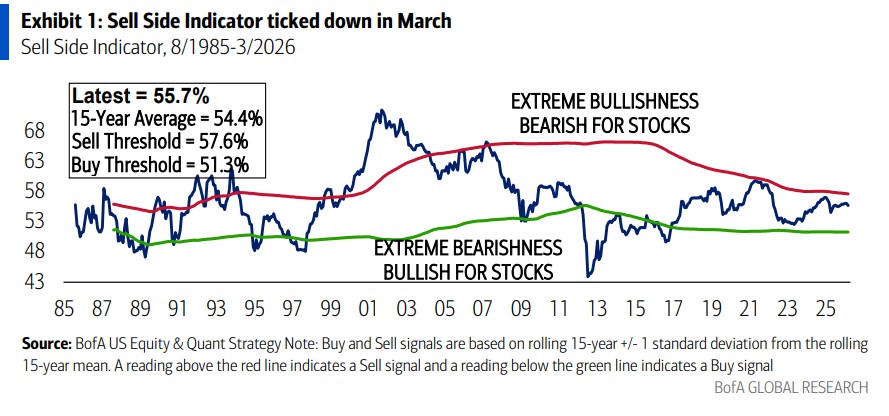
According to Wind Information, Bank of America equity and quantitative strategists Victoria Roloff and Savita Subramanian noted in a report released on April 1st that the Sell Side Indicator (SSI) shows that as geopolitical tensions pushed the S&P 500 down 5% in a single month, Wall Street strategists' average recommended stock allocation slightly fell from 56.0% to 55.7%. Despite this marginal cooling of sentiment, the indicator is currently closer to a "sell" signal than a "buy" signal, and still a considerable distance from triggering the contrarian buy zone.
This marks the first time the strategists' average recommended stock allocation has been lowered in over six months, but the decrease was only 30 basis points, about one-fifth of the drop following last April's tariff announcement. This indicates a relatively mild adjustment in sentiment. The current SSI reading is only 1.9 percentage points away from the "sell" signal threshold, while it is 4.4 percentage points away from the "buy" signal threshold, and still significantly below the levels that typically exceed 59% during historical market tops.
On a fundamental level, Bank of America maintains its year-end S&P 500 price target of 7100, implying about a 9% price return potential from current levels, higher than the modest expectations at the beginning of the year. Concurrently, BofA economists lowered their forecast for US real GDP growth in 2026 from 2.8% to 2.3%. However, Bank of America believes that as long as the economic outlook does not deteriorate further, S&P 500 earnings per share can still achieve healthy double-digit growth.
Sentiment Cooled But Not "Capitulation"; Indicator Remains Biased Towards Sell Zone
The SSI is a contrarian sentiment indicator that tracks the average stock allocation recommendation of Wall Street sell-side strategists in balanced funds. The buy and sell signal thresholds for this indicator are defined as plus or minus one standard deviation from the rolling 15-year average. The current "sell" threshold is 57.6%, the "buy" threshold is 51.3%, and the latest reading in March was 55.7%, falling within the neutral-to-high zone between these two levels.
Bank of America pointed out that the pullback in March was the first decrease in six months, triggered by rising geopolitical risks that led to the S&P 500's worst monthly performance in nearly a year. However, the magnitude of this adjustment was far less than that of previous major shocks experienced by the market—the drop in the indicator after last April's tariff announcement was about five times larger than the current one. This suggests that despite significant market fluctuations, the overall sentiment of Wall Street strategists has not fundamentally shifted.
Historically, when the SSI is in the "buy" zone, the average return of the S&P 500 over the subsequent 12 months has been as high as 20.5%, with a median of 19.7%. Conversely, when in the "sell" zone, the average return is only 2.7%, with a 38.9% probability of negative returns. The current indicator reading implies an approximate 12.5% price return for the S&P 500 over the next 12 months.
Rising Oil Prices Drag Down GDP Forecasts, But Impact on S&P 500 Earnings Limited
Despite the cooling market sentiment, Bank of America believes the fundamentals remain solid. S&P 500 earnings expectations for 2026 were raised by 2% in March, pushing the year-over-year growth rate of consensus expectations to 17%. Meanwhile, the forward P/E ratio of the S&P 500 has fallen by approximately 15% from its recent peak in late October last year, easing valuation pressures.
Bank of America maintains its forecast for S&P 500 earnings per share at $310, corresponding to a year-over-year growth rate of about 13%. The report noted that from the current level to the year-end target price of 7100, there is approximately a 9% price return potential.
Bank of America economists lowered their forecast for US real GDP growth in 2026 from 2.8% to 2.3%, mainly due to the economic drag from rising oil prices. However, Bank of America believes that the impact of this macroeconomic headwind on the overall earnings of the S&P 500 is relatively limited.
The report explained that energy costs represent a relatively small portion of the overall operating costs for S&P 500 constituents. Rising oil prices mainly exert pressure on specific sectors rather than posing a systemic threat to the index's overall earnings. Under the baseline scenario where the economic outlook does not experience further substantial downgrades, Bank of America believes that S&P 500 earnings per share can still achieve healthy double-digit growth, and maintains the full-year earnings forecast of $310.
Wall Street Has Consistently Underweighted Stocks Long-Term
The SSI has historically been a reliable contrarian sentiment indicator. It is worth noting that Wall Street strategists consistently underweighted stocks during the bull markets of the 1980s and 1990s, as well as during the bull markets from 2009 to 2020. The 2008 Global Financial Crisis pushed this indicator below the traditional balanced fund stock allocation benchmark range of 60% to 65%, reaching a historical low of 43.9% in 2012. While the current reading of 55.7% has significantly rebounded from the historical low, it remains below the aforementioned traditional benchmark range, reflecting a structural shift in Wall Street's overall allocation style after the financial crisis.
This indicates that sell-side strategists, as a group, have been in a state of systematic underweighting of stocks for a long time—which is the fundamental reason why this indicator works on a contrarian basis. When they truly become extremely optimistic, it often means that the upside potential has already been fully priced in. The current reading of 55.7% remains above the post-financial crisis average but still a considerable distance from historical extreme optimism levels.
