


Trump Set to Speak, US Stocks See First 'Two-Day Rally,' Gold on 'Four-Day Winning Streak,' Wall Street Hits FOMO
Trump will deliver a national address at 9:00 PM to provide an "important update" on the Iran conflict, with markets expecting him to reiterate his intention to end military operations within two to three weeks. This expectation has directly ignited FOMO on Wall Street: the Nasdaq recorded its best two-day performance since last May overnight, and gold has risen over 6% this week, marking four consecutive days of gains. Oil prices swung back and forth amid Trump's contradictory remarks. Amid the FOMO, the market also remains wary of another Trump "TACO."
One speech has left all of Wall Street unwilling to be absent.
On April 1st local time, as reported by Xinhua News Agency, the White House announced that President Trump will deliver a national address at 9 PM ET tonight (9 AM Beijing Time on April 2nd) to issue an "important update" on the Iran issue. White House Press Secretary Leavitt made the statement on social media but provided no further details.
Markets expect him to reiterate in the speech that military operations will end within two to three weeks. Trump signaled this earlier yesterday. According to Xinhua, he stated that the US might end military operations against Iran within two to three weeks, saying "we will be leaving soon," and that his sole objective was for Iran not to possess nuclear weapons, "and that goal has already been achieved." He also stated that the US could end the conflict even without reaching an agreement with Iran.
This rhetoric directly ignited the market's FOMO (fear of missing out) sentiment.
Overnight, US stocks rose for a second consecutive day, with the Nasdaq recording its best two-day performance since May 2025. Meanwhile, gold has risen more than 6% this week, trending higher for a fourth consecutive day in early trading as traders bet that the Federal Reserve may pivot toward interest rate cuts due to downward economic pressure. Simultaneously, oil prices fell again in early trading, retreating to around $100 per barrel.
However, will this be another TACO? In this early April rally sparked by "hopes for a ceasefire," the divergence between hard economic data and market sentiment is becoming extremely dangerous. US macroeconomic hard data continues to trend lower, yet survey-based "soft data" has surged due to "hope" that the war has bottomed out. Faced with the highly exaggerated exchange of rhetoric between Trump and Iran, an increasing number of clear-headed traders are beginning to question: Is this the dawn of peace, or another "head fake" by Trump used to manipulate the market?
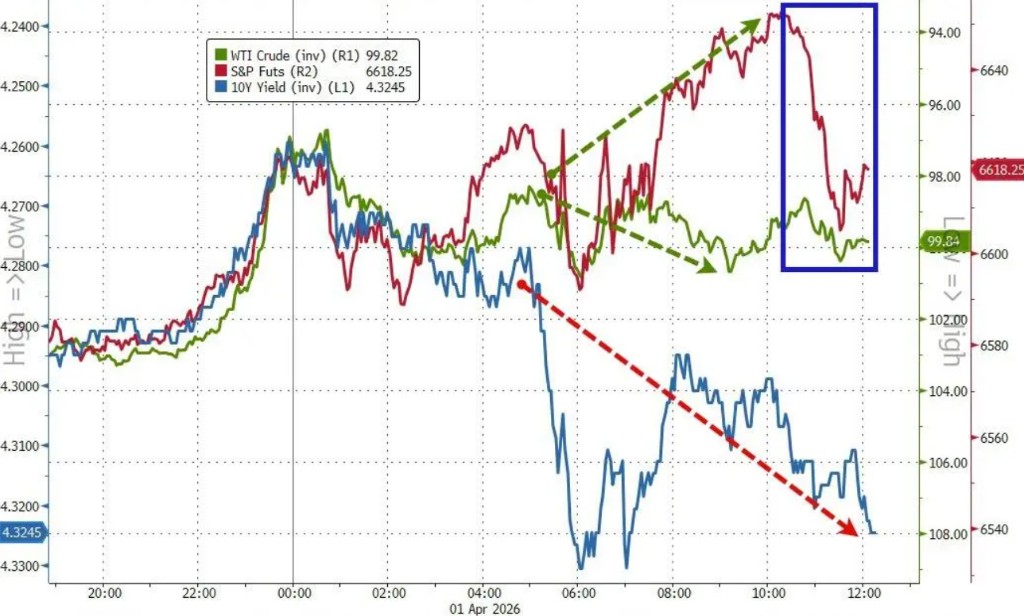
US Stocks "Two-Day Rally": No One Wants to Miss Out, But the Market is Still Being "Played" by Headlines
US stocks rose for a second consecutive day on April 1st. The NASDAQ Composite Index gained 1.2%, marking its best two-day performance since May 2025; the S&P 500 Index rose 0.7%.
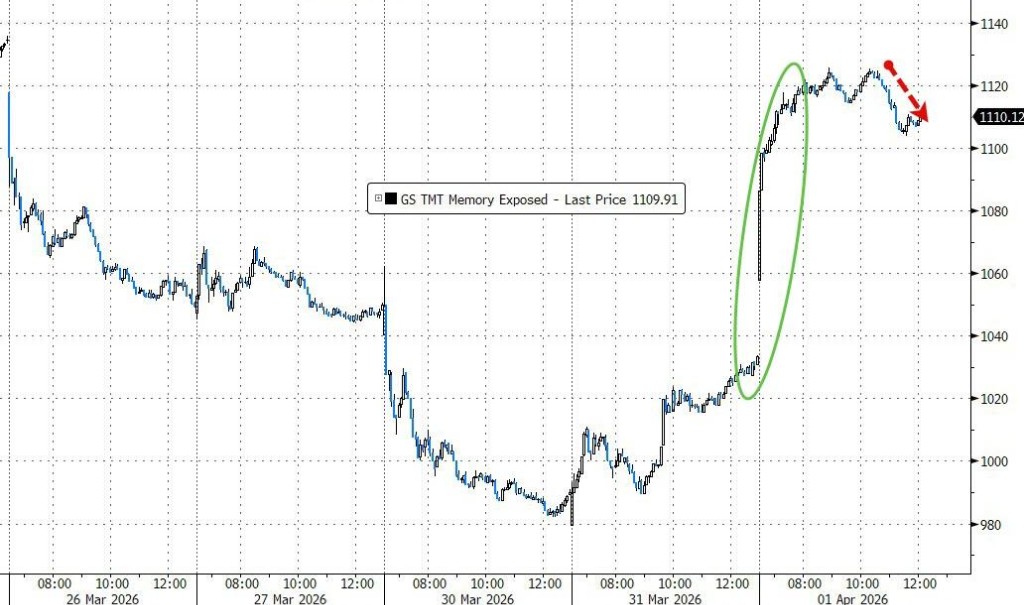
Gains in Boeing and Caterpillar pushed the Dow Jones Industrial Average to a three-day winning streak. The memory stock sector (GSTMTMEM, +8.2%) led the way, recording its second-best performance ever.
The US Mag 7 stocks were on track for their best two-day performance in nearly a year, but their momentum subsequently weakened.
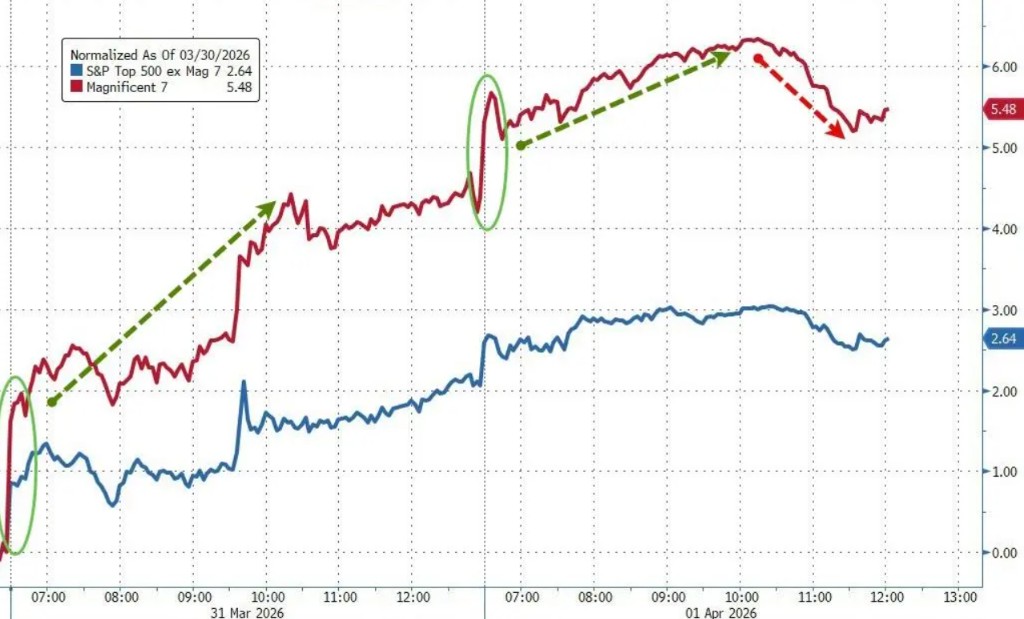
Driving this move is not just fundamental optimism, but a collective FOMO psychology of "not daring to miss out."
Tom Keen, a derivatives trader at Piper Sandler, said: "As soon as there is a whiff of good news or a hint of progress, everyone quickly re-loads into risk assets."
"This is a 'war is ending' trade," said Rocky Fishman, founder of Asym 500.
This mindset has a track record. After Trump announced a tariff pause for "Liberation Day" last year, the Nasdaq surged over 10% in a single day, catching many hedge funds off guard. That scene remains fresh in memory, and no one wants to be left on the sidelines again.
Data from prediction markets also confirms this optimism. According to Polymarket data, traders recently gave a roughly 65% probability of a US-Iran ceasefire being announced by June 30th, up from approximately 52% in late March.
However, some analyses suggest this rally might be a technical "short squeeze" rather than a substantive position-building driven by fundamentals. Real transaction data from Goldman Sachs Prime Brokerage (PB) shows that the net buying in the US stock market overnight (1.7 standard deviations above the one-year average) was overwhelmingly driven by short covering—data shows that the volume of short-covering buys was 4.7 times the size of long-selling.
Furthermore, institutional funds have actually "frozen." The Goldman Sachs trading desk noted that overall trading activity for the day was only a 5 (on a scale of 1 to 10), with both long-only (LO) funds and hedge funds (HFs) remaining in a wait-and-see mode, with net positions basically flat all day.
Goldman Sachs analyst Chris Hussey also pointed out that today's rally was largely a passive closing of short positions (a squeeze) rather than genuine long building.
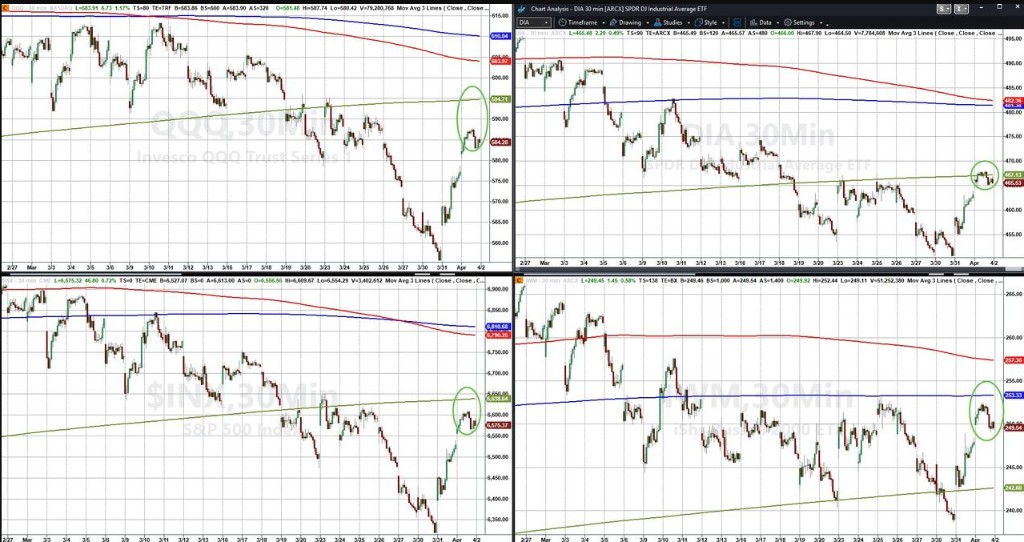
At the open, accompanied by optimistic expectations for Trump's speech, stock indices surged rapidly and touched key technical resistance levels; however, as more headlines about the Middle East conflict broke, the morning short-squeeze failed to stabilize, and gains quickly narrowed. Throughout the day, the three major US stock indices failed to hold their ground, instead staging three "pump and dumps" alongside news-driven reversals.
Derivatives Market "Booster": Every Point Gain Forces More Buying
Behind this rebound, the structural forces of the derivatives market are equally impossible to ignore.
Option market makers' hedging operations clearly amplified the gains on Tuesday. David Boole, Managing Director at BayCrest Options, stated that as stock prices rose, the value of option positions on some professional traders' books changed rapidly, forcing them to buy stock index futures for hedging.
"Every point it goes up, it forces more buying," Boole said. "This looks more like a market driven by momentum, positioning, and technicals rather than long-term fundamental logic."
According to Goldman Sachs data, after the end-of-quarter option expirations, market makers' gamma exposure has shifted from a net short of over $7 billion to basically flat, meaning the amplification effect of two-way market volatility will converge.
Gold "Four-Day Winning Streak": Traders Bet on a Fed Pivot
Meanwhile, gold has risen for four consecutive days, with a cumulative gain of over 6% this week, the largest weekly gain in nearly 10 weeks.
Spot gold rose about 0.6% in early trading on April 2nd to $4788.13 per ounce, touching above $4790 intraday.
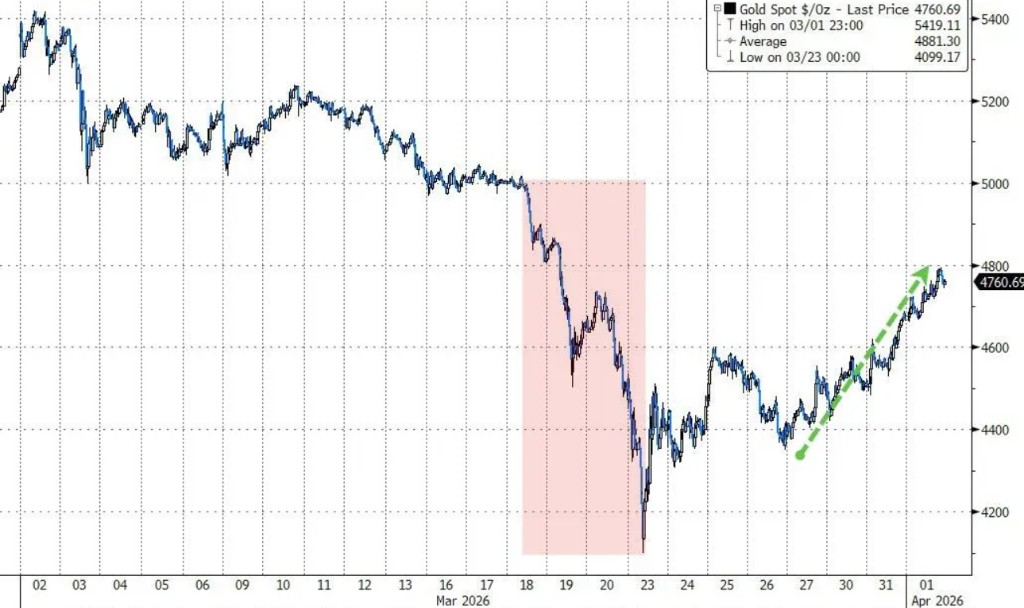
The logic for gold's rise is slightly different from that of the stock market. OCBC strategist Christopher Wong analyzed: "If geopolitical tensions cool, or if concerns about economic growth resurface, market expectations for a Fed rate cut may return. In this scenario, real yields would trend lower, providing support for gold. In fact, recent price movements are already hinting at this dynamic."
Simply put, the market logic is: War ends → Economic downside risk rises → Fed forced to cut rates → Gold benefits. Currently, market expectations for the Fed's interest rate changes in 2026 have shifted toward a dovish stance, returning to the "rate cut" zone...
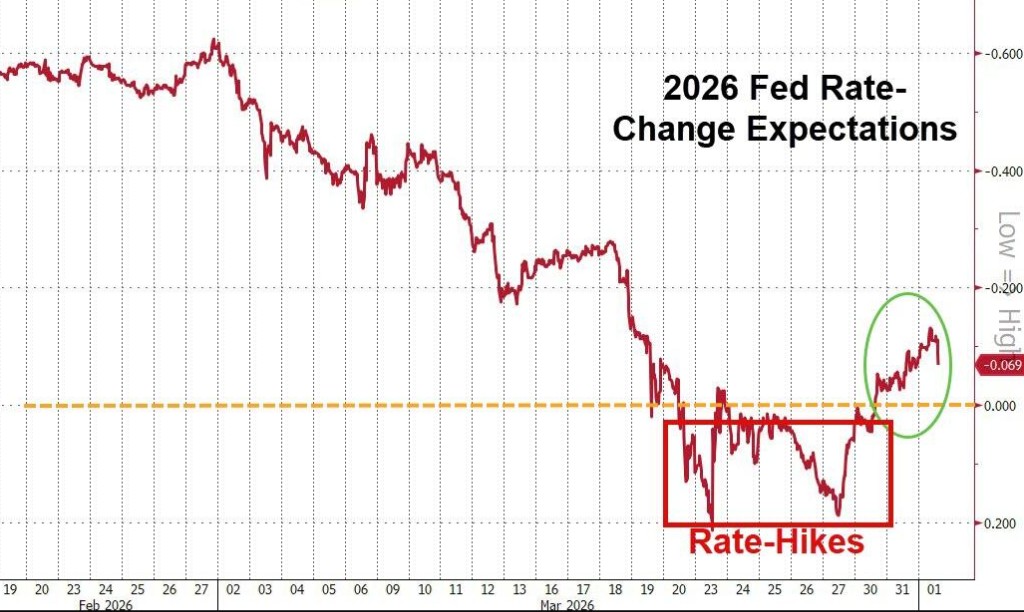
It is worth noting that gold fell nearly 12% in March, marking its worst monthly performance since October 2008. At that time, high oil prices pushed up inflation expectations and suppressed rate cut expectations, causing gold's safe-haven attribute to fail. Now, with ceasefire expectations rising, this logic is reversing.
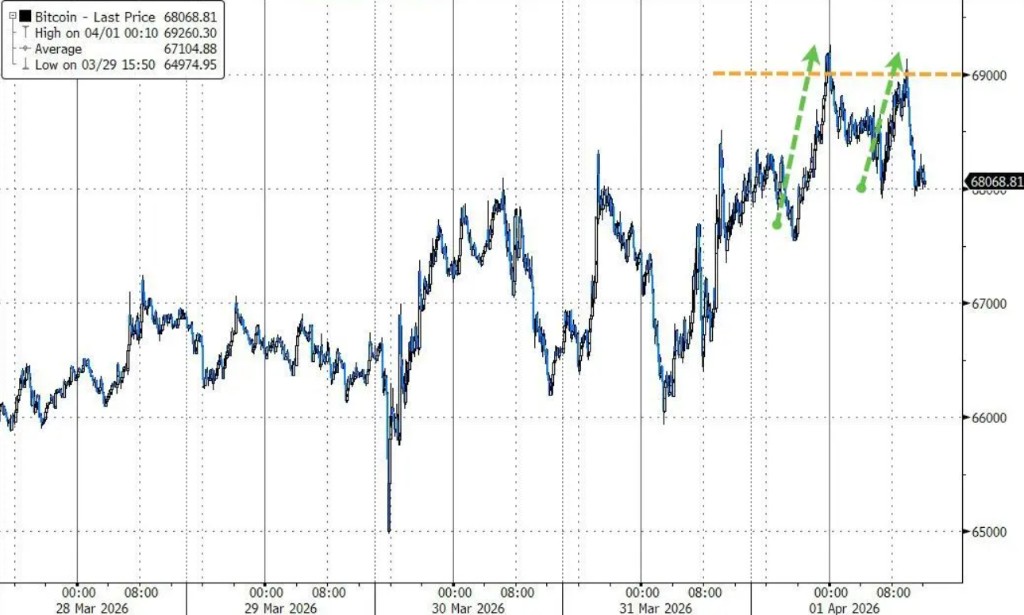
Additionally, the US dollar fell for a second consecutive day, providing extra support for gold. Bitcoin touched $69,000 twice intraday, but as US stocks pulled back in late trading, Bitcoin gave back its early gains to close flat.
Oil Prices: Battered by "Trump's Rhetoric," Physical and Futures Markets Disconnect
Oil price movements have been more complex. Over the past 24 hours, the energy market has been as skittish as a startled bird, swinging between headlines of "ceasefire statements" and "refutations."
WTI crude oil fell as much as 1.8% to $98.37 per barrel in early trading on April 2nd, following a 1.2% drop the previous day. Brent crude futures retreated 2.7% to $101.16 per barrel on April 1st. The S&P 500 energy sector fell 3.9% that day, its worst single-day performance since the tariff turmoil a year ago, with Exxon Mobil shares falling 5.2%.
But every drop in oil prices has been accompanied by a rebound. According to data analysis, throughout the day on April 1st, oil prices swung violently along with news between Trump and Iran:
-
at 08:45 AM local time, Trump posted on Truth Social stating that Iran had requested a ceasefire, oil prices fell; subsequently, Trump threatened that if the strait was not reopened, he would bomb Iran back to the Stone Age, oil prices rebounded.
-
at 10:30 AM, the Iranian Foreign Ministry immediately denied the claims, calling them "false and groundless," oil prices rebounded above $100;
-
at 1:00 PM, White House officials revealed that Trump's speech would reiterate the timeline of ending the war within two to three weeks, oil prices fell again;
-
at 1:45 PM, the Israel Broadcasting Corporation reported that US-Iran negotiations were not progressing smoothly, oil prices turned upward again, and US stocks fell.
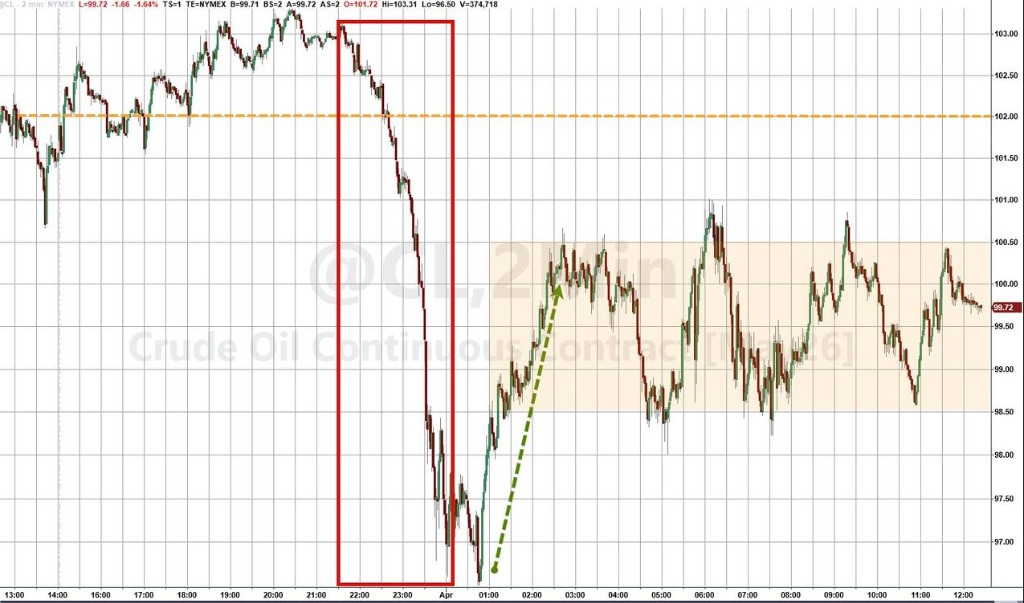
This "headline-driven" market reflects a deep divergence in the market. Goldman Sachs analysis stated that the biggest divergence in current client conversations lies between macro clients and physical or professional clients, who have diametrically opposed judgments on oil prices—the former are increasingly inclined to price in a ceasefire, while the latter believe current futures prices are still too low relative to the scale of actual supply disruptions.
In short: the futures market is trading on the expectation of "the war ending," while the physical market is trading on the reality that "oil cannot be shipped out." Wall Street macro traders are betting on a ceasefire, but spot traders believe current futures prices are severely underpriced compared to the actual scale of supply disruption.
International Energy Agency Executive Director Fatih Birol warned that as oil supply shocks deepen further this month, some countries may soon face energy rationing. Gas stations from France to Australia have already seen supply disruptions.
A Gap Between Ceasefire Expectations and Reality: Will the Market Be Fooled Again?
Market optimism is not without its hidden concerns.
As a classic proverb echoes in the hearts of Wall Street traders: "Fool me once, shame on you... fool me... you can't get fooled again." (Fool me once, shame on you; fool me again... absolutely impossible).
According to CCTV News, Trump recently hinted that the US military might withdraw without reopening the Strait of Hormuz. However, media analysis states that this scenario was previously considered almost impossible. Before the war, the Strait of Hormuz accounted for about 20% of the world's oil and liquefied natural gas transport.
The Iranian parliament approved a plan this week to impose transit fees on passing vessels, which means some supply may be restored, but it also highlights the risk that Iran may continue to control this waterway in the future.
British Prime Minister Keir Starmer stated on Wednesday that officials from dozens of countries will meet this week to discuss how to restore the free flow of energy. But he also admitted: "I must be honest with everyone: this will not be easy." He added that a ceasefire and the reopening of the strait "do not necessarily happen simultaneously."
Will Todman, a senior fellow in the Middle East Program at the Center for Strategic and International Studies (CSIS), pointed out Iran's calculation directly: "If a ceasefire opens the door to a new round of conflict in the future, it is highly unlikely that Iran will agree. The Iranian regime believes time is on its side—the longer the Strait of Hormuz is blocked, the greater the pain inflicted on the global economy."
