


Breakfast | US-Iran Ceasefire Stalemate Continues, Storage Sector Surges 8% to Lead Gains!
Investors are betting that the US-Iran conflict is nearing its end, and US stocks rose for the second consecutive trading day. The energy sector fell nearly 5% at one point. The storage sector surged 8%, with Micron Technology up nearly 9% and Western Digital soaring 10%. Eli Lilly rose 3.78% after its oral weight-loss drug Foundayo was approved by the US FDA. Google rose over 3%, and the 'Magnificent Seven' tech stocks recorded their best two-day performance in nearly a year
Market Overview
Investors are betting that the US-Iran conflict is nearing its end, and US stocks rose for the second consecutive trading day. The Nasdaq once rose 1.8%. After midday, reports indicated the US Department of Defense was accelerating the deployment of A-10 attack aircraft, narrowing the gains in US stocks. The S&P closed up 0.72%, and the Nasdaq closed up 1.16%.
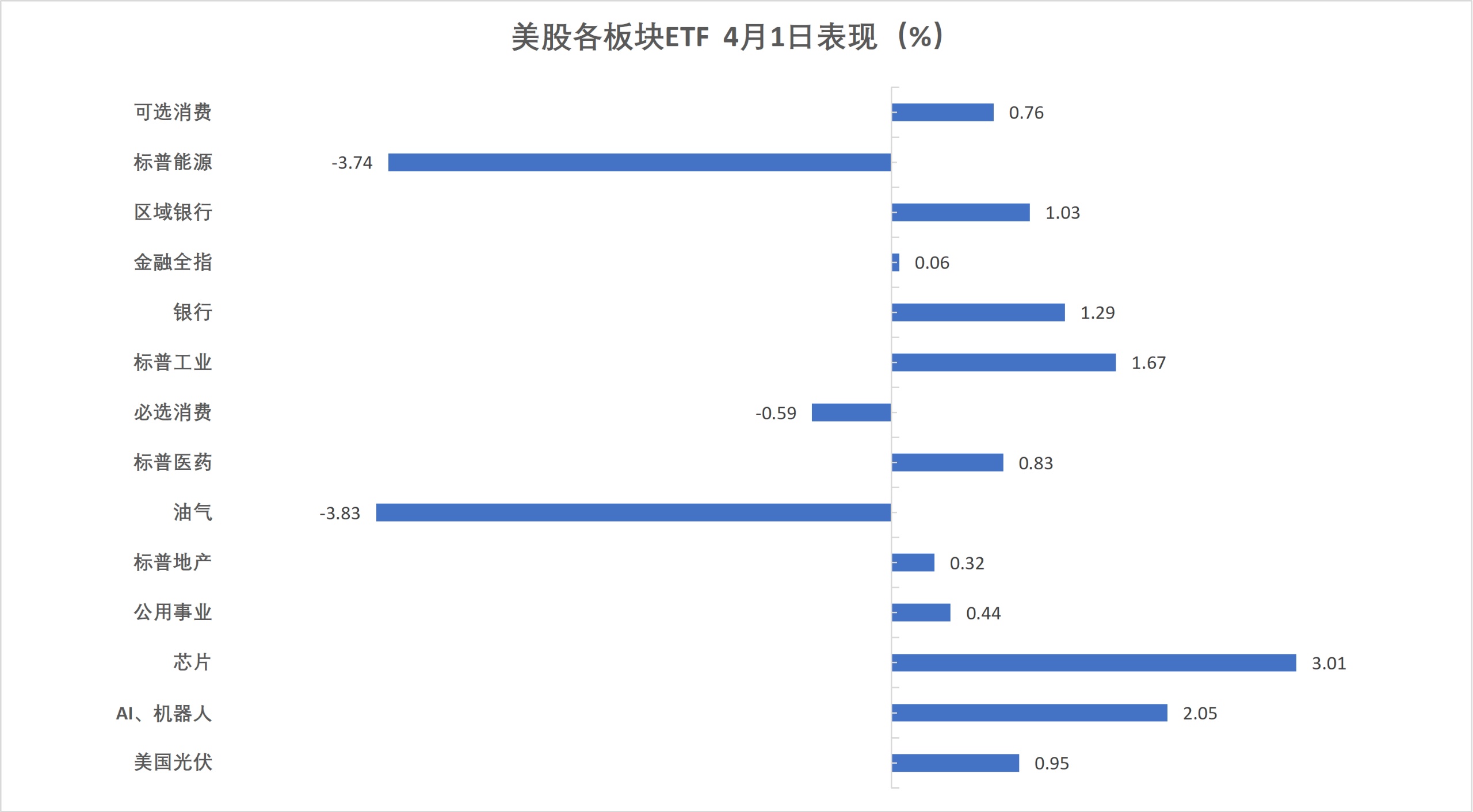
The energy sector fell nearly 5% at one point. The storage sector surged 8%, with Micron Technology up nearly 9% and Western Digital soaring 10%. Eli Lilly rose 3.78% after its oral weight-loss drug Foundayo was approved by the US FDA. Google rose over 3%, and the 'Magnificent Seven' tech stocks recorded their best two-day performance in nearly a year.
US ADP employment data exceeded expectations, and the ISM manufacturing employment component suggested rising inflationary pressures. US Treasury yields rebounded in a V-shape and closed flat, with the 2-year yield up slightly by 0.4 basis points.
The dollar fell for the second consecutive day. Bitcoin briefly broke through $69,000 before falling back to flat at $68,000. Ethereum rose 1.7%.
Gold rose nearly 2%, strengthening for the fourth consecutive trading day, briefly approaching $4800. Spot silver and copper futures fluctuated slightly lower.
Crude oil dropped about 7% from its daily high before rebounding, fluctuating around $100 per barrel. By the New York close, WTI crude oil fell nearly 3%, and Brent crude oil fell over 3%.
During the Asian session, the ChiNext Index rose nearly 2%, with the pharmaceutical sector experiencing a significant surge. Laplace "board broke" [fell sharply after opening higher], the Hang Seng Index rose over 2%, and Zhipu AI soared over 30%.
Key News
China
Li Qiang: Focus on promoting the construction of a new type of power grid and accelerating the optimization of the energy structure.
China's Caixin Manufacturing PMI in March was 50.8, expanding for the fourth consecutive month, but price and supply chain pressures are heating up.
Amidst the conflict, China's government bonds are the only safe haven in the world.
Overseas
Trump stated that a ceasefire would only be considered if the Strait of Hormuz reopened. Iran: The strait will not be opened to enemies, and calls for a ceasefire statement are baseless. Reports indicate the US military will double its deployment of A-10 attack aircraft in the Middle East. Trump is "seriously considering" withdrawing the US from NATO. Iranian President's open letter to the American public: The US has become Israel's proxy; Iran harbors no hostility towards other countries and is not initiating war. Iran reportedly demands that ceasefire negotiations must be predicated on a permanent end to the war, while US intelligence agencies believe Iran currently has no intention of substantive negotiations. Trump stated Iran is no longer capable of developing nuclear weapons. Reports suggest the UAE is prepared to help the US militarily open the Strait of Hormuz.
Reports indicate the US Treasury expects oil prices to remain above $100 for a long time, and does not rule out a rise to $200. IEA: Oil losses in April will be double those in March, with an impact scale exceeding the sum of the three previous crises in history. The Philippines, South Korea, and other Asian countries are urgently turning to Russian oil.
The conflict in Iran is impacting the global aluminum supply chain, with the Middle East's top aluminum producer shutting down its smelter.
The Trump administration is reportedly planning to adjust steel and aluminum tariffs, unifying the tariff rate for steel and aluminum finished products at 25%, which is said to potentially increase the cost of imported goods.
The US March ADP employment report significantly exceeded expectations, with the employment component indicating accelerating wage growth. The US ISM Manufacturing PMI hit its strongest since 2022, with soaring input costs exacerbating inflation concerns. US February retail sales saw their largest increase in 8 months, with a month-on-month growth of 0.6% exceeding expectations, driven by a recovery in auto consumption, boosting domestic demand.
Driven by energy prices, European CPI reached its fastest growth rate in four years.
$600 million in OpenAI shares were left unsold in the secondary market, while Anthropic shares were in high demand.
SpaceX has secretly filed for a US IPO.
The US launched a rocket for a manned lunar mission.
"King of Shorts" Muddy Waters shifts focus to credit bonds, CEO predicts AI will trigger widespread layoffs and defaults.
Market Close
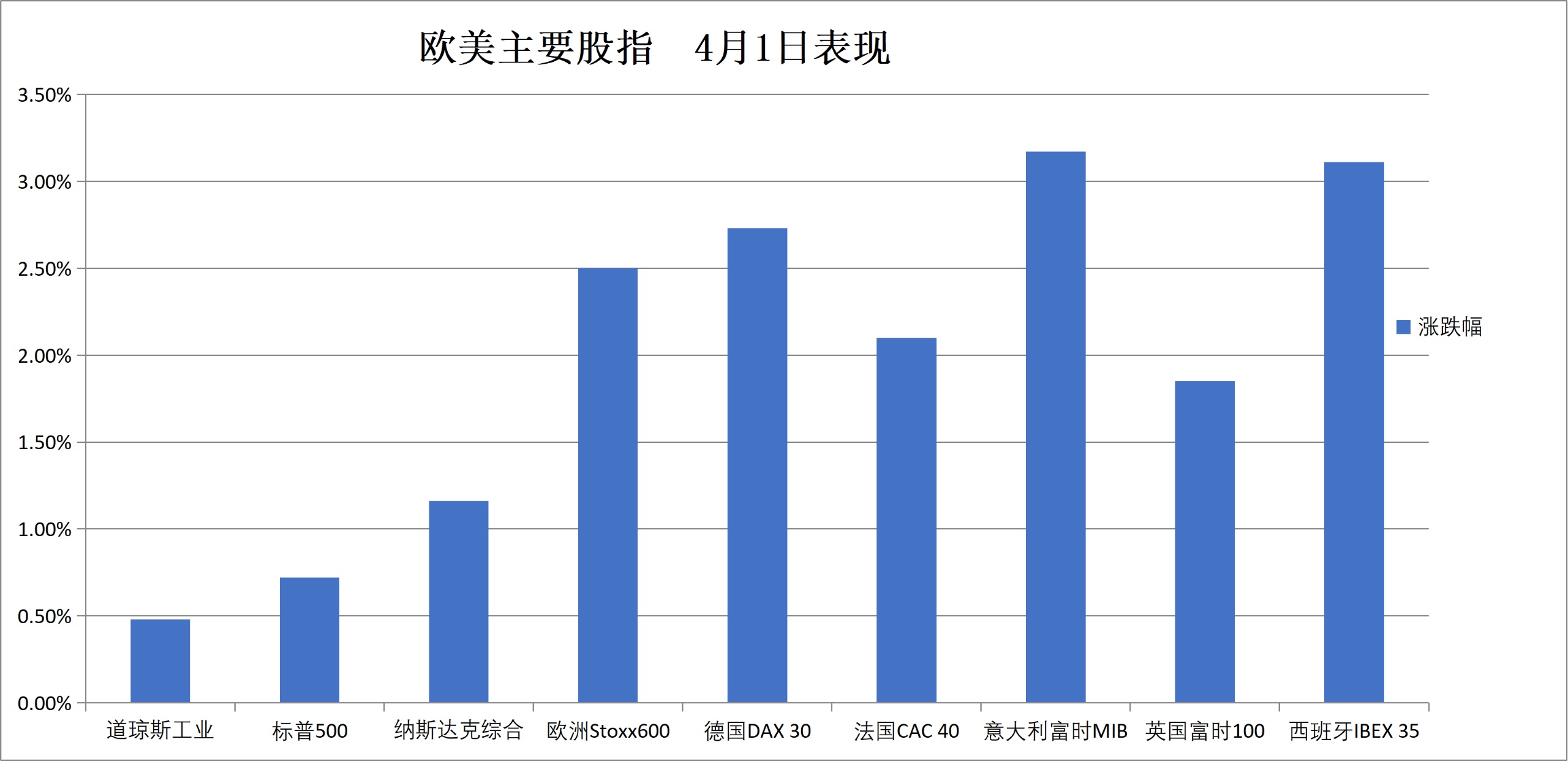
European and American Stock Markets: The S&P 500 rose 0.72% to 6575.32 points. The Dow Jones Industrial Average rose 0.48% to 46565.74 points. The Nasdaq Composite rose 1.16% to 21840.947 points. The European STOXX 600 index rose 2.50% to 597.69 points.
A-shares: The Shanghai Composite Index closed at 3948.55 points, up 1.46%. The Shenzhen Component Index closed at 13706.52 points, up 1.70%. The ChiNext Price Index closed at 3247.52 points, up 1.96%.
Bond Market: The yield on the US 10-year benchmark Treasury bond rose 0.20 basis points to 4.3186%. The yield on the 2-year US Treasury bond rose 0.80 basis points to 3.8010%.
Commodities: WTI crude oil futures for May settled down 1.24% at $100.12 per barrel. Brent crude oil futures for June settled down 2.70% at $101.16 per barrel. Spot gold rose 1.91% to $4757.17 per ounce. Spot silver fell 0.09% to $75.0995 per ounce.
Key News Details
Global Highlights
China
Li Qiang: Focus on promoting the construction of a new type of power grid and accelerating the optimization of the energy structure. Li Qiang stated that efforts should be made to actively explore new architectures, new technologies, and new services, improve grid construction, enhance system synergy and regulation capabilities, strengthen diversified demand assurance, and build a new type of power grid that is safe, reliable, green, low-carbon, strong, resilient, intelligent, and flexible.
China's Caixin Manufacturing PMI in March was 50.8, expanding for the fourth consecutive month, but price and supply chain pressures are heating up. China's Caixin Manufacturing PMI in March slowed significantly from 52.1 in February, remaining the second-fastest level in the past six months. However, input prices in March accelerated to their highest level since March 2022, and the lengthening of supplier delivery times reached a more than three-year high. Caixin founder Yao Yu stated that escalating international geopolitical conflicts are intensifying fluctuations in the commodity raw material market, and this imported inflationary factor is expected to continue to pose a "severe challenge" to manufacturers' costs in April.
Amidst the conflict, China's government bonds are the only safe haven in the world! The Iranian conflict is impacting global bond markets, but Chinese government bonds have strengthened against the trend, becoming the only safe haven amidst the chaos. US Treasury yields surged by 38 basis points, and UK bonds jumped by 70 basis points, while the yield on China's 10-year government bond slightly declined to 1.81%. A diversified energy structure, a low inflation environment, expectations of loose monetary policy, and the predictability of central bank policies are driving global institutional investors to re-examine the long-term strategic value of the Chinese bond market.
Overseas
Trump stated that a ceasefire would only be considered if the Strait of Hormuz reopened. Iran: The strait will not be opened to enemies, and calls for a ceasefire statement are baseless. Trump stated that Iran's new President is more rational than his predecessor and has requested a ceasefire from the US. He added that the US "will not consider it until the Strait of Hormuz is reopened and unhindered," and before that, "will turn Iran into ruins"; he will withdraw from the Iran conflict soon and is "definitely" considering withdrawing from NATO. Iran reiterated its intention to block the strait as a countermeasure, stating that the strait is under Iran's firm and absolute control and "will not be reopened to its enemies through the US President's theatrics."
Reports indicate the US military will double its deployment of A-10 attack aircraft in the Middle East, narrowing US stock gains. Reports indicate that the US Air Force is dispatching 18 A-10 attack aircraft to the Middle East. The US military's deployment adjustment aims to enhance its close air support and "low-intensity warfare" capabilities. The A-10 is primarily used to strike Iranian-backed armed forces, drones, and small vessel threats; doubling the deployment of this aircraft type means the US military's capacity to conduct "persistent suppression" missions in the Persian Gulf region has significantly increased.
Trump is "seriously considering" withdrawing the US from NATO, US Defense Secretary: When launching large-scale operations against Iran, NATO allies do not even grant transit rights to the US. US Secretary of Defense Lloyd Austin stated that Iran's missiles "cannot reach the US mainland" but can hit some NATO allied countries. However, the world has seen that when the US launches large-scale operations against Iran, NATO allies do not even grant simple transit rights to the US. When the US needs these allies, these countries are unwilling to stand with the US, thus the alliance is not living up to its name.
Iranian President's open letter to the American public: The US has become Israel's proxy; Iran harbors no hostility towards other countries and is not initiating war. Pezeshkian stated that Iran's past and future actions are responses based on legitimate self-defense rights, and the US military buildup around Iran constitutes a substantial military threat, with attacks on Iranian infrastructure being a war crime; US-Iran relations are among the most misunderstood, calling on the American public to look beyond political rhetoric and re-examine Iran's position and intentions, questioning whether current US policies align with its core interest of "America First"; warning that the cost of continuing on the path of confrontation is "higher than ever and utterly pointless."
Iran reportedly demands that ceasefire negotiations must be predicated on a permanent end to the war, while US intelligence agencies believe Iran currently has no intention of substantive negotiations. US officials revealed that US intelligence agencies assess that the Iranian government believes it is in a favorable position in the war and therefore has no need to accept the diplomatic demands put forth by the US; while Iran is willing to keep communication channels open, it does not trust the US and does not believe Trump is serious about negotiations.
Iran emphasizes disregarding US and Israeli "fantasies and lies," warns of proportional response to "terrorist acts," former Iranian Foreign Minister seriously injured in attack, Trump says Iran is no longer capable of developing nuclear weapons. Iranian President emphasizes national independence and security; the Iranian Ministry of Foreign Affairs states the Supreme Leader is in good health but has postponed public appearances due to the war, and is prepared to respond to any attack; the Iranian military warns of striking US-related intelligence companies and reiterates its warning to strike 18 US companies; Iran claims to have shot down 150 US and Israeli drones, with the ultimate goal of counter-attacks including the withdrawal of US forces from the Middle East. Israel has suffered its largest missile attack since the conflict began. Trump plans to deliver a national address on the Iran issue with an "important update" on Wednesday evening. Trump reportedly asked the military to submit a plan to seize Iranian nuclear materials; it was revealed that he conveyed a message through Vance, considering a ceasefire if "specific demands" such as the reopening of the Strait of Hormuz are met.
Reports indicate the UAE is prepared to help the US militarily open the Strait of Hormuz. The UAE is rapidly transforming from a "mediator" to a "quasi-war participant." Iran launched over 2500 missiles and drones at Dubai, severely impacting its core tourism, shipping, and real estate sectors. The UAE is now actively lobbying the UN Security Council for authorization to forcefully open the strait and seeking to form an international joint military force. However, analysts warn that military feasibility is questionable and that any misstep could lead to an intractable regional war.
Reports indicate the US Treasury expects oil prices to remain above $100 for a long time, and does not rule out a rise to $200. According to reports, the US Treasury Department has considered prices above $100 as a "baseline scenario" and has not ruled out an extreme possibility of reaching $200. The White House has denied predicting short-term oil prices. The report cites sources saying the government is exploring unconventional measures, such as using emergency powers to restrict crude oil exports, to curb oil prices. Analysts warn that a supply "window" will lead to the real impact reaching the US in about two weeks, with prices of diesel, jet fuel, and other products facing a jump, significantly increasing the burden on consumers.
IEA: Oil losses in April will be double those in March, with an impact scale exceeding the sum of the three previous crises in history. "There will be nothing in April." The IEA Executive Director warned that in March, some oil tankers that had already passed through the Strait of Hormuz before the outbreak of war were still arriving, but this buffer will completely disappear in April; the current oil shock exceeds the combined total of the two oil crises of the 1970s and the natural gas cutoff in Russia in 2022. He also warned that shortages of jet fuel and diesel have already affected Asia and are expected to spread to Europe from April to May.
The Philippines, South Korea, and other Asian countries are urgently turning to Russian oil. According to reports, taking advantage of the US's 30-day exemption for sanctions on Russian oil, many Asian countries, such as the Philippines, South Korea, and India, which are highly dependent on Middle Eastern energy, are urgently restarting or expanding their purchases of Russian oil to fill supply gaps and alleviate domestic energy emergencies. The Philippines declared a state of energy emergency, and its refiner Petron purchased 2.5 million barrels of Russian oil; India's purchase volume doubled to 1.9 million barrels per day.
The conflict in Iran is impacting the global aluminum supply chain, with the Middle East's top aluminum producer shutting down its smelter. Emirates Global Aluminium's (EGA) Al Taweelah smelter in Abu Dhabi was forced to shut down due to a power outage following Iranian missile and drone attacks. If combined with the production cuts at Qatar's Qatalum smelter, the attacks could affect nearly half of the Middle East's aluminum production. Following the news from EGA, Alcoa accelerated its rise, gaining nearly 9% during intraday trading.
The Trump administration is reportedly planning to adjust steel and aluminum tariffs, unifying the tariff rate for steel and aluminum finished products at 25%, which is said to potentially increase the cost of imported goods. The current policy requires calculating tariffs based on the steel and aluminum content of products, with a maximum tariff of 50%. Critics believe the new adjustment does not mean a substantive reduction in protectionism. For companies that previously found it difficult to accurately calculate metal content, the tax burden may actually become more certain or even increase, and unified taxation may expand the scope of tariff application.
"Mini-Nonfarm" Greatly Exceeds Expectations! US March ADP Employment Increased by 62,000, Wage Growth Accelerates. The number of private sector jobs added in the US in March was 62,000, higher than the median forecast of 40,000 by Bloomberg survey analysts. The previous month's figure was 63,000, roughly the same as this month. The annualized wage growth for continuing employees remained at 4.5%, unchanged for three consecutive months; wage growth for job switchers increased by 0.3 percentage points from the previous month to 6.6%.
US ISM Manufacturing PMI Hits Strongest Since 2022, Soaring Input Costs Exacerbate Inflation Concerns. The US ISM Manufacturing Index in March was 52.7, a three-year high. The manufacturing input price index increased by 7.8 points in a single month to 78.3, its highest level since mid-2022; over the past two months, this price index has increased by a cumulative 19.3 points, the largest increase in nearly a decade. Rising input costs may put upward price pressure on US manufacturers, leading the market to adjust inflation expectations upward.
US February Retail Sales See Largest Increase in 8 Months, Month-on-Month Growth of 0.6% Exceeds Expectations, Recovery in Auto Consumption Boosts Domestic Demand. US February retail sales increased by 0.6% month-on-month, compared to expectations of 0.5% and a previous figure of -0.2%. A significant driver of this increase was the recovery in auto purchases. Core retail sales, excluding autos, gasoline, building materials, and food services, increased by 0.5% month-on-month, exceeding expectations of 0.3% and the previous figure of 0.2%. Analysts suggest that tax refunds in February boosted consumption among low-income groups, but high-income households remain the main drivers of consumption.
Driven by energy prices, European CPI reached its fastest growth rate in four years. Although core inflation in the Eurozone unexpectedly fell to 2.3% in March, and service inflation also cooled. However, overall inflation rose to 2.5% year-on-year in March, its highest level since January 2025. It surged 1.9% month-on-month, marking the largest increase since 2022. Several central bank officials have signaled hawkish stances, not ruling out the possibility of an early interest rate hike.
600 Million USD in OpenAI Shares Unsold in Secondary Market, Anthropic Shares in High Demand. The founder of Next Round Capital stated that in recent weeks, about six institutional investors have contacted his company seeking to sell approximately $600 million worth of OpenAI stock. Last year, these shares would typically be snapped up within days. Now, there are no buyers. The market is currently valuing OpenAI at around $76.5 billion, a discount of about 10% from the previous valuation of $85 billion; the valuation for Anthropic is around $60 billion, more than 50% higher than its previous funding round. OpenAI stated that it does not recognize or participate in these transactions.
- Global Investors Are Pushing Large Model Companies Towards "Dream Valuations". OpenAI has achieved one of the largest financings in Silicon Valley history. Measured by P/E ratio, the company is not yet profitable and is unlikely to turn a profit for several years – this is precisely a "dream valuation": investors are betting on the faith that AI will change everything. With soaring revenues, high losses, short-sellers waiting in the wings, and IPOs and lock-up expirations looming, this narrative-driven capital frenzy is reaching a critical juncture.
SpaceX has secretly filed for a US IPO. According to media citing sources familiar with the matter, SpaceX has secretly filed for an Initial Public Offering (IPO). The company has submitted a draft IPO registration statement to the US Securities and Exchange Commission (SEC) and requested anonymity. SpaceX has informed potential investors that it will arrange for company executives to conduct roadshows this month. The company has invited Bank of America, Citigroup, Goldman Sachs, JPMorgan Chase, and Morgan Stanley to serve as lead underwriters for the IPO and has added more banks to the syndicate.
The US launched a rocket for a manned lunar mission. On the evening of the 1st local time, NASA's new generation lunar rocket, the "Space Launch System," lifted off from the Kennedy Space Center in Florida for the "Artemis II" manned lunar mission. This is the first time the United States has sent humans to the moon since 1972.
"King of Shorts" Muddy Waters shifts focus to credit bonds, CEO predicts AI will trigger widespread layoffs and defaults. Carson Block, founder of Muddy Waters Capital, believes that AI will lead to mass unemployment, resulting in high unemployment rates and an economic slowdown, eroding corporate revenues and debt repayment capacity, ultimately leading to widening credit spreads and a wave of defaults. He also pointed out that the current market has an excessive amount of passive investment, and the liquidity of corporate bond ETFs is far greater than that of the underlying bonds, which will amplify volatility when shocks occur.
Research Reports
Citadel Star Analyst: Understand the Iran War, "Follow the Troops, Not Twitter". Citadel Securities analyst Shah issued a warning: the Middle East war is not a one-time shock but a persistent crisis capable of reshaping the trajectory of global growth and inflation. The conflict has shifted from an inflationary shock to a growth risk, with the shadow of stagflation looming. AI, heavily reliant on energy, faces unique vulnerabilities, and bonds are expected to regain their hedging value. His only advice is: "Follow the troops, not Twitter."
What does Trump "Washing His Hands" of the Strait of Hormuz Mean for Oil Prices? Trump stated his willingness to end the war while the Strait of Hormuz remains largely closed and shifted the responsibility of reopening the strait to his allies. Deutsche Bank warned that data on actual transit volumes through the strait has not shown significant improvement, and if the blockade continues until November, the average price of Brent crude could reach $177 per barrel. Multiple obstacles, such as the absence of US minesweepers, the potential involvement of Houthi rebels, and the IEA's reserves being sufficient for only one month, also make the timeline for reopening the strait uncertain.
"Super Bull" Tom Lee: US stocks often bottom out in the early stages of a war, and the current adjustment is nearing its end. Wall Street's renowned bull, Fundstrat founder Tom Lee, pointed out that the S&P 500 index typically bottoms out within the first 10% of a war's duration; inflation-adjusted oil prices below the historical average for this century have a limited impact on the US economy; combined with the current extremely cautious market positioning, he believes that the current adjustment is 90% to 95% complete.
SemiAnalysis In-depth Analysis: Full Details of Blackwell Architecture, Nvidia's Never-Before-Revealed Secrets. SemiAnalysis provides the first-ever breakdown of Nvidia's Blackwell architecture: under AI workloads, tensor cores and memory bandwidth approach theoretical peaks, but performance heavily relies on instruction shape and software optimization. The 2SM MMA achieves near-perfect scaling, but SMEM bandwidth and the approximately 300-cycle latency across dies become key bottlenecks. The research reveals that Blackwell's performance release does not depend on hardware limits but on scheduling and optimization capabilities.
Domestic Companies/Industries
Zhipu AI's First Financial Report Released, CEO Zhang Peng's Latest Remarks: Redefining the "First Principles" of AGI Commercialization, Intelligence Upper Bound Determines Pricing Power. Zhipu AI's first financial report shows revenue of 724 million yuan, ranking first in the domestic market, breaking the industry's loss cycle. CEO Zhang Peng emphasized the AGI commercialization first principle of "intelligence upper bound determines pricing power." Zhipu AI rejects price wars, has increased prices against the trend, and seen a surge in call volume. The MaaS flywheel is fully operational, and the company has introduced the Token Architecture Coefficient (TAC), leading the large model industry back to the path of creating value through technological innovation.
- Wall Street Comments on Zhipu AI's Financial Report: ARR Explosion is the Biggest Surprise, Token Price and Volume Increase Simultaneously Signifies Substantive Pricing Power. Zhipu AI's open platform API's Annual Recurring Revenue (ARR) reached 1.7 billion yuan, an increase of about 60 times compared to 12 months ago. JPMorgan believes that the price of Zhipu's API platform tokens has increased by 83% year-to-date, and demand continues to accelerate – the simultaneous increase in volume and price is extremely rare amidst the current fierce price war in the domestic large model market, directly confirming that Zhipu has formed substantial pricing power in high-value scenarios such as programming and intelligent agents.
PCB and Fiberglass: Nvidia Stimulates New Industry Demand, Leading Enterprises Launch a New Round of Expansion, Key Materials to Increase Prices Starting Wednesday. The AI computing power wave has ignited the PCB industry chain! Shenghong Technology, Hubei Cong, and Zhen Ding Technology are investing over 20 billion yuan in expansion plans, and Nvidia's Rubin architecture changes are further driving interconnection demand. Upstream raw materials are in short supply across the board – Mitsubishi Gas CCL prices increase by 30%, the supply-demand gap for fiberglass in 2027 is expected to widen to 10.6%, and the price of high-frequency copper foil is also continuously rising. The data center PCB market may reach $23 billion by 2030, and this hardware arms race is far from over.
Innovative Drugs Explode Again After Half a Year, Leading Companies Enter Dense Harvest Period, Is the Profitability Turning Point Here? The CSI Innovative Drug Industry Index has surged 11% in the past week. Securities firms believe that the innovative drug sector is in a phase of "earnings realization, valuation repair, and conference catalysis." Many biopharmaceutical companies have historically turned losses into profits, and their fundamentals are improving. In the first quarter of this year, the total amount of overseas licensing for Chinese innovative drugs reached nearly $57 billion, exceeding the total for the entire year of 2024. With the AACR and ASCO annual meetings approaching, the dense disclosure of clinical data is expected to provide catalysts.
March Electric Vehicle Performance: BYD Remains Top, Overseas Sales Up 65%, NIO Up 136% Year-on-Year, XPeng Falling Behind. China's new energy vehicle manufacturers' March delivery data has been released, clearly showing a strong dominance: BYD delivered 300,200 vehicles in March, ranking first, with overseas sales up 65%; Geely New Energy delivered 127,000 vehicles; Li Auto delivered 41,000 vehicles; NIO delivered 35,000 vehicles in March, a year-on-year surge of 136%; Zeekr delivered 29,000 vehicles; XPeng delivered 27,000 vehicles.
Overseas Macro
St. Louis Fed's Musalem: Current Interest Rate Levels May Be Maintained "For Some Time," Fed is Prepared for "Bidirectional Adjustments". St. Louis Federal Reserve President Alberto Musalem stated on Wednesday that current interest rate levels may remain appropriate for a considerable period, but he would support adjusting policy rates in either direction if economic conditions necessitate it. He warned that risks on both the labor market and inflation fronts are rising. Market pricing currently indicates rates remaining unchanged for the full year.
Since the Iran War, Global Central Banks Have Sold $90 Billion in US Treasuries. Since the outbreak of the US-Iran conflict, global central banks have been selling US Treasury bonds for five consecutive weeks, with a cumulative amount exceeding $90 billion, reducing holdings to their lowest level since 2012. Led by Turkey, Thailand, India, and others followed suit, with countries scrambling to liquidate dollar reserves to cope with foreign exchange interventions, energy imports, and defense spending pressures. Meanwhile, data from Morgan Stanley shows that the proportion of US Treasuries held by foreign investors has fallen to 32.4%, the lowest since 1997.
Alert Escalated! Bank of England: AI Deployment Speed Could Get Out of Control, Potentially Triggering Systemic Shock in Private Credit Market. The Bank of England has issued a warning about the potential threat of AI to financial stability, pointing out that the use of AI by financial institutions could expand rapidly, leading to systemic financial risks. This risk has already emerged in the private credit market, with recent waves of fund redemptions partly attributed to investors' concerns about the disruptive potential of AI. AI-related risks could escalate rapidly, spreading from payments and financial markets to areas like private credit, exacerbating refinancing difficulties.
Under the Shadow of the Iran War, South Korea's Exports Soared 48% in March, with Semiconductors as the Core Driver. Amidst the energy and logistics crisis triggered by the Iran war, South Korea's exports surged 48.3% year-on-year in March, exceeding $80 billion for the first time. This performance was mainly driven by semiconductor exports, which surged 151.4% year-on-year, boosted by the global AI boom, breaking the historical $30 billion mark. However, the Middle East conflict led to a sharp drop in South Korea's exports to the region and forced South Korea to impose export restrictions on key energy products such as naphtha.
Overseas Companies
After Reading Claude Code's Leaked 500,000 Lines of Code, We Discovered the Secret to Its Usability. Anthropic's accidental mistake unexpectedly revealed the underlying secrets of Claude Code: it actively organizes memories like a human; the parallel processing mode of sub-agents makes 5 agents cost almost the same as 1. More thought-provoking than the technology is Buddy – the electronic pet residing in the terminal. With this April Fools' Day prank, Anthropic conveyed their product philosophy: tools are not just extensions of efficiency, but can also be emotional connections.
Anthropic is Rushed, Their "Lobster" Accidentally Exposed, Karpathy: This is Claude Claw. The leaked source code of Claude Code unexpectedly exposed Anthropic's secret project "KAIROS." This native "lobster" AI possesses strong proactivity, personalization, and skills, can automatically execute tasks, and processes memories through "dreaming." This confirms Karpathy's prediction: AI is evolving towards high autonomy, officially entering the "post-prompt" era.
AI Strategy Lagging, Successor Unclear, Stock Price Down Nearly 7% This Year, Apple Faces "Five Soul-Searching Questions" on its 50th Anniversary. This tech giant, which once reshaped the consumer electronics industry with the iPod and iPhone, now faces multiple challenges, including a lagging AI strategy, lackluster hardware innovation, pressure in the Chinese market, and an unresolved succession issue. The direction of its second fifty years is under close scrutiny from Wall Street and the industry.
"Father of HBM" Predicts Disruption of AI Architecture: Memory Will Replace GPU as the Core. The "Father of HBM" predicts that AI architecture will shift from GPU-centric to memory-centric. The memory demand in the era of intelligent agents may increase by a million times, and existing HBM technology will hit its ceiling. New HBF technology based on stacked NAND is expected to have engineering samples in 2027 and be adopted by Google or Nvidia in 2028. SK Hynix has partnered with SanDisk to take the lead in standard setting, and Samsung is also actively involved.
Memory Price Tracking: DDR3 Steadily Rising, DDR4/DDR5 Prices High, Demand Weak. The memory spot market shows increasing divergence. DDR3, supported by its price advantage and sporadic urgent orders, remains relatively firm; DDR4 and DDR5 are in a stalemate between buyers and sellers due to high prices and suppressed end-user demand. Analysis indicates that this adjustment is more driven by sentiment rather than a systemic deterioration of demand, and contract prices remain firm.
After Aggressively Buying Gold, "Stablecoin Leader" Tether Suddenly Fires 2 Gold Traders, "Just Months" After Hiring Them from HSBC. The reasons for the departure of two senior metal traders, Vincent Domien and Mathew O'Neill, are unknown. When they joined, Tether was in the midst of a record-breaking year of gold purchases, aiming to build the "world's best gold trading desk." However, gold prices fell under multiple pressures in March, and gold and Bitcoin were under pressure simultaneously. Analysts believe Tether chose to shrink its team after completing its build-out.
High Oil Prices "Fueling" Renewable Energy, US Photovoltaic Stocks "Showing Promising Gains". The Hormuz crisis has triggered energy security anxiety, and the renewable energy sector is repeating the logic of the 2022 market. SolarEdge has risen 79% year-to-date, showing a high correlation with the price movements of Brent crude oil and European natural gas. The higher the price of fossil fuels, the stronger the competitiveness of solar energy – this trading logic is gaining widespread market recognition, further igniting enthusiasm for the sector with policy expectations and energy security narratives.
"An Era Has Ended," Musk: Custom Orders for Model S and Model X Have Ended. Musk personally announced the end – Tesla's Model S and Model X have closed global custom orders, with production at the Fremont factory fully concluding, marking the end of a 14-year flagship mission. Meanwhile, Musk's net worth has soared to $839 billion, topping the list of the world's richest people in history. Behind the curtain call of a legend is Tesla's strategic gamble to fully focus on the mass market and autonomous driving.
Global Luxury Goods Winter Arrives Quietly, LVMH's Quarterly Decline is the Largest Since the Dot-com Bubble Burst. LVMH's stock price plummeted 28% in the first quarter, exceeding the single-quarter decline during the COVID-19 pandemic and the 2008 financial crisis. The Middle East conflict, coupled with the company's exposure to a less affluent customer base, has led to an excessive drop in LVMH's stock price. UBS analysts point out that in an extremely pessimistic sentiment, even a slight outperformance in earnings could trigger a significant rebound in stock prices.
From Weight Loss Drugs to Sleep Disorders! Eli Lilly Plans to Acquire Centessa for Up to $7.8 Billion, Entering the Field of Narcolepsy and Wakefulness Disorder Treatment. Eli Lilly announced its plan to acquire Centessa for up to $7.8 billion, entering the field of narcolepsy and wakefulness disorder treatment. This move fills the gap in its insomnia portfolio and is a continuation of its central nervous system expansion strategy. The potential market for orexin-based drugs far exceeds sleep disorders and can extend to broader areas such as neurodegenerative diseases and ADHD, opening up billions of dollars in possibilities.
Nike Warns of Revenue Decline in 2026, Middle East Situation and High Inflation Dragging Down Recovery Process, Stock Plummets Over 15%. Nike issued a pessimistic earnings outlook, warning that revenue could decline in fiscal year 2026. Despite exceeding expectations in the third fiscal quarter, the volatile Middle East situation and disruptions in its European business are putting pressure on its prospects. CEO Elliott Hill frankly admitted he is "not satisfied" with the current performance and that the transformation process is ongoing.
Today's Key News Preview
US initial jobless claims last week.
US February trade balance.
US February factory orders and durable goods orders.
The White House announced that Trump will deliver a speech on the Iran issue.
French President Macron begins a state visit to South Korea.
Dallas Fed President Logan will speak.
