


"Victim" of the Iran War: Heavily Invested in Gold and Copper, Renowned Hedge Fund Caxton Suffers $1.3 Billion Monthly Loss, Net Value Plummets 15%
The Middle East conflict has caused global market turmoil, with London Hedge Fund Caxton suffering heavy losses. Since March, its $9 billion macro fund has seen its net value fall by 15%, with cumulative losses exceeding $1.3 billion. The primary cause was the surge in oil and gas prices triggering a Bond Sell-Off in the Bond Market, which impacted Caxton's bond and metal holdings. Market expectations of rising inflation forcing central banks to hike rates affected short-term bond performance. Caxton also experienced significant losses in commodities, with both gold and copper prices seeing substantial pullbacks
The Middle East conflict has triggered global market turmoil, and London Hedge Fund Caxton is becoming one of the hardest-hit institutions in this wave of volatility.
According to a Financial Times report on March 25 citing two people familiar with the matter, the $9 billion macro fund managed by Caxton has fallen 15% since March, with cumulative losses exceeding $1.3 billion as of last Friday.
Previously, it was reported that the fund had already recorded a loss of approximately 7%, or over $600 million, in the first week of March, and the losses have continued to widen since then.
The root cause of these losses is the sudden deterioration of the situation in the Middle East. Oil and gas prices surged, and the Bond Market suffered a Bond Sell-Off. Several of Caxton's positions came under pressure in this environment; the fund's macro strategy is led by CEO Andrew Law.
Bond Holdings as the Core of the Hit, Metal Holdings Also Damaged
The Bond Market was the primary "killer" for this round of Hedge Fund losses.
Market expectations that soaring oil and gas prices would significantly push up inflation and force central banks to restart interest rate hikes led investors to sell off global government bonds on a large scale.
This dealt a severe blow to funds that had previously bet on rate cuts or held so-called "steepening" trades. Steepening trades involve betting that short-term bonds will outperform long-term bonds.
However, since March, expectations for rate cuts by major global central banks have shifted. The market still generally believes the possibility of rate hikes this year is higher than rate cuts, so interest-rate-sensitive short-term bonds have all fallen sharply.
(Policy rate expectations for the US, Europe, UK, and Japan)
Late last year, Caxton CEO Andrew Law was optimistic about the outlook for UK gilts, stating there was a "pricing dislocation" in UK gilt yields and that borrowing costs would converge with other major economies.
But in this global government bond slump, UK gilts were hit particularly hard, with 10-year yields rising to their highest level since the 2008 financial crisis.
In addition to bonds, Caxton's losses in commodities are also significant. The fund had profited from long positions in gold and copper last year, but both assets saw sharp pullbacks after the conflict broke out.
Gold is usually seen as a safe-haven asset; however, it has cumulatively fallen by 15% since the war broke out at the end of February, and copper prices have also trended lower.
Policy Reversals Leave Macro Traders in a Dilemma
Market participants pointed out that the particular difficulty of this market movement lies in the extreme confusion of geopolitical signals.
One macro Hedge Fund manager stated that Trump's frequent social media posts created "false dawns and sharp turns," making trading decisions extremely difficult to grasp.
According to CCTV News, US President Trump said on the 23rd that he had directed the suspension of all military strikes against Iranian power plants and energy infrastructure for five days. Previously, he had threatened to bomb Iranian energy facilities.
Wall Street Insights mentioned that Trump's statement immediately triggered a rebound in government bond prices and a retreat in oil prices. Brent crude once fell by more than 14%.
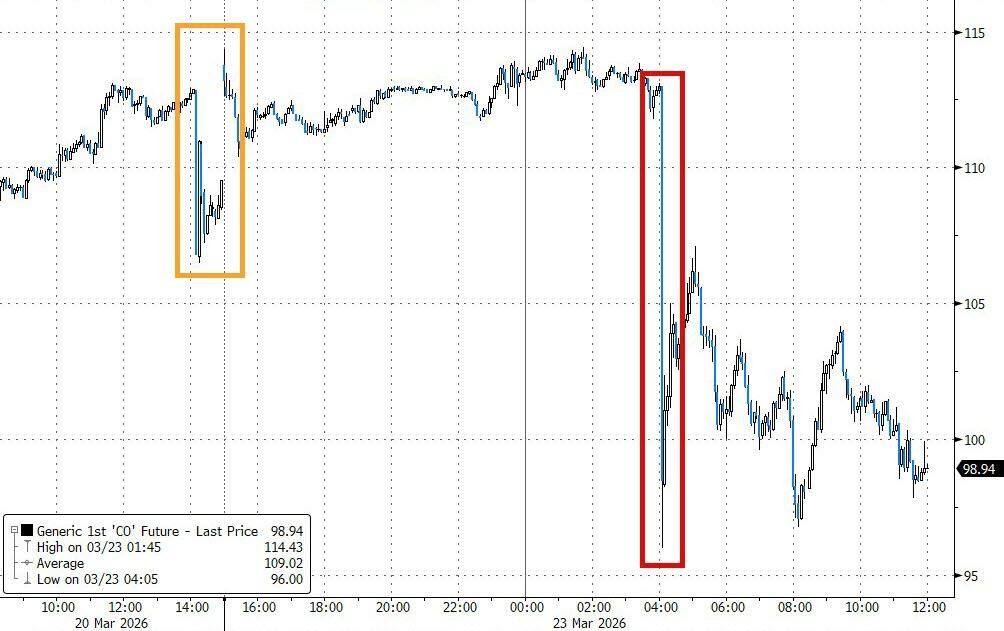
(Brent crude futures plummeted as much as 14% intraday on Monday)
According to CCTV News, Brent crude prices also briefly fell below $100 per barrel after the US submitted a 15-point ceasefire proposal to Iran.
The frequent reversal of policy signals makes it difficult for macro funds to establish stable directional judgments, and it has made institutions like Caxton, which rely on macro trend judgments, lose particularly heavily in this shock.
Risk Warning and Disclaimer
Market risks exist; investment requires caution. This article does not constitute personal investment advice, nor does it take into account the specific investment objectives, financial situation, or needs of individual users. Users should consider whether any opinions, views, or conclusions in this article align with their specific circumstances. Investing based on this information is at your own risk.
