


TurboQuant "Emerges Out of Nowhere," Tech World Hails it as "Google's DeepSeek" and the "Real-life Pied Piper," While Wall Street Says "Heh, Buy the Dip in Memory Stocks"
Google's launch of TurboQuant memory compression technology has sparked heated discussions in the tech world and led to a valuation re-rating of the U.S. storage chip sector. Despite market concerns over storage demand prospects, the storage chip sector suffered a heavy blow on Wednesday, with shares of companies like Sandisk and Micron Tech falling significantly. Wall Street analysts believe the market overreacted and suggest that investors Buy the Dip in memory concept stocks during the pullback. This technology may serve as a catalyst for industry expansion rather than destroying storage demand
Google's release of a new AI memory compression technology has not only ignited a frenzy in the tech industry regarding a revolution in underlying computing power efficiency, but has also subjected the U.S. storage chip sector to a drastic valuation re-rating. However, Wall Street institutions see an opportunity to buy amidst this panic.
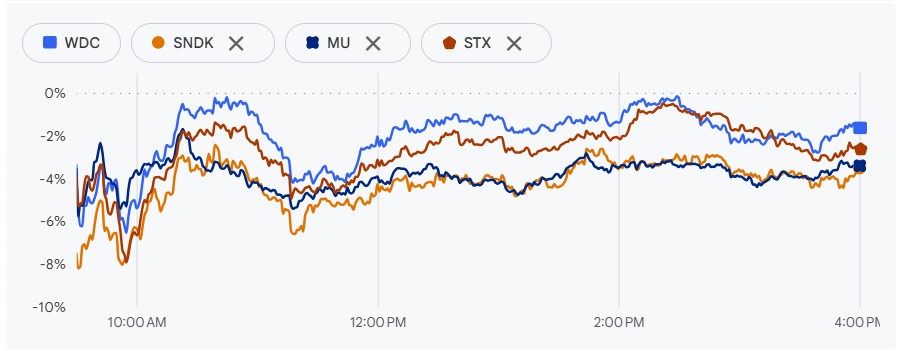
On Wednesday, the U.S. storage chip sector experienced a sharp decline during intraday trading, impacted by expectations that this technology could significantly reduce AI hardware demand. By the close, the Storage Chips and Hardware Supply Chain Index fell 2.08%, with leading companies like Sandisk and Micron Tech both closing significantly lower, highlighting the market's defensive reaction to demand prospects.
However, while the tech community hails this breakthrough technology as the "real-life Pied Piper" and "Google's DeepSeek," the stance of Wall Street investment banks is markedly different. Multiple analysts point out that the actual impact of this technology has been over-priced by the market, and they explicitly state that investors should take the opportunity to Buy the Dip in memory concept stocks during the pullback.
Despite lab data demonstrating impressive compression efficiency, from a macroeconomic and practical computing deployment perspective, this technology—designed to break through AI memory bottlenecks—may ultimately not only not destroy storage demand, but instead become a catalyst for further industry expansion.
Storage Sector Slumps in Response
Following Google's release of the memory compression algorithm named TurboQuant, market concerns about long-term demand for storage hardware quickly spread, leading to a sell-off in related assets.
During Wednesday's trading session, the storage chip sector collectively moved lower. Sandisk once plunged 6.5%, Micron Tech dropped 4%, and Western Digital and Seagate Technology fell more than 4% and 5%, respectively. As market sentiment was somewhat digested toward the end of the session, the declines in related stocks narrowed. By the close, Sandisk and Micron Tech both fell over 3.4%, Seagate Technology closed down 2.6%, and Western Digital's decline narrowed to 1.6%. On that day, the Storage Chips and Hardware Supply Chain Index closed at 113.03 points, having touched an intraday low of 109 points.
The direct cause of market panic is Google's claim that TurboQuant can reduce the cache memory footprint during the operation of large language models by at least 6 times without sacrificing accuracy. Under the logic of an AI arms race highly dependent on hardware scale expansion, any technological advancement that could reduce physical memory procurement is sufficient to put pressure on the chip sector, which is already at high valuations.
"Real-life Pied Piper" and "Google's DeepSeek"
In the tech industry, the release of TurboQuant is seen as a crucial milestone in addressing the high operating costs of large language models. This technology is specifically designed to solve the Key-Value Cache (KV Cache) bottleneck in AI systems, primarily by compressing the otherwise space-consuming cache into 3 bits.
According to media reports, Google employs a two-step compression method: first, it uses PolarQuant technology to convert data vectors into polar coordinates to eliminate additional normalization overhead, and then it utilizes the quantization algorithm QJL to eliminate residual errors.
In tests using open-source models like Gemma and Mistral, the algorithm not only achieved a 6-fold memory reduction but also achieved up to an 8-fold performance increase on NVIDIA H100 GPUs compared to a non-quantized 32-bit solution.
This stunning data sparked heated discussions online, with people jokingly referring to it as the "real-life Pied Piper"—the fictional startup from the classic HBO series Silicon Valley that disrupted industry rules with its lossless compression algorithm. Others, like Cloudflare CEO Matthew Prince, called it Google's "DeepSeek moment," believing it could significantly lower AI operating costs through extremely high efficiency gains, much like DeepSeek.
Wall Street Unfazed, Urges to "Buy the Dip"
Despite the frenzy in the tech circle and the sell-off in the secondary market, Wall Street investment banks have shown remarkable composure and believe the market has overreacted.
KC Rajkumar, an analyst at Lynx Equity Strategies, questioned the "disruptive" nature of this technology. In a report to clients, he pointed out that media coverage of the technology has been exaggerated.
He stated that current inference models have already widely adopted 4-bit quantized data, and Google's claimed 8-fold performance increase is based on a comparison with older 32-bit models. He emphasized that these advanced compression technologies are merely to alleviate computational bottlenecks and will not destroy the demand for memory and flash storage, which is expected to remain strong for the next three to five years due to supply constraints. Therefore, he maintained his $700 price target and buy rating for Micron Tech, explicitly recommending to "buy on the pullback caused by Google's news."
Andrew Rocha, an analyst at Wells Fargo, similarly pointed out that while TurboQuant directly addresses the memory cost curve of AI systems, historical experience shows that the existence of compression algorithms has never fundamentally changed the overall scale of hardware procurement, and the fundamental demand for AI memory remains strong.
Jevons Paradox Reappears, Long-Term Demand May Be Boosted
In addition to pointing out the market overreaction, institutions have reassessed the impact of TurboQuant from a longer-term economic perspective.
Morgan Stanley's analysis indicates that TurboQuant only affects the KV Cache in the inference stage and does not impact model training tasks or the High Bandwidth Memory (HBM) occupied by model weights. The core significance of this technology lies in improving the throughput of individual GPUs, allowing the same hardware to support longer contexts or larger batch sizes.
Morgan Stanley further cited the "Jevons Paradox" to explain this phenomenon: improvements in technological efficiency often reduce usage costs, thereby stimulating greater overall demand. By significantly lowering the service cost per query, TurboQuant enables models that could previously only run on expensive cloud clusters to be migrated locally, effectively lowering the threshold for large-scale AI deployment.
This implies that efficiency improvements will activate more AI application scenarios that were previously constrained by cost. Investment banks concluded that this technology reshapes the cost curve of AI deployment, and its long-term impact on computing power and memory hardware is not a negative signal but rather a "neutral to positive" one.
Risk Disclosure and Disclaimer
Markets have risks, and investments require caution. This article does not constitute personal investment advice, nor does it consider the specific investment objectives, financial situation, or needs of individual users. Users should consider whether any opinion, view, or conclusion in this article is appropriate for their specific circumstances. Investment based on this is at the user's own risk.
