


Unclear Direction, Unpredictable Reversals! When AI Disruption Meets Geopolitical Turmoil, How to Trade in a Market Without Certainty?
BofA believes that the global market is currently in a state of "certainty vacuum" due to unresolved geopolitical risks compounded by AI disruption. In a low-confidence market environment, investors tend to chase momentum trades that are currently effective until they are exhausted and become fragile, as seen in the recent bursting of bubbles in gold and South Korean stock indices. With momentum trades prone to collapse at any moment and market reversals occurring frequently, BofA suggests that the priority right now should not be chasing trends, but rather managing and hedging market volatility
As AI reshapes fundamentals and geopolitical conflicts disrupt expectations, the market is entering a phase where it is "difficult to see the direction, yet one must trade."
According to the Zhuifeng Trading Desk, on March 23, Bank of America Merrill Lynch released its latest "Global Equity Volatility Insights" report, pointing out that the global market is in a state of "certainty vacuum." The report states: "When geopolitical pressures and AI disruption coexist, the market lacks a clear anchor, and investors can only rely on short-term effective trading logic."
This shift is reshaping capital behavior and price structures. "In a low-confidence market environment, investors tend to chase momentum trades that are currently effective until they are exhausted and become fragile."
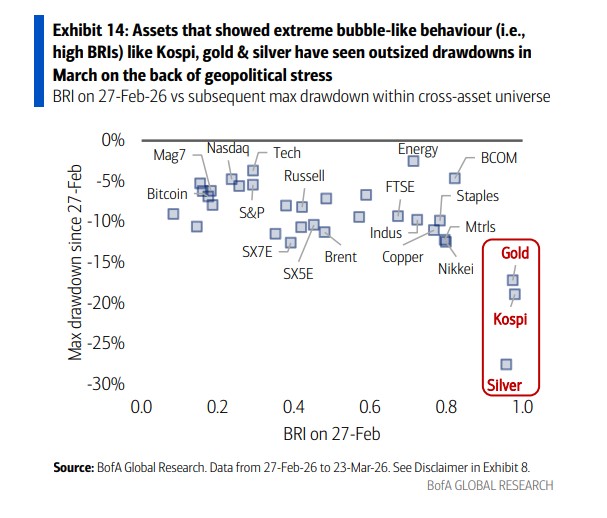
The report cites examples such as the South Korean stock market, gold, and silver, which previously exhibited "bubble characteristics" and experienced larger pullbacks during geopolitical shocks. The logic is simple: when capital is driven by trends rather than fundamentals, price declines become more severe once the trend reverses.
A Prelude to the Bursting Bubble: From Gold and Silver to Korean Stocks
BofA points out that the historic volatility seen in gold, silver, and the KOSPI index over the past few weeks was not accidental.
BofA's "Bubble Risk Indicator" (BRI) had previously warned of bubble risks in these areas. Data shows that after weeks of bubble-like behavior, gold experienced a historic pullback last week, starkly contrasting with its traditional status as a "safe-haven asset." Strategist Benjamin Bowler stated bluntly in the report:
"Momentum trades work until they are exhausted and become fragile, which makes tools like the Bubble Risk Indicator particularly useful in assessing risk."
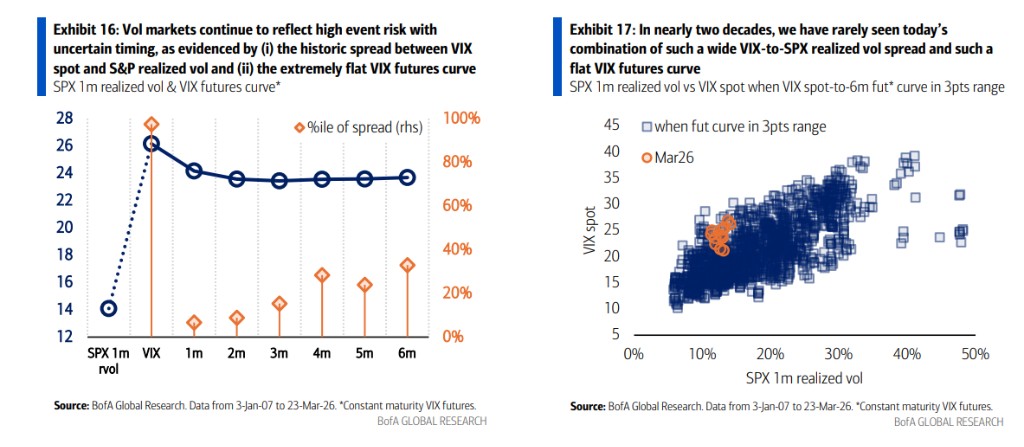
Currently, the volatility market provides the clearest signal: uncertainty is being priced to the extreme. The report highlights a startling phenomenon: VIX spot and futures levels are much higher than the realized volatility of the S&P 500 (20+ vs. 10+), and the VIX futures curve remains unusually flat despite such high volatility levels.
This combination of "high premium + flat curve" has almost no parallel in the past 20 years. This indicates that the market is not only pricing in a massive risk premium for geopolitical events but is also completely unable to predict when those risks will be resolved.
Deteriorating US Market Microstructure: Why Are Prices Always Reversing?
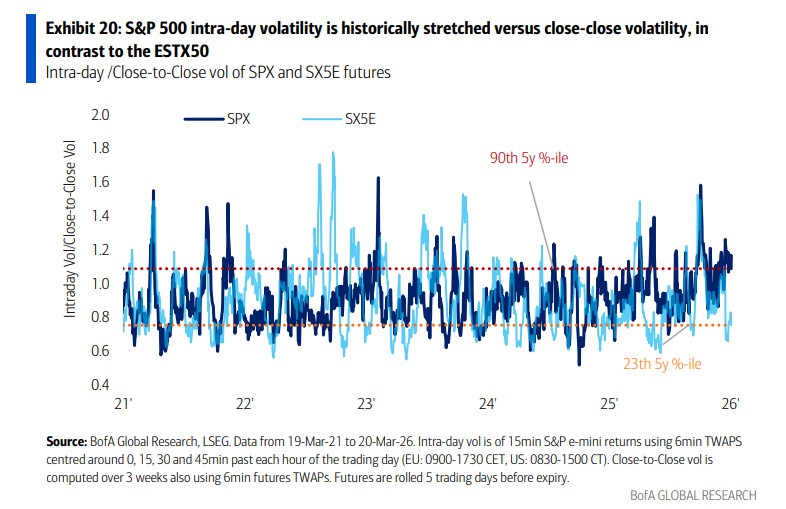
In an uncertain market environment, investors have recently found that US stocks have become extremely prone to "mean reversion" and intraday reversals. BofA analysis attributes this to policy flip-flopping, volatile macro data, and deeper changes in market microstructure.
The report reveals that as the US government withdrew its threats against Iran's energy infrastructure, market sentiment performed a 180-degree turn. The report states:
"As the market digested President Trump's statement regarding the 'temporary cessation of hostile actions in Iran,' asset prices jumped accordingly. This serves as another reminder that intraday volatility captures current stock market risk better than closing volatility."
This "rapid reversal" has led to an imbalance in market microstructure. BofA observed that although the S&P 500 rebounded on signals of de-escalation from Iran, the proportion of overnight trading volume has risen to a high of 20%, while order book depth has shrunk. This "news-driven" rally is prone to causing price overreactions, followed by sharp mean reversions when liquidity returns.
"This environment causes overnight trading to easily trigger price overreactions. Due to a lack of liquidity support, this pricing becomes very fragile; when another batch of investors returns the next day and liquidity improves, prices often reverse."
European Energy Sector: A Fragile Player at a Crossroads
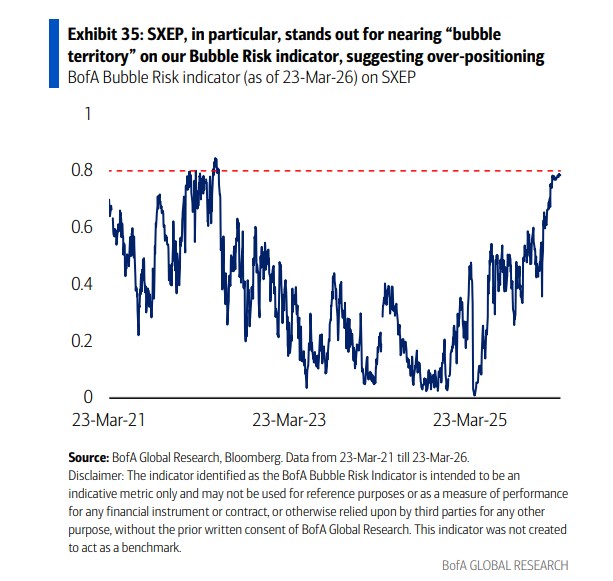
In the European market, geopolitical conflicts have pushed energy prices to a fork in the road, but they have also made the European energy sector (SXEP) look particularly dangerous. Although the sector is up 27% year-to-date, outperforming almost all its European peers, its "Bubble Risk Indicator" (BRI) reading is nearing the peaks seen at the start of the Russia-Ukraine conflict in 2022.
BofA believes the European energy sector has now detached from levels suggested by its typical energy and equity betas, and positioning is unusually crowded. Both future geopolitical paths are unfavorable for the sector:
-
Geopolitical Cooling: Energy prices will reset directly downward.
-
Escalation of Conflict: Extremely high energy prices will instead suppress global growth prospects, causing the correlation between related stocks and commodities to turn from positive to negative.
"Under both geopolitical paths, we see fragility in the European energy sector."
Survival Rules in a "Certainty Vacuum"
In a "certainty vacuum" environment, analyst Benjamin Bowler believes that investors should not blindly chase momentum but should instead exploit structural opportunities in the volatility market. Investors should shift from seeking trends to managing volatility.
Bowler suggests: first, use VIX April put spreads to bet on a short-term de-escalation of geopolitical conflicts; second, use 0DTE (zero days to expiration) options to construct reversal strategies to hedge against intraday price overreactions caused by missing overnight liquidity; and third, perform "cross-sector volatility hedging" in the European market by buying put options on the overheated energy sector (SXEP) while selling put options on the resource sector (SXPP), which is at a valuation trough.
This combination of strategies aims to exploit the disconnect in volatility pricing to protect portfolios during "drip-downs" and "sudden reversals," thereby hedging against the potential sudden collapse of the AI bubble.
