


"Redemption Wave" Sweeps U.S. Private Credit Industry, PE Giants' Stock Prices Plunge Across the Board
The U.S. private credit market is experiencing a collective "gatekeeping" storm. Ares Management and Apollo Global have successively capped quarterly redemptions at 5%, while actual investor redemption demand has exceeded 11%. Giants like Morgan Stanley and BlackRock led the tightening earlier this month. In the first quarter, the industry received a total of $13 billion in redemption requests, with over $4.6 billion still pending. This turmoil has not only triggered a collective decline in stock prices but also completely exposed the structural contradictions of the "liquidity illusion" in private credit
The U.S. private credit market is facing a concentrated liquidity stress test. Ares Management and Apollo Global Management have successively announced restrictions on redemption requests for their private credit funds, triggering widespread market concerns and causing the stock prices of several alternative asset management giants to fall in response.
On Monday evening, Apollo Global was the first to disclose that its $25 billion business development company (BDC), Apollo Debt Solutions, would cap quarterly redemptions at 5% after investors requested to redeem 11.2% of its shares.
Ares Management followed suit, with its $10.7 billion Ares Strategic Income Fund also triggering the 5% redemption cap, as redemption requests for the quarter had climbed to 11.6%. The moves by both companies have further intensified market doubts regarding the liquidity of private credit.
Impacted by this news, shares of Ares Management and Apollo Global both fell by more than 4% in New York trading on Tuesday. Peers such as TPG, Blackstone, KKR, and Blue Owl Capital also traded lower across the board, with the financial sector index reaching a maximum intraday decline of 0.8%. Since the beginning of this year, the stock prices of several alternative asset management firms have seen cumulative double-digit declines.
Redemption Wave Spreads, Multiple Giants Successively "Close the Gates"
This wave of redemption pressure is not an isolated incident but a concentrated outbreak of an industry-wide trend. According to Bloomberg, Morgan Stanley, Cliffwater LLC, and BlackRock had already implemented redemption limits on their multi-billion dollar private credit funds earlier this month; Ares Management and Apollo Global are merely the latest to follow.
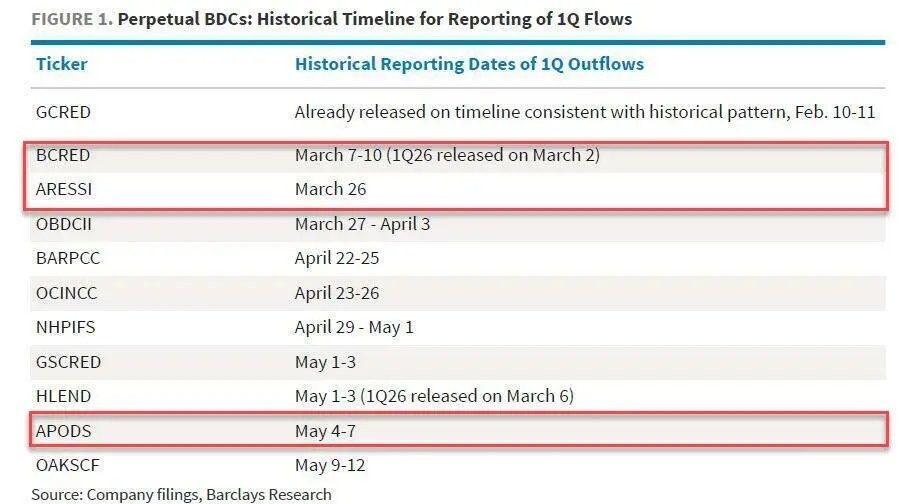
In the first quarter of this year, tracked funds received a total of $13 billion in redemption requests. The total investment portfolio size managed by these funds is approximately $211 billion. Currently, funds have only paid out about two-thirds of the requests, leaving $4.6 billion in redemption applications pending.
Taking Ares Strategic Income Fund as an example, the fund received a total of $1.2 billion in redemption requests in the first quarter, ultimately paying out only $524 million, or slightly more than two-fifths of the total requested. Ares Management attributed the redemption pressure to a "handful" of family offices and small-to-medium institutional investors, stating they represent less than 1% of over 20,000 investors, yet hold assets exceeding 11% of the fund's total size. Notably, the fund still recorded $708 million in new subscriptions during the same period, meaning its asset size did not shrink; however, analysts generally expect the momentum of new capital inflows to be nearing its peak.
Behind the redemption wave lies persistent investor concern over lending practices in the private credit market and their exposure to sectors sensitive to artificial intelligence. Mark Malek, Chief Investment Officer at Siebert Financial, noted in a client report that Apollo Global's filings show a clear discrepancy between its public narrative and actual portfolio exposure, with the software industry remaining its largest holding sector. "This discrepancy erodes confidence at a time when confidence is most critical," he wrote.
"Liquidity Illusion" Questioned, Systemic Risk Debate Intensifies
The concentrated emergence of redemption restrictions has pushed the long-standing structural contradictions of liquidity in the private credit market to the forefront. These non-traded private credit funds, issued to retail and high-net-worth investors, essentially hold underlying assets with low liquidity while offering investors relatively flexible exit channels through quarterly redemption mechanisms. This mismatch becomes acutely apparent when redemption pressure surges.
Significant divisions have emerged in the industry regarding whether this turmoil signals deeper risks. Prominent financial figures such as JPMorgan CEO Jamie Dimon and former Goldman Sachs CEO Lloyd Blankfein have compared the current volatility in the private credit market to the situation leading up to the 2008 global financial crisis.
However, some have challenged this comparison. Mark Malek stated, "This is not a 2008-style systemic banking crisis, because private credit largely exists outside the traditional deposit-funded banking system. The more core issues are valuation, transparency, and the fact that this asset class has never truly possessed liquidity yet created a liquidity illusion."
From a long-term perspective, the spread of redemption restrictions has begun to weigh on the industry's overall fundraising outlook. Analysts expect that new fundraising from high-net-worth individuals for firms like Blackstone, Ares Management, and Blue Owl Capital will slow significantly—a channel that had previously been a core driver of industry growth. Meanwhile, the private credit industry is actively lobbying regulators to allow 401(k) retirement plans access to private investments; this liquidity turmoil may further complicate the advancement of such policies.
