


NVIDIA splashes out $26 billion to enter the AI model arena, directly challenging OpenAI

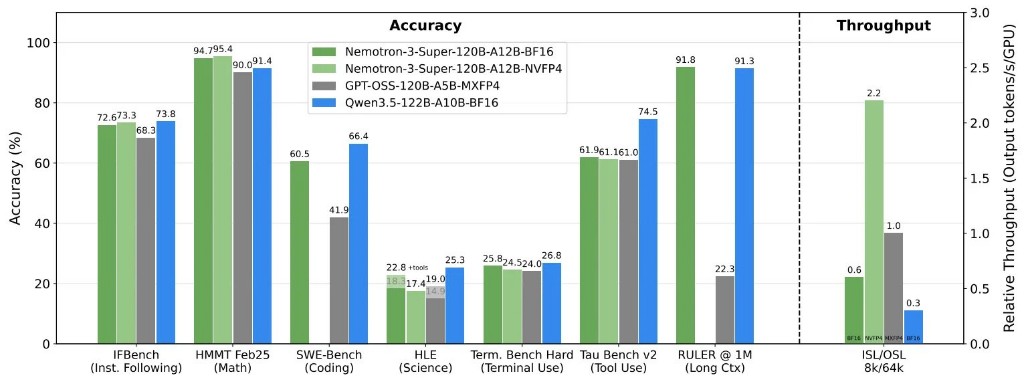
NVIDIA announced an investment of $26 billion in research and development for open-source large models over the next five years, officially transforming from a hardware giant into a full-stack AI company. The newly released Nemotron 3 Super has 128 billion parameters and surpasses OpenAI GPT-OSS with a score of 37 compared to 33. This move deeply binds its own hardware ecosystem through an open-source strategy, challenging laboratories like OpenAI while further consolidating its absolute dominance in the AI computing market
NVIDIA announces a $26 billion investment over the next five years to develop open-source AI large models. The world's largest AI chip manufacturer is officially transforming into a cutting-edge model laboratory, directly challenging the market positions of OpenAI, Anthropic, and DeepSeek.
According to NVIDIA's 2025 financial documents and executive interviews obtained by WIRED on the 11th, this massive investment has been confirmed by the company's management. Meanwhile, NVIDIA released its strongest open-source model to date, Nemotron 3 Super, on Wednesday, claiming it surpasses OpenAI's open-source model GPT-OSS in several benchmark tests.
The impact of this move on the market cannot be underestimated. NVIDIA's chips have always been the industry standard for training large AI models, and its open-source models are specifically optimized for its own hardware, helping to further consolidate its dominant position in the AI computing market.
From a broader perspective, this investment marks a profound shift in NVIDIA's strategic focus—from a mere hardware and software stack supplier to a full-stack AI company capable of directly competing with top AI laboratories.
Nemotron 3 Super: Performance Metrics Close to Top Models
NVIDIA's newly released Nemotron 3 Super has 128 billion parameters, comparable in scale to the largest version of OpenAI's GPT-OSS. NVIDIA claims that in the Artificial Intelligence Index comprehensive scoring, Nemotron 3 Super scored 37 points, while GPT-OSS only scored 33 points—although the company also acknowledges that some Chinese models scored higher than this level.
Additionally, NVIDIA stated that Nemotron 3 Super participated in a new benchmark test called PinchBench, which specifically evaluates the model's control capabilities over OpenClaw, with Nemotron 3 Super ranking first in this test.
On a technical level, NVIDIA has disclosed several innovative methods used to train this model, covering architectures and training techniques that enhance model inference capabilities, long context processing abilities, and reinforcement learning responsiveness. NVIDIA's Vice President of Deep Learning Research, Bryan Catanzaro, stated, "NVIDIA is placing far greater emphasis on open-source model development than ever before, and we are making significant progress."
Catanzaro also revealed that NVIDIA has recently completed the pre-training of a 550 billion parameter model. Since releasing the first Nemotron model in November 2023, NVIDIA has successively launched dedicated models for vertical fields such as robotics, climate modeling, and protein folding.
The Strategic Logic Driven by Hardware and Models
NVIDIA's move is not merely about model competition; it is a strategic layout deeply tied to its hardware roadmap. Kari Briski, Vice President of Enterprise Business for NVIDIA's Generative AI Software, stated, "The company's future AI models will not only serve chip development but will also be used to optimize the overall architecture of supercomputing data centers." "We build these models to stretch our systems, testing not only computational capabilities but also storage and networking, thereby constructing a hardware architecture roadmap," she said.
The open-source strategy also has long-term commercial significance for NVIDIA. When NVIDIA releases its models, it will publicly share weights and technical details, facilitating startups and researchers to modify and innovate based on its technology. This helps to form a developer network around NVIDIA's hardware ecosystem, further strengthening the market stickiness of its chips.
Catanzaro stated, "Helping the ecosystem develop aligns with our interests." He joined NVIDIA in 2011 and has led the company's historic transformation from gaming graphics cards to AI chips.
Industry Experts Highly Praise Its Strategic Significance
The research community has responded positively to NVIDIA's layout. Nathan Lambert, an AI researcher at the Allen Institute for AI (Ai2) and head of the American True Open Source Models (ATOM) project, expressed that he is a "staunch supporter of Nemotron" and called for the U.S. government to provide funding support for open-source models.
Andy Konwinski, founder of the non-profit organization Laude Institute focused on promoting AI openness and a computer scientist, characterized NVIDIA's investment as a milestone signal. "They are at the forefront of the intersection of many open and closed AI projects," Konwinski stated, "This is an unprecedented declaration of their belief in openness."
