


Set the upper limit on the U.S. Treasury General Account (TGA)? Will Waller "taper" like this?

The discussion on the Federal Reserve's "balance sheet reduction" is heating up, and an obscure mechanism is back in the spotlight: limiting the size of the Treasury General Account (TGA) or restarting the Treasury Tax and Loan (TT&L) program, which could theoretically release reserves, create space for quantitative tightening (QT), and achieve net balance sheet contraction. However, Bank of America bluntly stated that this plan is "extremely unlikely" to be implemented—three major obstacles almost eliminate the motivation for advancement: the Treasury is unwilling to reduce the TGA, banks find deposits unstable, and the volatility under the debt ceiling crisis is difficult to control
Federal Reserve Chair nominee Waller advocates for a "balance sheet reduction" plan, a long-ignored mechanism discussion that is gaining traction—limiting the size of the Treasury General Account (TGA), which, while theoretically sound, the Treasury may not allow.
According to a report from Bank of America Securities interest rate strategist Katie Craig, she breaks down this logical chain: Setting a cap on the TGA would mean that any cash exceeding this limit would flow into the banking system as reserves, and with more ample reserves, the Fed would be in a position to restart quantitative tightening (QT), selling assets and absorbing reserves, ultimately achieving a net contraction of the balance sheet.
The logic on paper is coherent, but her judgment is equally clear—this plan is "extremely unlikely" to be implemented, as there has been no official communication from the Fed or the Treasury regarding this direction, and the Treasury does not want a smaller TGA. This year, the Treasury has seen an average outflow of about $825 billion over a rolling 5-day period, which tends to be higher during large repayments or tax refund seasons.
It is worth mentioning that TT&L is not a new concept—before the financial crisis, the Fed operated this mechanism on behalf of the Treasury. After the crisis, as reserves shifted from scarcity to abundance, TT&L gradually faded from the historical stage. Canada and the UK still have similar arrangements, but the obstacles to replication in the U.S. are significant.
TGA—A Major Variable on the Fed's Liability Side
The Fed's main liabilities consist of three parts: (1) currency in circulation; (2) Treasury General Account (TGA); (3) bank reserve balances.
Bank of America points out that the TGA is a liability on the Fed's balance sheet: when the Treasury deposits money, the Fed's liabilities increase; when the Treasury spends money, the liabilities decrease. The TGA itself is one of the largest liability items on the Fed's balance sheet and is largely outside the Fed's control. The Treasury's minimum cash target is the sum of expected expenditures over the next 5 days, with an average of about $825 billion year-to-date, which tends to see a temporary spike around large debt repayments or tax refund seasons.
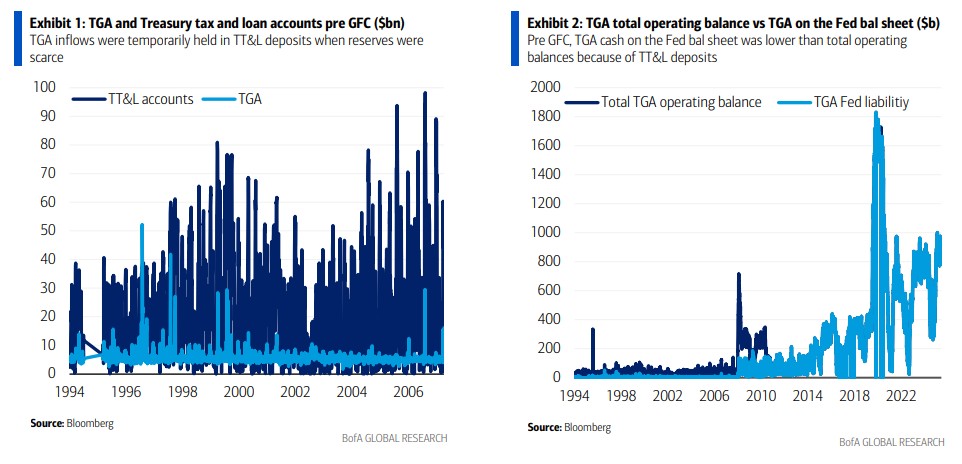
The Fed has a precedent for controlling the TGA; before the 2008 global financial crisis, the Fed executed Treasury Tax & Loan (TT&L) operations on behalf of the Treasury, meaning that when tax revenues came in, not all cash was immediately deposited into the TGA, but rather allowed commercial banks to retain tax payments for a period, smoothing the inflow to the TGA and mitigating the impact of passive reserve outflows on the money market.
At that time, the system also had two "incentive" designs: the Treasury could earn interest on money placed in TT&L deposits, while the TGA earned 0; additionally, the funds were more flexibly utilized, allowing for term investments or investments in Treasury repurchases.
Subsequently, as the Fed entered an era of ample reserves, TT&L operations gradually diminished, and the Fed deemed their necessity significantly reduced
Modern Solutions: Limit TGA Cap or Restart TT&L
If today "set a cap on TGA/restart TT&L," the Bank of America Merrill Lynch research team explored a two-phase transmission mechanism:
Phase A: TGA funds transfer to commercial banks in the form of TT&L deposits
Federal Reserve Balance Sheet: TGA decreases by 100, reserves increase by 100, total size remains unchanged
Commercial Banks: Reserve assets increase by 100, Treasury deposits liabilities increase by 100
Phase B: Federal Reserve restarts QT, compresses balance sheet
Federal Reserve: U.S. Treasury assets decrease by 100, reserve liabilities decrease by 100, total size shrinks
Commercial Banks: Reserves decrease by 100, securities assets increase by 100, net change is zero
Through these two steps, the Federal Reserve's balance sheet can be substantially compressed, while the total reserves in the banking system remain unchanged. The net interest impact on the Treasury essentially offsets—interest expenses on the debt stock are roughly equivalent to interest income on deposits.
Three Major Realistic Obstacles Not to Be Ignored
Despite the logical consistency of the mechanism, the Bank of America Merrill Lynch team holds a highly skeptical attitude towards the practical implementation of this plan and lists three core obstacles:
Treasury unwilling to reduce TGA: TGA is not just a savings account; it also needs to address the timing mismatch of large payments within a single day. A too-low balance would create liquidity risks.
Banks may not be on board: The rhythm of Treasury deposits in and out is difficult to predict, and compared to ordinary retail deposits, its stability is poor, making banks more passive in liquidity management.
Extreme volatility under the debt ceiling crisis: Each time the debt ceiling is reached, TT&L-type accounts experience severe disturbances, significantly increasing management difficulty.
Together, these three obstacles essentially eliminate the Treasury's motivation to actively promote this plan. In official communications between the Federal Reserve and the Treasury, there has never been mention of plans to limit TGA or restart TT&L.
Solutions from Canada and the UK, Not Applicable to the U.S.
Bank of America Merrill Lynch compared the discussions in the U.S. with two overseas cases:
Canada (BoC's RG auction mechanism):
The Bank of Canada conducts daily "Receivable General Account" (RG) auctions on behalf of the federal government, selling government deposits to banks in overnight or short-term forms, allowing the government to earn deposit interest—expected to generate approximately CAD 223 million in interest income for the entire year of 2026.
Auction demand is highly correlated with the settlement balances of the banking system. When funding demand tightens and pushes repo rates significantly away from the central bank's target, the Bank of Canada will also supplement its own overnight and term repo operations.
UK (DMO's proactive cash management):
The UK's arrangement is more thorough: the management of the Treasury account is not by the Bank of England, but by the Debt Management Office (DMO). The DMO neutralizes fiscal fund flows daily through bilateral repos or deposit operations, keeping reserves relatively stable, allowing the Bank of England to focus on interest rate management without being disturbed by fluctuations in the fiscal account
However, this framework has a byproduct—it requires more temporary Treasury bond issuance to absorb or inject liquidity, while the U.S. Treasury's consistent stance is to maintain a "regular and predictable" bond issuance pace, which presents a direct conflict.
Even if implemented, the effect is only temporary
If a cap is set on the TGA or the TT&L is restarted, the initial effect would be a loosening of dollar financing conditions: cash flows from the TGA into bank reserves, which then flows into the money market, creating downward pressure on short-term interest rates. However, this easing window will not last—once the Federal Reserve restarts QT or accelerates balance sheet reduction, the excess reserves will be withdrawn, and financing conditions will revert to their original state.
Bank of America's judgment is: on the interest income and expenditure side, the income from the Treasury's TT&L deposits roughly offsets the corresponding debt financing costs, approaching neutrality; however, operationally, the troubles are not few, especially during the debt ceiling negotiation period, where the TT&L deposit balance may experience significant fluctuations, becoming a new source of instability.
Therefore, Bank of America believes that by limiting the TGA or restarting the TT&L plan, the Federal Reserve's balance sheet could theoretically achieve marginal compression, but this path is unlikely to be realized
