


Oil prices continue to rise! The shipping industry questions Trump's escort promise: Are there enough warships? Is the insurance reliable?

The escort plan has not effectively alleviated market concerns. After a brief retreat, Brent crude oil continues to rise, currently surpassing $84 and approaching previous highs. Several shipowners have expressed uncertainty about whether the U.S. military has enough vessels to escort ships while maintaining operations against Iran; they remain cautious about tying their fate to the policy-volatile U.S. government
On Tuesday afternoon Eastern Time, Trump announced the Strait of Hormuz escort plan, which temporarily led to a drop in oil prices, but it did not effectively calm the situation. As of the time of this report, Brent crude oil has risen again, surpassing $84 and approaching previous highs.
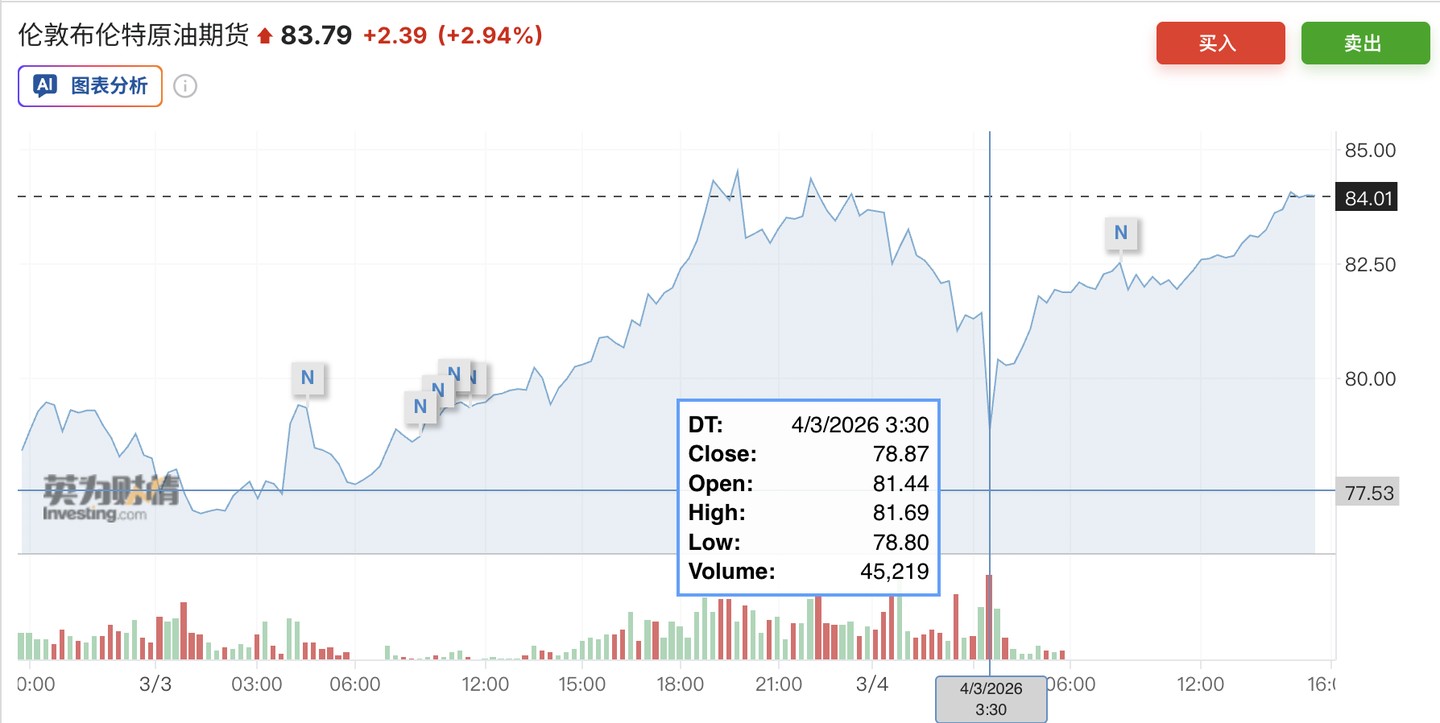
Trump stated that the U.S. will ensure the smooth flow of energy through the Persian Gulf by providing insurance backing and military escort. This statement briefly suppressed the increase in oil prices on Tuesday. However, according to Bloomberg, the shipping industry generally believes that this plan is at best a partial solution to this historic crisis, rather than a fundamental solution.
Wall Street Insight previously published an article “Trump Orders Dual Measures to Protect Shipping in the Gulf Region, Iran Warns Vessels Not to Transit the Strait of Hormuz”, which cited comments from professionals stating that if Iran continues to resist, even with these U.S. guarantees, the full restoration of shipping through the strait will take weeks.
Currently, the details of the insurance and escort plans mentioned by Trump are still unclear, but Iraq has already begun to cut production, and the storage tanks along the Persian Gulf are continuously filling up. The longer the wait, the more severely the supply chain is damaged.
The Hormuz Dilemma: Closed Passage, Pressured Energy Supply Chain
The impact of the blockade of the Strait of Hormuz has quickly spread to the upstream supply side. Iraq, the second-largest oil producer in the Middle East after Saudi Arabia, has begun to significantly reduce production and is facing further pressure to cut back, becoming the most direct signal of pressure on regional suppliers.
Vessels are unable or unwilling to transit, producers are hindered in their exports, and the capacity market is thrown into chaos.
Karnan Thirupathy, a partner at Kennedys Law LLP and an expert in commodities, shipping, and insurance, stated: "The core concern for shipowners is the real risk of loss. Once the risk of loss is too high to bear, no one will enter this shipping lane."
Insurance Backing Plan: Precedents Exist, but Scale and Execution Face Challenges
The plan proposed by Trump relies on the U.S. International Development Finance Corporation (DFC) (which primarily supports the private sector in providing financing to developing countries) to provide guarantee support for charterers, shipowners, and key marine insurance institutions.
Such mechanisms are not without precedent. In November 2023, an insurance mechanism involving Lloyd's insurers and the Ukrainian government was established, specifically to provide affordable war insurance for vessels supporting Ukraine's grain and other maritime exports. The DFC had also previously participated in arrangements related to war insurance reinsurance.
However, according to Bloomberg, several shipowners have stated that covering oil and gas transportation across such a large area of the Persian Gulf involves a number of producers and consumers far exceeding that of the Ukrainian plan, and the complexity is not comparable. They remain cautious about binding their fate to the policy-volatile U.S. government. RBC Capital Markets analysts pointed out in a research report: "Although Trump's statements regarding insurance and naval escort have triggered a pullback in oil prices, we remain skeptical about the current planning level of the insurance safety net and believe that rapid implementation may face numerous challenges."
Naval Escort Plan: A Dual Test of Confidence and Capability
The escort plan also faces multiple real-world obstacles. Several shipowners, speaking on condition of anonymity, stated, Considering Iran's ongoing strikes and the dispersion of U.S. naval forces due to simultaneous operations against Iran, whether naval escort can effectively boost market confidence remains in question.
Many oil tankers are neither U.S.-owned nor flying the U.S. flag, which further complicates the escort arrangements.
RBC also wrote in the aforementioned report: "The U.S. is currently leading operations against Iran, and a key question is whether the navy has enough vessel assets to maintain operations against Iran while escorting ships."
Meanwhile, several shipowners have cited the experiences of the Houthis to express skepticism about the actual effectiveness of the escort plan.
Time Window: Implementation Takes Time, Both Supply and Demand Cannot Wait Long
Even a phased plan aimed at restoring limited shipping flow will require considerable time from design to implementation. This is precisely the cost that both producers and consumers find difficult to bear. Iraq's production cuts have already occurred, and storage tanks along the Persian Gulf are continuously filling up; the longer the wait, the deeper the damage to the supply chain.
Warren Patterson, head of commodity strategy at ING Groep NV, admitted: "This is good news, but it clearly won't happen overnight. Naval escort will help, but it also requires time. Escort vessels will be sitting ducks in the face of Iranian attacks."
With the details of both the insurance and escort plans still unclear, the shipping industry has chosen to remain inactive. Shipowners are watching the coverage and costs of insurance terms, while the restoration of confidence is far from being achieved by a mere statement
