


The US-Iran conflict suppresses global risk appetite, the blockade of the Strait of Hormuz restricts oil, and foreign capital inflow into Hong Kong stocks hinges on fundamentals --- 0203 Macro Dehydration

The conflict between the U.S. and Iran has led to a decline in global risk appetite, with the blockade of the Strait of Hormuz driving up oil prices, and foreign capital inflow into Hong Kong stocks being affected by fundamentals. The joint strikes by the U.S. and Israel against Iran have triggered geopolitical tensions, resulting in a rise in commodity risk premiums in the short term, which has led to a decline in U.S. Treasury yields. There are divisions within the Federal Reserve, with the market expecting three rate cuts throughout the year, but the timing of the first cut has been delayed. Hong Kong stocks have performed weakly, mainly influenced by the Chinese credit cycle, the market's lack of favor for the AI narrative, and the hawkish nominations from the Federal Reserve
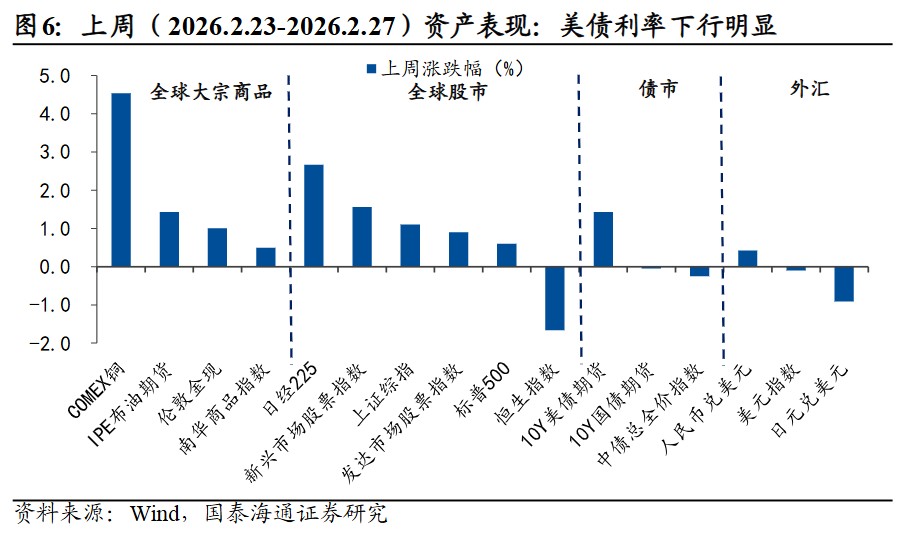
- On February 28, the United States and Israel launched a joint strike against Iran, which subsequently retaliated. The geopolitical situation temporarily raised the risk premium for commodities and suppressed global risk appetite, leading to a decline in U.S. Treasury yields. There are significant internal divisions within the Federal Reserve; although the market maintains expectations for three rate cuts throughout the year, the timing of the first cut has been pushed back.
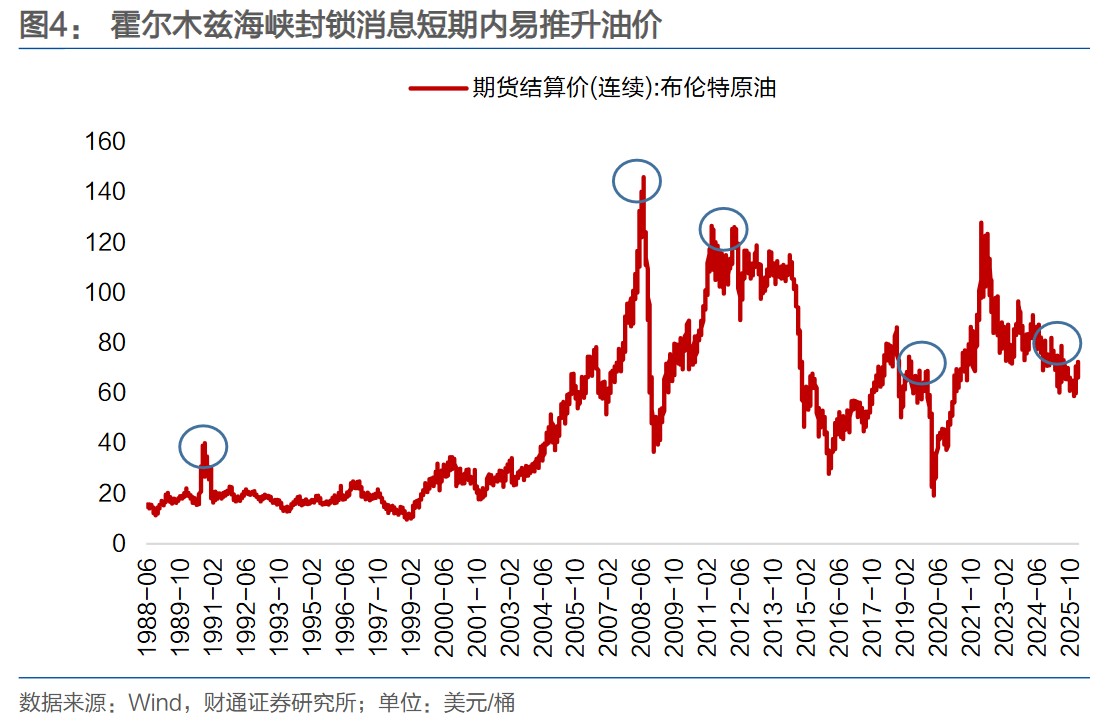
- Iran has implemented a blockade of the Strait of Hormuz for the first time, which handles over 25% of global maritime oil trade. War risk premiums have surged, sharply increasing energy transportation costs and supply risks. In the short term, oil prices may spike due to panic, but Iran's crude oil exports depend on this strait, and the blockade could easily trigger joint intervention, making sustained significant increases unlikely.
- Recently, Hong Kong stocks have performed weakly, mainly influenced by three factors: the Chinese credit cycle is turning towards a turbulent slowdown, limiting the upward space for the index; the AI narrative structure is not favored by the market; and the Federal Reserve's hawkish nominations are disturbing global liquidity expectations. Historical experience shows that the core condition for sustained foreign capital inflows is an improvement in fundamentals.
I. U.S.-Iran Conflict Suppresses Global Risk Appetite
U.S.-Iran Conflict Suppresses Global Risk Appetite (Citi Haitong)
Citi Haitong pointed out that on February 28, the United States and Israel launched a joint strike against Iran, which subsequently retaliated with missile strikes and announced a blockade of the Strait of Hormuz. The geopolitical situation temporarily raised the risk premium for commodities and suppressed global risk appetite, leading to a decline in U.S. Treasury yields. There are significant internal divisions within the Federal Reserve; although the market maintains expectations for three rate cuts throughout the year, the timing of the first cut has been pushed back.
- On February 28, the United States and Israel launched a joint strike against Iran, which was followed by Iran's missile retaliation and the announcement of a blockade of the Strait of Hormuz.
- On March 1, Iranian media reported that Supreme Leader Khamenei "died in the line of duty."
- Trump announced that the bombing would continue for a week.
- In the short term, the risk premium for gold and oil has increased, driving up commodity prices.
- Global risk appetite is suppressed, leading to a pullback in risk assets and a decline in U.S. Treasury yields.
- There are still significant divisions within the Federal Reserve.
- Waller stated that despite the January employment report significantly exceeding expectations, one should not rely on single-month data to determine policy. If employment improvement continues, a wait-and-see approach should be maintained; if employment continues to weaken, there would be reason to cut rates.
- Goolsbee reiterated that it is not advisable to cut rates before seeing a tangible decline in inflation.
- The market maintains expectations for three rate cuts throughout the year.
- The timing of the first rate cut has been pushed back, with only a 45.9% probability of a cut in June.
- The employment market remains stable, with initial jobless claims at 190,000, but continuing claims for unemployment benefits remain high, reflecting a "low hiring, low layoff" situation.
- Mortgage applications have declined, but refinancing activities remain active.
II. The Blockade of the Strait of Hormuz Restricts Oil
The blockade of the Strait of Hormuz restricts oil (Caitong)
Caitong pointed out that Iran has implemented a blockade of the Strait of Hormuz for the first time, which handles over 25% of global maritime oil trade. War risk premiums have skyrocketed, and energy transportation costs and supply risks have sharply increased. In the short term, oil prices may spike in panic, but Iran's crude oil exports rely on this strait, and the blockade could easily trigger a joint intervention, making sustained significant increases unlikely.
- The blockade of the Strait of Hormuz has sharply increased global energy transportation costs and supply risks.
- On February 28, Iran implemented a physical blockade of the Strait of Hormuz for the first time.
- The Strait of Hormuz handles over 25% of global maritime oil trade, and the blockade has nearly halted shipping, causing war risk premiums for regional vessels to soar.
- Global oil supply is constrained.
- Although eight OPEC+ member countries announced an increase in production starting in April on March 1, the blockade will limit the release of production capacity.
- The U.S. Department of Energy has clearly stated it will not release strategic petroleum reserves, shale oil production is slowing, and there is a time lag, making it difficult to immediately offset the gap.
- Existing land pipelines can only offset a small portion of supply losses.
- Rerouting maritime transport will significantly increase unit transportation costs, exacerbating supply tightness.
- Oil prices may rise in the short term, but the possibility of sustained increases is limited.
- In the short term, geopolitical risk premiums drive oil prices to spike in panic.
- In the long term, prices will be constrained by inventory consumption, adjustments in transportation routes, and demand contraction.
- It is expected that oil prices will find it difficult to sustain significant unilateral increases, as Iran's crude oil exports heavily depend on this strait, and the blockade could easily lead major consuming countries to intervene jointly to restore navigation.
III. The key to foreign capital inflow into Hong Kong stocks lies in fundamentals
The key to foreign capital inflow into Hong Kong stocks lies in fundamentals (CICC)
CICC pointed out that the recent performance of Hong Kong stocks has been weak, mainly influenced by three factors: the Chinese credit cycle is turning to a period of turbulence and slowdown, restricting the upward space of the index; the AI narrative structure is not favored by the market; and the hawkish nominations by the Federal Reserve disturb global liquidity expectations. Historical experience shows that the core condition for sustained foreign capital inflow is the improvement of fundamentals.
- The recent weakness of Hong Kong stocks is mainly due to the credit cycle shift, industrial narrative differentiation, and liquidity headwinds.
- By 2026, the Chinese credit cycle may shift from recovery to turbulence and slowdown, restricting the overall upward space of the index.
- The internal AI narrative structure of Hang Seng Technology is not favored by the current market.
- The hawkish nominations by the Federal Reserve disturb global liquidity expectations.
- The condition for foreign capital inflow is the improvement of fundamentals; interest rate cuts or RMB appreciation are merely auxiliary factors.
- Historically, there have been two rounds of significant inflows.
- From May 2017 to May 2018, supply-side reforms and the inclusion of A-shares in MSCI
- Historically, there have been two rounds of significant inflows.
- From November 2020 to February 2022, China was the first to recover after the pandemic, and the new energy industry rose.
- Currently, active funds in Europe and the United States are still significantly underweight in China. If they return to their current benchmark allocation, it is expected to bring in HKD 500 to 550 billion.
- Recently, since early 2026, active foreign capital has flowed into China for seven consecutive weeks.
Risk Warning and Disclaimer
The market has risks, and investment requires caution. This article does not constitute personal investment advice and does not take into account the specific investment goals, financial situation, or needs of individual users. Users should consider whether any opinions, views, or conclusions in this article are suitable for their specific circumstances. Investment based on this is at one's own risk
