


If oil and gas infrastructure is attacked, oil prices may surge to $120! The key moving forward lies in the Strait of Hormuz

Citigroup raised its short-term Brent crude oil price forecast to $85 and warned that in the extreme scenario of oil and gas infrastructure being attacked, Brent crude could soar to $120. HSBC pointed out that if the oil transportation route through the Strait of Hormuz is disrupted, OPEC+'s approximately 4.6 million barrels per day of idle capacity would become useless, as this capacity cannot be exported, which would put significant upward pressure on oil prices
The shipping in the Strait of Hormuz is being obstructed, which is repricing the oil market as a "geopolitical shock priority" market. The common conclusion among several investment banks is that the key risk is not whether OPEC+ has idle production capacity, but whether these increments can pass through the strait. If the passage remains restricted, the upward space for oil prices will be quickly opened.
Brent crude oil opened on Monday with a jump of 13%, surpassing $82 per barrel, and as of the time of writing, the price is $78 per barrel. The market is beginning to prepare for longer periods of volatility and supply chain disruptions. Over the weekend, as the U.S. and Israel's strikes against Iran escalated into regional conflict, tanker traffic in the strait has nearly come to a standstill.
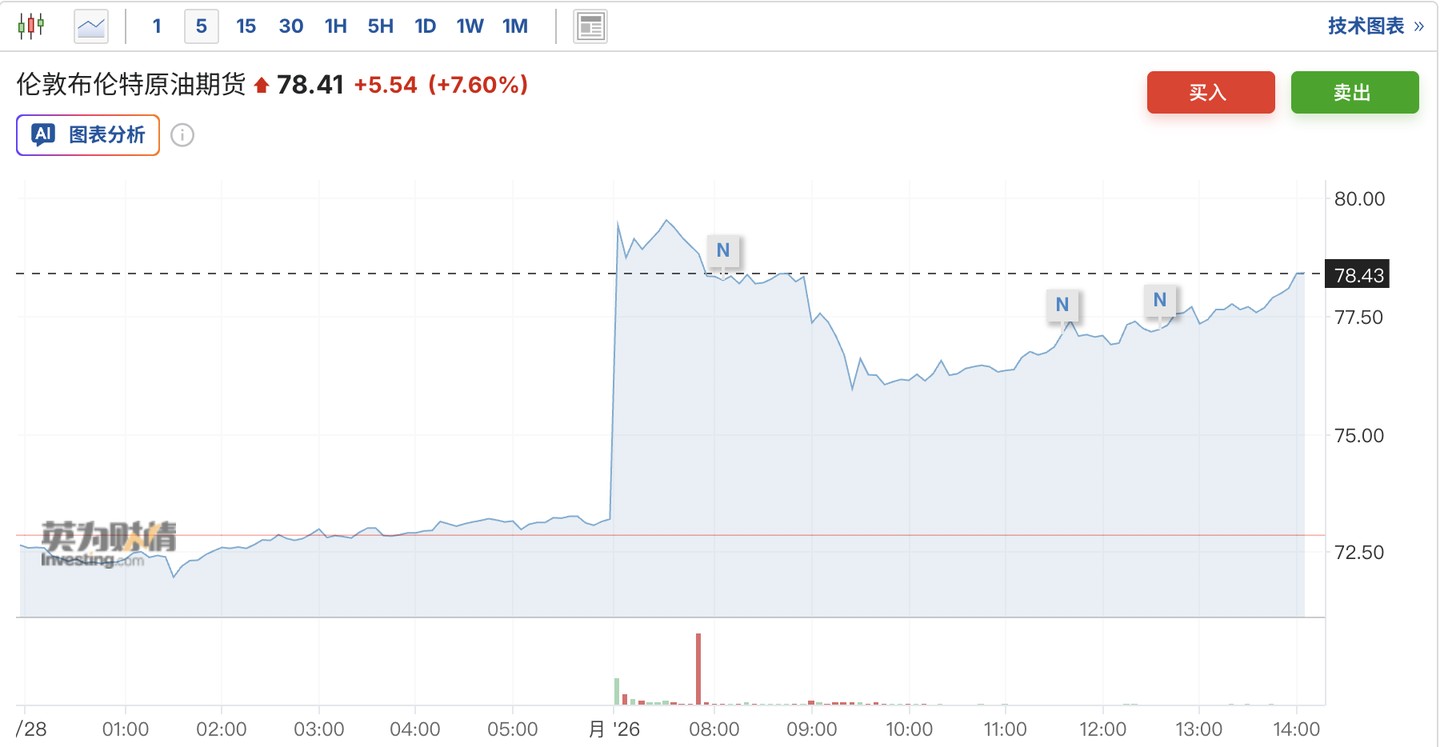
Iran claims that the waterway remains open but simultaneously stated responsibility for the attacks on three tankers on Sunday. After the U.S. designated a maritime warning zone, shipowners generally suspended passage through this "choke point," while about one-fifth of the world's crude oil and liquefied natural gas is typically transported daily through the Strait of Hormuz, making any delays potentially transform into risk premiums.
In this context, Citigroup has raised its short-term Brent forecast to $85 and warned that if regional oil and gas infrastructure is attacked, there is a tail risk for oil prices to surge to $120. HSBC emphasized that the strait is the "main variable" for oil market risks; once closed, the idle capacity in the Gulf region will struggle to play a stabilizing role due to inaccessible transportation.
Citigroup: Short-term anchored at $80-90, infrastructure attack scenario could push to $120
Citigroup has raised its short-term Brent forecast by $15 to $85. The bank expects that with ongoing risks to energy infrastructure and disrupted oil flows through the Strait of Hormuz, Brent is likely to trade in the range of $80 to $90 per barrel this week.
The "baseline scenario" provided by Citigroup is that the conflict will cool down within 1 to 2 weeks, triggered by factors such as changes in Iran's leadership or the U.S. choosing to de-escalate after observing changes in leadership and weakening Iran's missile and nuclear programs. In a more aggressive scenario, if regional oil and gas infrastructure is attacked, oil prices could rise to $120 per barrel, with Citigroup assigning a 20% probability to this scenario.
The latest news reports that the Ras Tanura refinery in Saudi Arabia has been shut down following a drone attack. According to Xinhua News Agency, Al Jazeera reported on the 2nd that three British and American tankers were attacked in the Persian Gulf and the Strait of Hormuz.
According to Saudi Aramco, the Ras Tanura refinery is the largest refinery in the Middle East, with a daily refining capacity of 550,000 barrels.
HSBC: Risks are "asymmetric," if the strait is closed, idle capacity cannot enter the market
In a research report dated February 27, HSBC assessed that the risks related to Iran are "asymmetric" for oil prices, with most escalation scenarios pointing to upward price movements, where the passage through the Strait of Hormuz is the "main concern." HSBC pointed out that the idle capacity in the Gulf region is "significant," with OPEC totaling about 4.6 million barrels per day, distributed among Saudi Arabia, the UAE, Iraq, Kuwait, and Iran. However, if the Strait is closed, a large portion of this capacity will be unable to enter the market.
Approximately 19 to 20 million barrels of oil equivalent liquids pass through the Strait daily, and alternative routes are insufficient to fully offset the impact of a closure of the Strait. The bypass capabilities listed by HSBC include Saudi Arabia's East-West pipeline with a capacity of 5 to 7 million barrels per day, as well as the Adcop pipeline from the UAE to Fujairah, but overall, it is still difficult to cover the volume carried by the Strait.
HSBC estimates that about 19% of global supply (crude oil and refined products) needs to pass through the Strait of Hormuz, and any "brief" interruption could push prices higher. The bank mentioned that in a scenario of "military escalation and Iranian retaliation," Brent could spike to $80.
Secondary Impact on Shipping and Refined Products: Not Just Crude Oil, Risk Premiums Will Spread Along the Chain
HSBC warns that the risks in the Strait of Hormuz not only affect crude oil but will also transmit to the refined oil market. About 10% of global diesel supply and 20% of aviation fuel supply rely on crossing the Strait of Hormuz, and the tense situation has already pushed up middle distillate prices. If the disruption extends, some varieties may be more prone to temporary shortages.
From the traffic data, the "volume constraint" of Hormuz explains why the market is particularly sensitive to shipping delays.
Gao Mingyu, chief researcher in energy and chemicals at CITIC Futures Research and Development Department, stated that by 2025, the total amount of crude oil and refined products exported by Gulf countries through the Strait of Hormuz will be 18.672 million barrels per day, accounting for 27.1% of the global total, of which crude oil and condensate will be 15.007 million barrels per day, accounting for 34.5% of the global total.
JP Morgan Warns: If the Strait is Blocked, Storage Limitations May Lead to a Complete Shutdown of Middle Eastern Crude Oil Production
According to previous reports from Wall Street Watch, JP Morgan conducted a detailed assessment of the storage capacity of seven Gulf oil-producing countries—Saudi Arabia, the UAE, Iraq, Kuwait, Qatar, Oman, and Iran.
The bank estimates that the onshore crude oil storage capacity of these countries is about 343 million barrels, equivalent to accommodating about 22 days of retained production. Additionally, there are about 60 vacant oil tankers in the Gulf region that can provide extra offshore storage buffer, collectively capable of storing about 50 million barrels of crude oil, thus extending the production maintenance time by another three to four days.
In total, under a complete blockade of the Strait, Middle Eastern oil-producing countries can only maintain normal production for about 25 days at most. Once this time limit is exceeded, storage facilities will become saturated, and oil-producing countries will have no choice but to forcibly cut or even stop production.
This assessment means that if the situation continues to deteriorate, the global energy market will face not only price shocks but also a physical interruption of supply.
The "Excess Supply Base" Still Exists, But the Short-Term Trading Framework Has Been Rewritten
Despite the oversupply situation in 2026, the price center and fluctuation range have clearly shifted upward in the short-term trading level.
Goldman Sachs analyst Daan Struyven pointed out that the current risk premium of about $18 per barrel corresponds to pricing in the impact of a complete shutdown for six weeks.
His calculations suggest that if the Strait is fully closed for a month, crude oil prices will rise by $15 per barrel; if all 4 million barrels per day of backup pipelines are utilized, the increase will narrow to $12 per barrel; if further coordinated with a daily release of 2 million barrels from the global Strategic Petroleum Reserve (SPR), the increase will drop to $10 per barrel.
Jorge Leon, head of geopolitical analysis at Rystad Energy, stated that if the Strait of Hormuz is disrupted for weeks or even months, a scenario of $100 per barrel is entirely possible; the actual effect of OPEC+'s production increase plan may be extremely limited, as this additional output also needs to be transported through the Strait.
Alan Gelder, senior vice president of refining, chemicals, and oil markets at Wood Mackenzie, also pointed out that even if OPEC+ announces a production increase plan in April, as long as the waterways remain closed, the incremental capacity and existing backup capacity cannot enter the market.
CITIC Construction Investment's Gao Mingyu indicated that the Brent crude oil price increase cycle may last about 2 weeks, 1 month, and 2-4 months, with target levels pointing to approximately $77 per barrel, $80-85 per barrel, and $90-100 per barrel.
