


With AI and geopolitical clouds looming, quick money is fleeing the US stock market in large amounts, pouring into gold and US Treasury bonds for safety

Due to the dual impact of concerns over AI disruption and geopolitical tensions, systematic capital is withdrawing from U.S. stocks on a large scale, with quantitative funds reducing their stock allocation to zero. Funds are flowing into safe-haven assets, driving U.S. Treasuries to their best performance in a year, and gold prices have surpassed $5,000. The market sentiment is heavily defensive, awaiting guidance from key data
The potential disruptive impact of artificial intelligence and the escalating geopolitical tensions are triggering a dramatic repricing in global capital markets, prompting systemic funds to withdraw massively from the U.S. stock market and flow into traditional safe-haven assets such as U.S. Treasury bonds and gold.
Affected by the weakness in tech stocks and uncertain macro policies, the U.S. stock market has seen significantly increased volatility in recent months, with the actual volatility of the S&P 500 index reaching its highest level since December last year. In this context, "fast money" relying on quantitative signals has reacted swiftly, with systematic investors such as Commodity Trading Advisors (CTAs) significantly reducing their risk exposure to U.S. stocks, and some funds even cutting their equity allocations to zero.
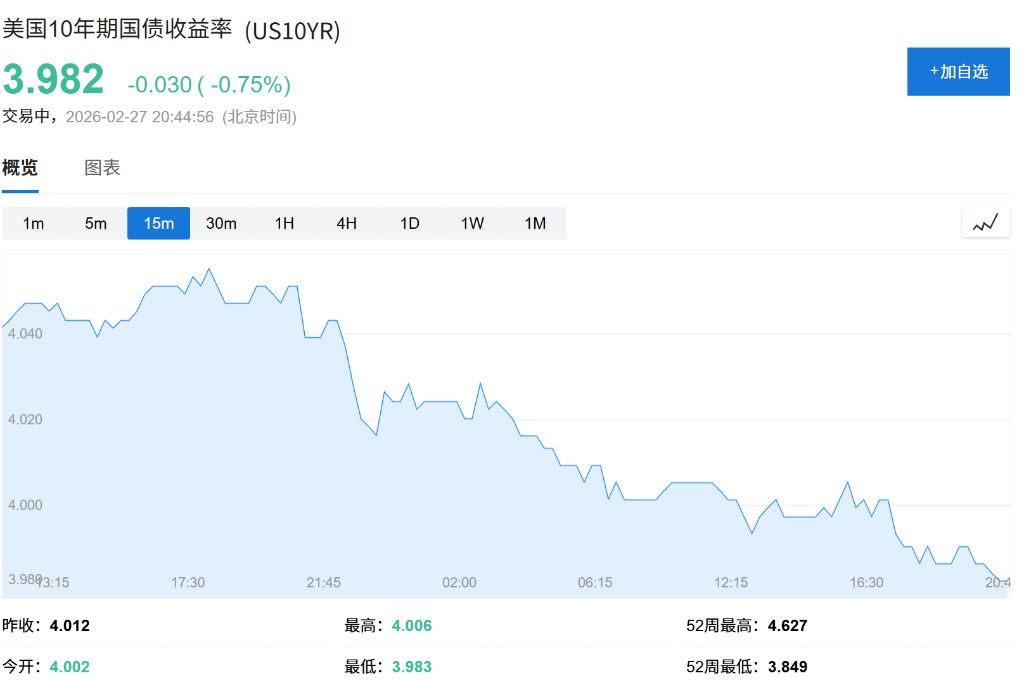
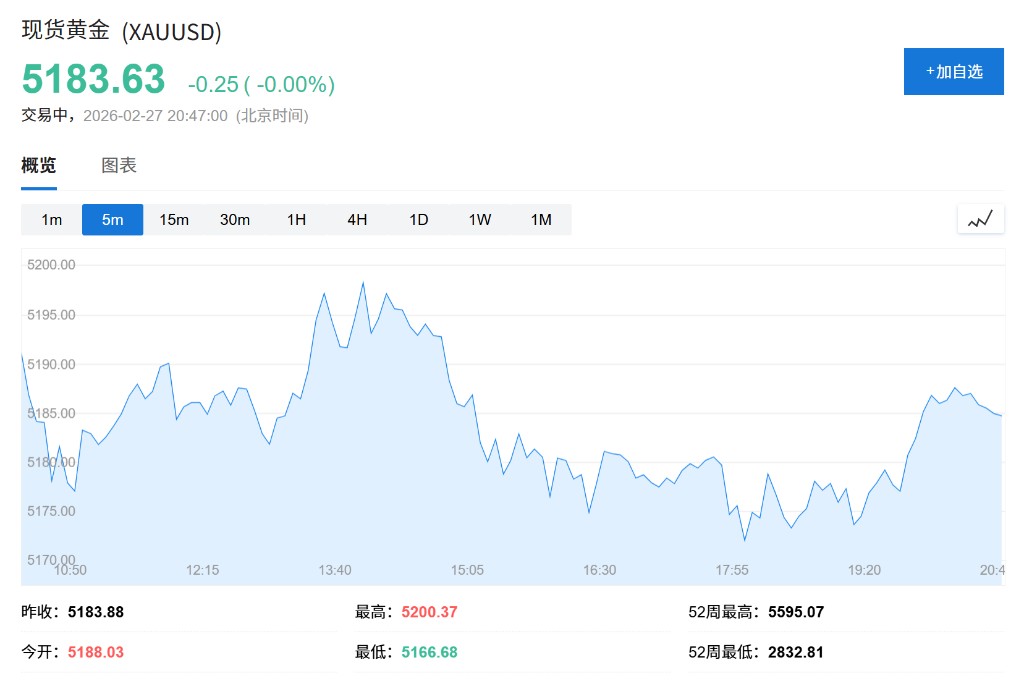
The panic withdrawal of funds has directly driven a strong rebound in safe-haven assets. According to Bloomberg, U.S. Treasury bonds achieved their best monthly performance in the past year in February, with significant long-end Treasury yields; at the same time, gold prices surged, breaking through the $5,000 per ounce mark.
Currently, with expectations that the Federal Reserve will maintain the benchmark interest rate, market defensive sentiment is strong. Investors are waiting for further macroeconomic data to confirm labor market trends and inflation trends; until then, the trend of funds moving towards high-quality assets is expected to continue dominating the market.
Quantitative Funds Rapidly Sell Off U.S. Stocks
As the continuous launch of artificial intelligence tools raises market concerns about industry reshuffling and inflation trends, coupled with Trump's warnings about negotiations with Iran escalating tensions in the Middle East, panic sentiment is spreading on Wall Street. The average intraday volatility of the S&P 500 index reached 1.2% this month, with tech stocks being the hardest hit; Nvidia saw a drop of 5.8% on recent trading days, dragging down the Nasdaq 100 index.
In the face of this turmoil, quantitative investment management firms are quickly shifting to defense. According to Bloomberg, citing Barclays data, CTA funds that rely on mathematical models have reduced their U.S. stock allocations to around the 50th percentile. Goldman Sachs' trading platform data shows that systematic strategies have turned their exposure to U.S. stocks negative this month, with a surge in client demand for downside protection.
Trend-following fund McElhenny Sheffield Capital Management reduced its stock allocation to zero on February 6, fully shifting to gold and U.S. Treasury bonds. The fund's portfolio manager, Grant Morris, stated that when the market falls below risk management levels, the fund will completely switch to a defensive stance, only reallocating to U.S. stocks when a clear upward trend emerges.
Safe-Haven Demand Achieves Best Monthly Performance for U.S. Treasuries
The outflow of funds from the stock market directly benefits the U.S. Treasury bond market, which has a total scale of $30 trillion. According to EPFR data, approximately $16.3 billion flowed into the Treasury bond market in the first two months of this year. This has caused the benchmark 10-year Treasury yield to decline by about 0.2 percentage points since the end of January, hovering around the lower limit of 4%. In February, the overall return on U.S. Treasuries reached 1.5%, with long-term Treasuries rising by 4%, marking the best performance since the same period last year James Athey, the portfolio manager at Marlborough Investment Management, stated that the U.S. Treasury market is vast and highly liquid, making it the preferred destination for safe-haven trades. Gregory Faranello, head of U.S. interest rate trading and strategy at AmeriVet Securities, also pointed out that despite the possibility of technical breakthroughs, the U.S. Treasury market has clear safe-haven attributes.
Not only in the U.S., but the global sovereign bond market is also benefiting from this. Japanese bonds are heading towards the largest single-month gain since November 2023, with overseas investors' purchases of Japanese debt reaching the second-highest level in history last month.
The Structural Upside Potential of Gold Remains Significant
With a huge demand for capital preservation, gold has also experienced explosive growth. As a traditional tool for hedging macro uncertainty and stock market pullbacks, gold's safe-haven value has been amplified once again in the current turmoil.
Jackie Rosner, managing director at PAAMCO Prisma, pointed out at the iConnections Global Alts conference that despite a significant rebound recently, gold remains structurally underweighted in institutional portfolios, with current allocation levels still below those of 15 years ago. He predicts that if macro uncertainty persists, gold prices could reach $6,000 or higher this year. For institutions that have fully exited U.S. stocks to invest in gold, this strategy has already shown results; for example, McElhenny Sheffield Capital Management has achieved a 4.35% return this year.
The Market Awaits Clues on Rate Cuts and Economic Data
Although risk aversion dominates, some investors remain cautious about fully going long on U.S. Treasuries due to uncertainties in the Federal Reserve's policy path. In January, Federal Reserve policymakers kept borrowing costs in the range of 3.5% to 3.75%, and traders currently believe the likelihood of a rate cut in March is almost zero. However, the market still anticipates at least two rate cuts by the end of the year, especially with Trump's nominee, Waller, set to take over as Fed Chair.
Priya Misra, a portfolio manager at JP Morgan, believes that as the market re-prices credit risk, the interest rate risk of holding U.S. Treasuries becomes more attractive. However, investors like George Catrambone, head of fixed income at DWS Americas, and Athey from Marlborough have begun to shift to neutral or short positions on 10-year U.S. Treasuries, believing that the recent rapid decline in yields needs a breather.
For off-market funds, clear economic data is a prerequisite for entry. Jack McIntyre, a portfolio manager at Brandywine Global Investment Management, stated that only by seeing clear data indicating a weakening labor market can the authenticity of the rebound be confirmed The upcoming U.S. non-farm payroll data to be released next week may provide key guidance for the market's next direction
