


Goldman Sachs initiates coverage on MiniMax: The strongest globalized Chinese large model!

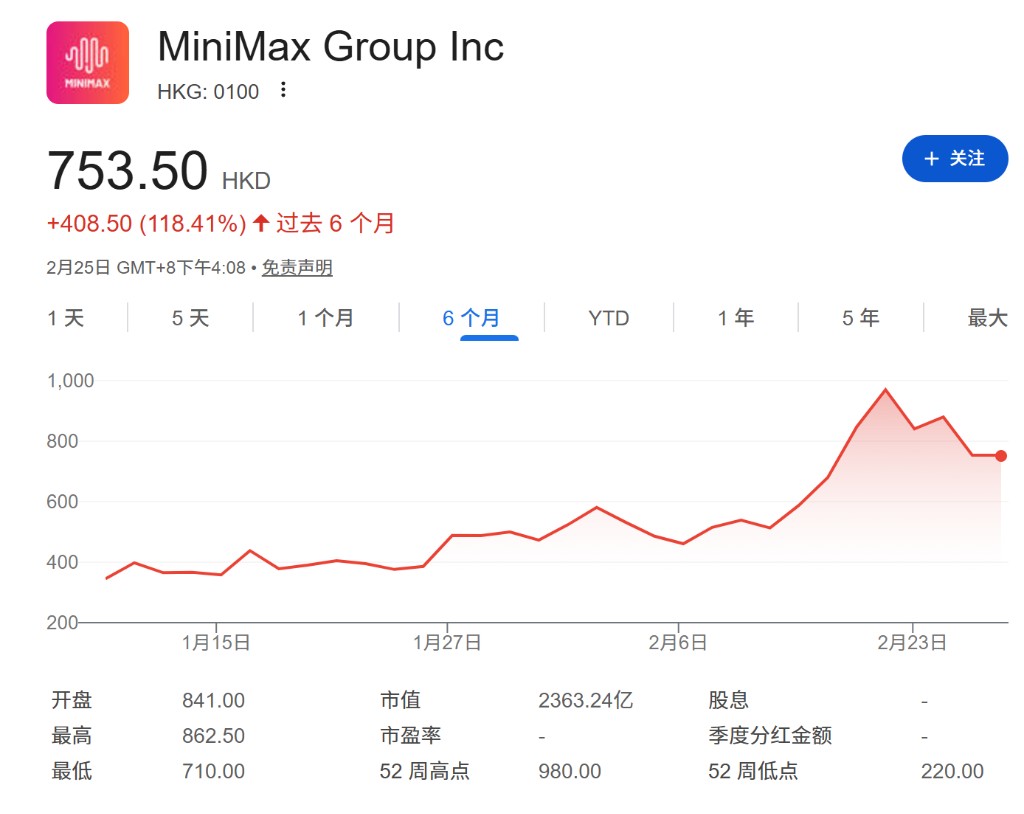
Goldman Sachs initiates coverage on MiniMax with a neutral rating and a target price of HKD 1,018 (valuation of USD 38.9 billion). Its core advantages include 70% overseas revenue, a full-modal product line, and performance at one-tenth the cost of the U.S. SOTA model. Revenue is expected to grow from USD 75 million in 2025 to USD 980 million in 2027. Bull/bear valuations are USD 66 billion / USD 16 billion, depending on global market share expansion
Goldman Sachs believes in its latest research report that MiniMax is one of the best-positioned companies in China's artificial intelligence model sector, with significant global potential market (TAM) growth space in the fields of text and programming.
According to the Chasing Wind Trading Desk, on February 23, Goldman Sachs initiated coverage of the Chinese full-modal AI company MiniMax, giving it a "Neutral" rating, with a 12-month target price set at HKD 1,018 based on a DCF model, corresponding to an enterprise valuation of approximately USD 38.9 billion (about RMB 282 billion).
Goldman Sachs pointed out that MiniMax, as one of the world's top AI model companies, is in a phase of rapid growth. Its biggest highlight is its highly globalized revenue structure (70% of revenue comes from overseas) and a comprehensive multi-modal product line (covering text, video, audio, music, and images). Goldman Sachs noted that MiniMax occupies an excellent competitive position in the vast global potential market (TAM) for text/code, multi-modal, and AI agents/digital labor.
Core Impact on Investors:
Valuation Elasticity Linked to Market Share: Goldman Sachs provided bull/base/bear market valuations of USD 66 billion / USD 42 billion / USD 16 billion, which mainly depends on its expansion in the global AI foundational model subscription and API revenue market share (base case forecast to reach 2.5% by 2030, bull case reaching 5.0%).
Commercialization and Profitability Path: The company’s revenue is expected to surge from USD 75 million in 2025 to USD 980 million by 2027. Although it is currently still in loss (adjusted net losses are expected to be USD 316 million / USD 413 million / USD 388 million from 2025 to 2027), the gross margin is expected to improve from 21% in 2024 to 38% in 2027, and the company has ample funds (over USD 1 billion in cash reserves), sufficient to support until the expected breakeven point in 2029.
Intensive Technological Catalysts: The release of the M2.5 model has significantly narrowed the gap with the U.S. SOTA (state-of-the-art) models, with costs only one-tenth. The subsequent release of the Hailuo 3.0 video model and the proliferation of AI agents at a cost as low as USD 1 per hour will become important valuation catalysts.
Multi-Modal Advantage and Global Business Landscape
Full-modal layout and a revenue share of up to 70% from overseas create a core moat.
Since its establishment, MiniMax has adhered to a multi-modal integration approach, currently possessing leading models such as M2.5 (basic text model), Hailuo 2.3 (video), Speech 2.6 (audio), Music-2.5, and Image-01. This native multi-modal integration technology (e.g., text models supporting video generation) gives it significant advantages in instruction following, semantic understanding, and physical interaction In terms of commercialization, MiniMax has targeted the global market from day one, with 70% of its revenue coming from overseas. Its AI-native products have served over 212 million individual users across more than 200 countries and regions, and its foundational models have supported over 130,000 enterprises and developers. The company has established diversified monetization channels, including subscriptions, token billing, online marketing, and API calls.
Extreme Cost Efficiency and Underlying Architecture Innovation
With the MoE architecture and linear attention mechanism, it approaches global top levels at a very low cost.
Goldman Sachs estimates that MiniMax has invested approximately $420 million (forecasted from 2022 to 2025) in training costs, placing it among the top AI companies globally. This is attributed to its early adoption of the Mixture of Experts (MoE) architecture and linear attention mechanism, which significantly reduced computational resource consumption and inference costs.
This cost advantage directly translates into competitive product pricing. For example, its API pricing is only about 8% of that of leading overseas models (such as Claude 4.5 Sonnet), allowing its To-B API business to maintain a healthy gross margin (with a gross margin of up to 69% in the first nine months of the open platform before 2025) even with significant price reductions. Additionally, the company's flat organizational structure (with about 300 R&D team members) ensures extremely high innovation efficiency.
The Explosion of Agents and “$1 Digital Labor”
The M2.5 model's performance approaches Claude Opus, with agent costs expected to ignite applications at $1 per hour.
The recently released M2.5 model has further improved its performance in programming and office scenarios, achieving an SWE-bench Verified coding score of 80.2%, very close to Anthropic's strongest model Opus 4.6 (80.8%), but priced at only one-tenth of the latter.
Based on this high cost-performance ratio, MiniMax's agent applications show tremendous disruptive potential. Goldman Sachs estimates that the operating cost of MiniMax agents is only $1 per hour (calculated at 100 tokens per second). This means that with a budget of just $10,000, four "digital employees" can be hired for high-intensity work 24/7 throughout the year. This highly attractive economics will drive the widespread application of AI in enterprise scenarios such as human resource screening and code debugging.
Financial Forecast and Valuation Logic
Revenue is aimed at $980 million by 2027, with multimodal APIs driving continuous gross margin growth.
Goldman Sachs predicts that MiniMax's revenue will grow from $75 million in 2025 to $980 million in 2027. The core drivers of revenue growth include:
Hailuo AI (Video): Expected to reach $311 million in revenue by 2027.
Open API Platform: With price competitiveness and multimodal capabilities, expected to reach $379 million in revenue by 2027
Talkie/Xingye (C-end entertainment): Expected revenue of $184 million in 2027.
Despite incurring losses in the short term due to high R&D and reasoning costs (with an expected adjusted net profit of -$388 million in 2027), the gross margin is expected to jump from 21% in 2024 to 38% in 2027. This is mainly attributed to the increased share of high-margin multimodal API revenue (accounting for 75% of total API revenue).
In terms of valuation, under the baseline scenario (HKD 1,018 / $38.9 billion), it is assumed that the company will capture 2.5% of the global foundational model subscription and API market by 2030; under the bull case scenario (HKD 1,600 / $66 billion), it is assumed that market share will accelerate to 5.0%, corresponding to a 44x price-to-sales ratio for Q4 2027 ARR (annual recurring revenue); under the bear case scenario (HKD 380 / $16 billion), it is assumed that intensified competition will result in market share being maintained at around 1.2%
